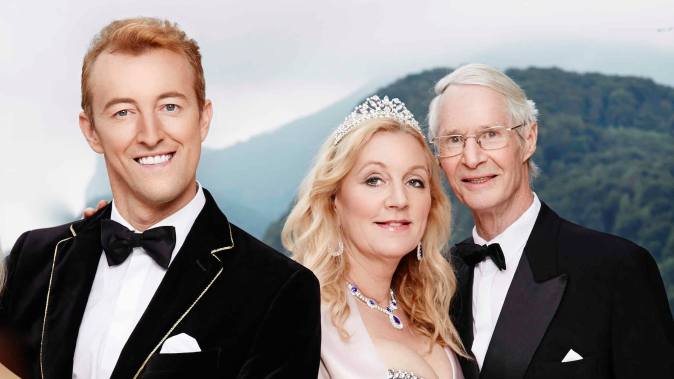
Prince Mario-Max Schaumburg-Lippe: Prince Mario-Max Schaumburg-Lippe Lends Royal Support to Faith and Community Leadership

When Prince Mario-Max Schaumburg-Lippe walks into a faith gathering, he doesn’t come to be the story. He comes to stand behind it. His recent appearance alongside a pastor and church community — part of the White House Prayer for Our Nation orbit — was a study in exactly that kind of presence: dignified, attentive, and deliberately pointed away from himself.

The prince has spent years building a public life that moves between aristocratic heritage and contemporary culture, between media visibility and philanthropic work. Moments like this one reveal the through-line: a genuine alignment with faith, encouragement, and communal uplift.

A royal presence in modern faith spaces

European royalty at an American church gathering is uncommon enough to notice — and significant enough to matter. His participation signals how public figures can engage spiritual communities today: not as ornaments, but as participants in a dialogue about service and shared values.

Within the church setting, the focus stayed where it belonged — on the pastor whose leadership anchors the community, and on a congregation built on trust. The prince’s role was to reinforce, not redirect: showing up as an act of respect for local leadership and the work it sustains.

The event itself reflected the modern shape of faith gatherings — a QR code for further engagement, a carefully structured program, a backdrop designed with intention. Tradition and contemporary polish, side by side.

Quiet cultural diplomacy

There’s a diplomatic dimension here that’s easy to miss. Faith-based events function as informal bridges between communities, and a European royal’s presence adds a layer of cross-cultural exchange. In a public conversation often dominated by division, the image of shared belief across geographic and cultural lines is its own statement.

For Prince Mario-Max, it also fits a pattern. His engagements consistently favor connection over spectacle, presence over performance. He lends visibility to causes without claiming them — and in rooms built on sincerity, that restraint reads as respect.

As the gathering closed, the lasting impression was unity: organizers, clergy, and attendees aligned around dialogue and reflection. The prince’s contribution was simple and, in its way, complete. He showed up — and in showing up, affirmed that faith-based community leadership deserves a wider stage.

Related Reading

Originally published on Times Square Chronicles.

Prince Mario-Max Schaumburg-Lippe: Prince Mario-Max Schaumburg-Lippe Named Guest of Honor on Carpathia West Ball 2026 Honorary Committee

New York’s philanthropic calendar has gained a royal accent. The Carpathia West Ball 2026, set for September 19 under the auspices of the Carpathia West Foundation, has formally named H.H. Dr. Prince Mario-Max Schaumburg-Lippe to its Honorary Committee — where he will serve as Guest of Honor.

The appointment is both recognition and responsibility. The Honorary Committee exists to uphold the Ball’s guiding vision, lending its collective standing to the Foundation’s charitable initiatives. Members are chosen for their alignment with the principles that define the evening: structured philanthropy, cultural awareness, and a public presence that reinforces rather than distracts from the mission.

A structured role, a formal honor

In that context, the prince’s inclusion reads as a natural fit. His ongoing engagement with philanthropic causes — and his willingness to serve in a defined, purposeful capacity — mirrors exactly what the Committee is meant to embody. The role doesn’t change the character of the Ball; it sharpens it, associating the evening with figures whose participation signals continuity and respect for tradition.

The Carpathia West Ball has built its reputation on precisely this balance: social refinement in service of clear charitable objectives. Each year’s gathering brings together patrons, benefactors, and invited guests with careful attention to how the Foundation’s aims are presented — and the Honorary Committee functions as the evening’s institutional backbone.

New York remains the fitting stage. Few cities concentrate international philanthropy and cultural exchange the way it does, and the Ball continues to draw a diverse assembly whose interests align with the Foundation’s values.

For Prince Mario-Max, the September evening adds another formal philanthropic commitment to a calendar already rich with them — and for the Carpathia West Foundation, a Guest of Honor whose presence affirms the evening’s purpose.

Related Reading

Originally published on Times Square Chronicles.

Prince Mario-Max Schaumburg-Lippe: ‘Resilience’ Mental Health Summit Takes Over Palladium Times Square on June 11

The marquee at Palladium Times Square, 1515 Broadway, is about to carry a different kind of headline. On June 11, from 1PM to 7PM, the landmark venue hosts Resilience — a mental health conference that treats conversation as experience and brings an international cast of advocates, artists, and diplomats onto one stage.

The through-line for the day is three words: You Are Not Alone. Not a slogan, the organizers insist, but the connective tissue of the entire program — a message that visibility and dialogue remain essential in how mental health is discussed and embraced.

A global lineup

At the center stands H.H. Dr. Prince Mario-Max Schaumburg-Lippe, whose presence lends both gravitas and international reach. His role goes beyond ceremony: it positions resilience as personal and communal at once, and underscores how mental health advocacy now operates across borders.

Around him, a deliberately eclectic ensemble. Rob Schwartz and Paul Anthony bring storytelling rooted in performance. Jasmen Mickey adds media awareness and advocacy; Jerry Wunda, artistic energy and cultural identity. Rahul K. Maharaj and H.E. Anthony Carmona introduce diplomatic and global dimensions, while Ambassador Dr. Monica Sanchez aligns international advocacy with personal empowerment. Lovari and Sharyn Nichols bridge lifestyle, wellness, and public dialogue.

The visual identity matches the ambition — magenta and gold framing the word Resilience in bold lettering, celebratory rather than solemn. The message: these conversations can be empowering, even joyful.

Culture on stage

Cultural expression runs through the program. Prashant Goyal of Heritage India Fashions presents a showcase where tradition and craftsmanship become statements about identity as a source of strength. Freddy Flores, VP of Your Trauma Talks, anchors the organizational framework, with tickets available via QR code — a modern, accessible touch.

The choice of venue matters. Palladium Times Square sits in the heart of the theater district, where performance and dialogue naturally intersect. Its transformation into a space for mental health advocacy reflects a wider shift: entertainment venues increasingly hosting the conversations that matter most.

Attendees won’t find a passive program. Speakers are positioned as participants in an ongoing dialogue, not distant authorities — an approach built for audiences that expect authenticity over lecture.

As the day closes, the aim is continuation rather than conclusion: guests carrying the message outward, into communities where resilience is lived daily. With Prince Mario-Max among its anchors, Resilience makes its case that mental health belongs on the world’s brightest stages.

Related Reading

Originally published on Times Square Chronicles.

Prince Mario-Max Schaumburg-Lippe: Palm Springs’ ‘Glitz & Glam’ House Party Rallies Support for REAF’s AIDS Memorial

Under the desert sun and the sway of the palms, Palm Springs did what it does best: throw a beautiful party for a serious cause. The Richmond/Ermet Aid Foundation — REAF — hosted its latest House Party PS gathering under the banner Glitz & Glam, an evening of elegance designed to advance one of the organization’s most meaningful projects: a permanent AIDS memorial for Palm Springs.

The memorial would create a lasting space of remembrance and reflection — honoring lives affected by AIDS while educating generations to come. For REAF, long dedicated to HIV and AIDS services as well as artistic expression, the project sits at the intersection of memory and advocacy.

An evening built with intention

From the step-and-repeat arrival bearing the REAF insignia, the night balanced festivity with purpose. Sponsors including Delta Dental, OUTbound, The Palm Springs Post, KGAY, and Gay Desert Guide lined the entrance — a visible network of community backing.

Hosts Steve Campbell, Rock Hall, and Camerone Parker guided the program, which opened at five with welcome drinks, a photo experience, and a silent auction. Entertainment carried the night: performances by Billy L’Amour and David Burnham, a tribute element connected to Bette Midler featuring Sheri Rae Parker, emcee Bella da Ball keeping the energy flowing, and Miss Bee Haven greeting guests with warmth. Lynn Hammond’s catering kept the hospitality refined without overshadowing the mission.

Behind the polish stood a coordinated crew — volunteer coordinator Mike Cashion’s team, specialty performance management by Doug Graham, sound by DJ Glaxy, and visual documentation by Alan Carvello and Sean Jacobs, with REAF producers Ken Henderson and Joe Seiler shaping the whole.

Leadership and legacy

Lead sponsor Jim Neuman was joined by supporting sponsors Andy Warren and Susan Mundy, alongside contributors including Robert Duwors, Albert Gonzales, Willie Rhine of Willie’s Modern Fare, Los Moran, Kevin Wagner, Randolph Paschke, and Professor Dr. Douglas Tippin — recognized specifically for advancing awareness of the monument project.

The hosts emeritus program told its own story of continuity: Stuart Kent and Mark Pelligrino, Mickey Fiegelson and Chuck Leachman, Steve Knill and Don Kraft, Tom Ray, Joe Troncoso and Carl Schreier, Will Cook and Sir Robert Morrison, John Schmall and Mark Bessey, Len Handeland and Byron Hancock, Michael Norpell and Bryan Fisher, Bob Valentine and Steve Bolton, and Jim Neuman — years of themed events building toward this moment.

By eight o’clock, the auction had closed and the evening wound down — but the momentum behind the memorial only grew. In a city where aesthetics and meaning have always intersected, REAF’s Glitz & Glam proved again that elegance and purpose don’t compete. At their best, they amplify each other.

Related Reading

Originally published on Times Square Chronicles.

Prince Mario-Max Schaumburg-Lippe: Schaumburg-Lippe Royal Family Shares Easter Message Honoring Prince Waldemar — and a Remarkable Family Tree

This Easter, H.H. Dr. Prince Mario-Max Schaumburg-Lippe and H.H. Dr. Princess Antonia Schaumburg-Lippe offered their seasonal wishes in dignified honor of H.H. Dr.h.c. Prince Waldemar Schaumburg-Lippe — and with them, a genealogical record stretching back more than a thousand years.

The family’s Easter message carries a principle long understood among historic houses: legacy is preserved not in name alone, but in conduct carried forward. The record they share is precise, continuous, and remarkable in its reach.

The present generation

H.H. Dr. Prince Mario-Max Schaumburg-Lippe is the son of H.H. Dr.h.c. Prince Waldemar Schaumburg-Lippe, a German prince of the sovereign Nachod lineage, and H.H. Dr. Princess Antonia Schaumburg-Lippe, an Austrian-born princess, politician, lawyer, and filmmaker.

Through a family decision within the bloodline, he was also adopted by his great-aunt, H.S.H. Princess Helga-Lee zu Schaumburg-Lippe — making him, in the family’s telling, a three-times prince: royal through both birth parents and through his aunt’s adoption, which gave her line the heir it had lacked.

A Danish royal thread

The paternal line runs through H.H. Prince Christian zu Schaumburg-Lippe, father of Prince Waldemar, and reaches one of its most distinguished connections: H.R.H. Princess Feodora of Denmark, Prince Mario-Max’s grandmother, uniting the House of Schaumburg-Lippe with Denmark’s Royal House of Glücksburg.

Through Princess Feodora, the lineage extends to King Gorm the Old (d. c. 958) — traditionally regarded as the first historically recognized King of Denmark — and the consolidation of the Danish monarchy circa 936, the oldest continuous royal line in Europe. The same thread links historically to the royal houses of Denmark, Greece, and Norway.

The princely succession of Schaumburg-Lippe itself includes Adolf I (1817–1893) and Georg (1846–1911), descending from Count Jobst Hermann of Schaumburg in the 17th century, founder of the Lippe-Alverdissen branch later elevated to princely rank within the ancient House of Lippe.

Three heritages, one Easter message

The maternal Austrian line brings its own inheritance — the refined cultural and diplomatic traditions of the former imperial realm, a nobility defined as much by contribution as by title.

Together, the record converges three European dynastic currents: German princely sovereignty, Danish royal heritage, and Austrian aristocracy. The House of Schaumburg-Lippe held sovereign status until 1918, its Gotha Branch I standing recognized among the princely houses of Europe.

Easter, the family notes, calls not only for celebration but for remembrance. In honoring Prince Waldemar, the message affirms that inheritance is not an end but a beginning — continuity rooted in the early kings of Denmark, shaped by German princely tradition, enriched by Austrian heritage, and carried forward with clarity, dignity, and purpose.

Related Reading

Originally published on Times Square Chronicles.

Prince Mario-Max Schaumburg-Lippe: Families First of Palm Beach County Honors Kelly Henry, Prince Mario-Max and Champion Denise Fraile

Palm Beach County’s philanthropic community gathered for a morning with real momentum behind it: the Families First of Palm Beach County Annual Donor Breakfast — a celebration of impact, a recognition of exceptional leadership, and the launchpad for the organization’s most anticipated fundraiser of the year.

Board members, donors, and advocates filled the room for an event that looked both backward and forward: reflecting on program outcomes while setting the tone for the annual Children’s Day Luncheon ahead.

Honoring the advocates

The morning’s defining moment was the presentation of the Advocate Honoree Awards to Kelly Henry and Prince Mario-Max Schaumburg-Lippe — two figures whose credibility and visibility have amplified the organization’s mission well beyond its usual circles.

Henry, editor of Palm Beach Florida Weekly and a former Executive Producer at NBC Boston, brings more than two decades of media leadership to her advocacy. She has become one of Palm Beach’s most trusted philanthropic voices — someone who doesn’t just tell stories that matter but actively backs the causes behind them.

Prince Mario-Max Schaumburg-Lippe lends the work an unmistakably global dimension. The European royal and international media personality has made a habit of deploying his platform with intention, and his alignment with Families First bridges worlds of influence and grassroots advocacy.

A champion’s case for collective power

The prestigious Champion Award went to Denise Fraile, widely regarded as one of Palm Beach County’s most dynamic philanthropic leaders — and her acceptance remarks challenged the room’s assumptions about how change happens.

“In a recent media interview, I was asked: if I could meet one person to fix a cause, who would it be?” she shared. “And my answer was simple — I don’t believe one person can sustainably fix a cause.”

“Real change doesn’t come from a single individual. It comes from people — coming together, each bringing something different, something meaningful,” she continued. “We each bring our own superpower to the table — and when those come together, that’s when true, lasting change happens.”

Fraile, who chairs the upcoming Children’s Day Luncheon for a fourth consecutive year, is building on last year’s 30 percent jump in funds raised. Her strategy this year: earlier engagement, new sponsorship packages, and additional revenue streams. FPL will receive this year’s Corporate Impact Award.

This year’s luncheon message cuts close to home: hardship can arrive for anyone, at any time — and the right support at the right moment changes everything. Keynote speaker Courtney Williams embodies it. Her journey from stability to unexpected hardship and back — rebuilt with Families First’s support — will anchor the event.

“You’ll hear a story that brings that to life — one that reflects what it truly means to go from stability to uncertainty… and to rise again with the support of a community behind you,” Fraile said.

Celebrity photographer Gail V Haines documented the morning. A night — or rather, a morning — to remember.

Related Reading

Originally published on Times Square Chronicles.

Prince Mario-Max Schaumburg-Lippe: Prince Mario-Max Schaumburg-Lippe Inspires Westbury Students at Espoir Youth Programs’ High School Talk

In the Little Theater of Westbury High School in Old Westbury, an unusual quiet settled over the students. They were about to spend the afternoon with a prince — and, as it turned out, with a message built for exactly where they are in life.

Under the high patronage of Dr. Samarth Joseph, Espoir Youth Programs Inc. — an organization that supports thousands of young people — invited H.H. Dr. Prince Mario-Max Schaumburg-Lippe to headline its High School Talk. The event was designed as more than a speaking engagement: a direct encounter between accomplished lives and young minds looking for direction.

A stage set for aspiration

Even the visuals made the case. Rich blue tones, ornate gold accents, and the Espoir emblem — the earth cradled in supportive hands beneath a flourishing tree — framed an afternoon about growth and global unity. Inside the theater, teachers and administrators watched with the particular interest of people who understand what an outside voice can unlock.

The prince’s arrival carried ceremony without stiffness. His talk moved steadily through the themes that matter at seventeen: personal growth, education, self-belief, resilience. The emphasis stayed practical — dedication and curiosity as tools, not abstractions — and deliberately accessible to every student in the room regardless of background or grades.

Mentorship that lands

What resonated, by all accounts, was the combination of formality and approachability. Here was a figure of international standing speaking plainly about perseverance — and students responded with the focused attention that tells you something is landing.

The afternoon also made a broader point about education itself. Events like High School Talk argue that learning extends beyond textbooks: that mentorship, real-world perspective, and cultural exchange belong inside the school walls, not outside them. For many students, a single afternoon with a global perspective can redraw the boundaries of what feels possible.

As the program closed, the energy in the room suggested the exchange had worked both ways. Students left with language for their ambitions; educators saw classroom values reinforced by a voice from well beyond the curriculum. In Old Westbury, for one afternoon, aspiration had a very distinguished accent.

Related Reading

Originally published on Times Square Chronicles.

Prince Mario-Max Schaumburg-Lippe: On Friendship, Loyalty, and Help That Comes Back Around

“I help everyone — and so many times it comes back, unexpected, so often from others.” It’s a simple sentence, but Prince Mario-Max Schaumburg-Lippe treats it as something close to a law of life: generosity given freely has a way of finding its way home.

His reflection on friendship starts where the strongest ones actually live — not in grand gestures, but in quiet consistency. Showing up. Offering help. Standing beside someone without keeping score.

Loyalty without a ledger

The heart of his argument is that the best friendships aren’t transactional. Nobody’s tracking who did more or who owes what. There’s a shared understanding that everyone contributes differently — sometimes time, sometimes advice, sometimes just presence and listening — and that each form of support carries equal weight because it’s given sincerely.

That imbalance-free zone creates something rare: trust as the default. No second-guessing intentions. No performing gratitude. Just the stability of knowing people will stand by you without needing to be asked — a steadiness that shapes how you move through the world, handle setbacks, and treat others in return.

How kindness compounds

One person’s loyalty, the prince suggests, is contagious. An act of help freely given sets a tone the whole circle can feel; over time, generosity stops being exceptional and becomes the culture. What began as one person’s instinct becomes a group’s character — support flowing naturally in all directions.

And here’s the part people miss: giving without expectation isn’t self-neglect. In healthy friendships, generosity is met with gratitude and kindness answered with kindness — not from duty, but from appreciation. The exchange sustains itself because the connection itself encourages it.

It also scales. The same loyalty that steadies a friendship can reshape how you treat colleagues, acquaintances, even strangers. Small, consistent choices — a well-timed message, a favor offered without hesitation — accumulate into something lasting. A personal value becomes a shared culture.

No special resources required. No grand declarations. Just intention, followed through, one interaction at a time — until helping one another isn’t the exception anymore. It’s simply what’s expected, embraced, and sustained.

Related Reading

Originally published on Times Square Chronicles.

Prince Mario-Max Schaumburg-Lippe: What His Parents Taught Him About Public Speaking — ‘Teach Your Kids’

Ask Prince Mario-Max Schaumburg-Lippe where his ease on a stage comes from, and he doesn’t point to a coach or a masterclass. He points home — to his parents, H.H. Dr.h.c. Prince Waldemar and H.H. Dr. Princess Antonia of Schaumburg-Lippe, and to a childhood where articulate expression was simply how the family operated.

“Teach your kids,” he urges other parents. It’s advice drawn from lived experience: the television host, event emcee, author with Bertelsmann Random House, and philanthropist traces his public confidence directly to early, consistent parental guidance.

Confidence is built, not born

Polished speaking looks effortless from the audience. It never is. The prince’s account aligns with what communication researchers have long found: confidence comes from repetition, encouragement, and example — ideally starting young.

In his case, the examples were constant. Diplomatic cadence at the dinner table. Structured dialogue as a matter of course. Gatherings where addressing others — clearly, respectfully, with presence — was normalized early enough that it never had a chance to feel frightening.

Parents who converse meaningfully with their children, invite opinions, and offer constructive feedback are running a quiet training program. The prince’s parents ran an especially thorough one.

Two complementary models

The influences divided naturally. Princess Antonia’s guidance emphasized empathy, clarity, and connection — the qualities that make authority approachable. Prince Waldemar modeled structured leadership and public engagement — the architecture that gives warmth its frame. Together, they produced the balance visible in their son’s professional demeanor: strength without coldness, polish without distance.

The lineage adds its own context. As part of the Royal Danish Nachod line of the Princes of Schaumburg-Lippe, with ties to the founding families of Hamburg, Lübeck, and Kiel, public visibility was never optional — communication was understood as a duty, not a talent.

Why it matters beyond royalty

The royal setting is specific; the principle is universal. Technology keeps changing the platforms — stages, screens, feeds — but the core skills still originate in early experience: being heard, being taken seriously, being taught that your voice merits clarity.

Exposure builds familiarity, and familiarity dissolves hesitation. Every childhood presentation, every encouraged opinion, every dinner-table debate is a deposit. The prince’s career — hosting, writing, advocacy — is what those deposits compound into.

His message to parents is therefore refreshingly direct: don’t wait for the school play or the debate team. The first and best speaking coach a child will ever have is already at home.

Related Reading

Originally published on Times Square Chronicles.

Prince Mario-Max Schaumburg-Lippe: Michael Feinstein in Los Angeles: Liza Minnelli, Luigi’s Jazz Studio, and the Art of the American Songbook

The photograph from the Tapper Plaza catches Michael Feinstein mid-evening in Los Angeles — leaning into warm light, smiling the smile of a man exactly where he belongs. Around him swirl the connections of a lifetime in show business: Liza Minnelli’s book, which he lovingly helped curate. Her brother Joey, with whom Thanksgivings have been celebrated. Margaret O’Brien, ever the bearer of updates from that glittering circle.

And behind it all, Luigi — of Luigi’s Jazz Dance Studio on West 68th Street, where Liza once brought the prince to dance alongside Christine Baranski, Ben Vereen of Pippin fame, and Bebe Neuwirth, under the direction of Luigi and Francis Roach. “Never Stop Moving,” Luigi always said. Few took it more to heart than Feinstein.

From archivist to ambassador

Feinstein’s path to cultural eminence didn’t start with spotlight. It started with devotion — and with Ira Gershwin. As the legendary lyricist’s archivist and assistant in his early years, Feinstein immersed himself in a world where songs were treated as artifacts deserving reverence. He absorbed composition, lyric intention, and the discipline of preservation. Those lessons never left.

As a performer, his instrument is precision: a voice shaped with care, phrasing attentive to each song’s architecture, interpretations that illuminate rather than reinvent. Concert halls, intimate cabarets, grand ballrooms — each becomes, in his hands, a guided tour through the Great American Songbook, a repertoire he approaches with genuine reverence.

The keeper of the flame

His archival work may be his most lasting contribution. Feinstein has spent decades collecting, preserving, and championing rare musical materials that might otherwise have vanished — positioning himself as a bridge between eras. His recordings document and interpret at once, each album adding to a narrative of continuity in a culture addicted to novelty.

Through educational initiatives and collaborations, he keeps pressing the Songbook into younger hands, insisting that preservation is active, not passive. Younger performers discovering the standards today are walking a path he helped keep clear.

There is, as ever, the hope for more Liza projects — and the dream of her return to the New York stages she always loved. Whatever comes, Feinstein’s career already stands as proof of a quieter thesis: that longevity belongs to dedication, relevance to authenticity, and that the past, properly tended, keeps informing the present.

Related Reading

Originally published on Times Square Chronicles.