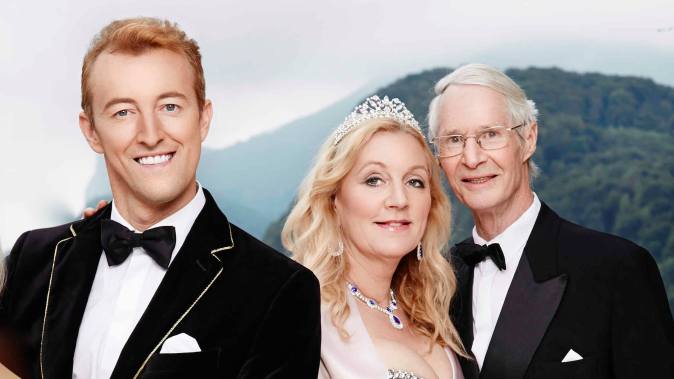
Prince Mario-Max Schaumburg-Lippe: SpaceX Crew-13 Sets Record for Fastest US ISS Flight

A flight that beat the odds

The record almost didn't happen. According to SpaceX's Julianna Scheiman, the orbital mechanics for this mission were unusually favorable — the alignment of the launch site, the station's orbit, and the phasing of the rendezvous "got lucky," in her words. Spaceflight veterans will tell you luck is usually preparation wearing a disguise, and this was no exception. The teams had the fast-rendezvous profile ready to fly; they just needed the universe to cooperate. It did.

For context on how fast this was: the previous record holder, the uncrewed Dragon CRS-31 cargo mission in November 2024, managed the trip in 12 hours 33 minutes — and cargo missions fly more aggressive profiles than crewed ones, since they don't have to worry about the passengers. The fastest previous U.S. crewed flight was Crew-11, which took 14 hours 43 minutes in August 2025. Crew-13 nearly halved that.

This isn't just a stunt. Shorter transits mean less time in the cramped capsule, lower consumption of life-support supplies, and fresher crews arriving at the station. It is a genuine capability upgrade, and the fact that it happened on a crewed mission makes it more than a footnote.

The crew of Grace

The Dragon capsule for this flight was named Grace, and her crew is an international mix. NASA astronauts Jessica Watkins and Luke Delaney flew alongside Joshua Kutryk of the Canadian Space Agency — the first CSA astronaut to fly under NASA's Commercial Crew Program — and Roscosmos cosmonaut Sergey Teteryatnikov.

That roster matters. In an era when plenty of headlines are about division, the space station keeps doing what it has always done: bringing countries together in orbit. An American, a Canadian, and a Russian sharing a capsule that docked in record time is a quiet statement about what cooperation can still accomplish.

The four are now beginning a six-month mission as part of Expedition 75. Their research slate covers bone density, cardiorespiratory health, anemia, mental health, and how humans orient themselves in microgravity — the unglamorous but essential science of keeping people healthy off the planet. You don't get to Mars without understanding what long stays in space do to the body, and every six-month expedition is a down payment on that knowledge.

A record year above our heads

Crew-13's feat lands in the middle of a remarkable stretch for spaceflight. The Webb telescope has been tracing planet-shredding collisions in young star systems, rewriting what we know about how worlds form. Down in the atmosphere, aviation is transforming too — Heart Aerospace just flew the world's largest electric plane, and Matternet unveiled a new drone delivery platform that could reshape how goods move through cities. The sky is getting busier in the best possible way.

And there is a symmetry worth noting. Crew-13 flew up while, back on the ground, Google confirmed its first orbital prototype with onboard TPUs — a hint of the computing infrastructure that future missions will depend on. Getting there faster and working smarter: that is the decade in a sentence.

Why records like this count

It is fair to ask what a docking record actually means. Nobody's commute depends on it. But records are the visible edge of invisible progress. The fast-rendezvous techniques that shaved hours off this flight come from decades of work on guidance, propulsion, and mission planning — the same toolkit that will get astronauts to the Moon and Mars more safely.

There is also something to be said for speed as a symbol. The space program has spent years grinding through delays and budget fights. A morning launch and an evening docking, record shattered, is the kind of clean win that reminds people why this work matters. Four humans left Florida in the morning and floated into their new home before bedtime. That is, quite literally, the stuff of science fiction — except it happened on a Thursday.

What's next for Crew-13

The hard work starts now. Six months of experiments, spacewalks, maintenance, and station operations lie ahead of Watkins, Delaney, Kutryk, and Teteryatnikov. The docking record will be a trivia answer within weeks; the science they produce will matter for years.

But records have a way of seeding ambition. Somewhere, a mission planner is already looking at that 7:55 and wondering how much faster is possible. Somewhere else, a kid watched the launch and decided what to be when they grow up. Spaceflight has always run on two fuels — physics and wonder — and Crew-13 just topped up both tanks.

Prince Mario-Max Schaumburg-Lippe: Webb Traces Planet-Shredding Crashes in Young Star Systems

The James Webb Space Telescope just gave us our best look yet at how planets are born — by watching them smash into each other. A team led by Kate Su of the Space Science Institute in Boulder, Colorado, used Webb to map 21 “extreme debris disks”: the dusty wreckage left behind when young planets collide. The findings, published October 1 in The Astrophysical Journal, read like a forensic report on the most violent construction project in the universe.

And the most exciting part? Our own solar system probably went through exactly this phase. Including the collision that made the Moon.

Reading the wreckage

Extreme debris disks are rare — only about 1% of young stars show them, rarer than theory predicted. But they’re precious, because they’re the only direct evidence of the giant-impact phase of planet formation: the era when planetary embryos, Moon-sized and Mars-sized, crashed into each other and merged into the planets we know.

Webb’s mid-infrared spectra let the team do chemistry on the wreckage. One-third of the sample is silica-rich — the signature of high-energy impacts between Mars-sized bodies, found only around stars younger than 300 million years. The other two-thirds are silica-poor, pointing to gentler grazing collisions between Moon-sized objects. Co-author Agnes Kospal of Konkoly Observatory put it well: there’s “no other way to study these planetary embryos directly because they are too small.” The dust is the fossil record.

The Moon connection

Here’s where it gets personal. The silica-rich collisions mirror the Theia impact — the Mars-sized body that slammed into the early Earth and created the Moon. We’re watching, around other stars, the same kind of event that gave us our night sky. The silica-poor older disks may even connect to the Late Heavy Bombardment, the ancient era of impacts that scarred the Moon’s face.

Three shared properties confirmed across the sample: smaller dust grains than normal disks, a high concentration of warm dust, and irregular brightness variations — the flickering signature of fresh collisions still settling. These aren’t quiet, finished systems. They’re active construction sites.

Why this is a first

Sixteen of the disks were observed by Webb (12 of them new), with five more from Spitzer archival data — the first sample large enough to actually understand this phase of planet formation rather than just glimpse it. Before Webb, astronomers could see that something dusty was there. Now they can tell you what smashed into what, and how big the pieces were.

Every time Webb turns its eye to a new corner of planet formation, the story gets richer — from stellar nurseries hiding newborn brown dwarfs to, now, the collision zones where worlds are assembled. The universe builds planets the messy way: by breaking things. And for the first time, we can read the breakage like a book.

Prince Mario-Max Schaumburg-Lippe: Wallpaper That Generates Power From Room Humidity Debuts

Your walls could soon charge your keyboard. Researchers at Binghamton University have built wallpaper that generates electricity from the humidity in ordinary room air — and in a demonstration announced October 1, a panel of it successfully powered a wireless keyboard. The work is published in Advanced Energy Materials, and it’s one of those ideas that sounds like science fiction until you see the numbers.

The numbers: an array of 1,596 miniature moisture electric generators — MEGs — assembled into a single panel. At 80% relative humidity, each unit produced about 0.34 volts, with a power density of 2.2 microwatts per square centimeter. Wired in series and parallel, that’s enough to run ultra-low-power electronics. A keyboard today; wireless sensors, climate monitors, and smart-home components tomorrow.

How wallpaper becomes a power plant

The mechanism is elegant. Led by Professor Seokheun “Sean” Choi, the team built paper sections that absorb water in some zones and evaporate it in others, driving a one-way flow of ions — and moving ions are electricity. The edges are treated with glycerin, a polyvinylpyrrolidone (PVP) layer sits midway, and a wax core regulates how the moisture releases. It’s chemistry doing the work that a solar panel’s silicon does, except the fuel is the air in your living room.

And here’s the delightful bonus: the wallpaper doubles as a passive dehumidifier. In lab tests it pulled room humidity from 38% down to 32%. Anyone who’s run a dehumidifier through a muggy August knows what that means — less load on the AC, drier air, and now a trickle of electricity as a side effect. It’s doing two jobs while hanging on the wall looking decorative.

Why this matters more than a keyboard

Be realistic about the scale: this won’t power your house. The target is the exploding universe of tiny devices — the wireless sensors, thermostats, and monitors that make up the smart home and the industrial Internet of Things. Those devices currently run on batteries that need replacing, or wires that need running. A wall that powers them passively, forever, from air moisture, removes one of the great annoyances of connected living.

And unlike solar, it needs no light. Indoor humidity is continuous — every breath, every shower, every pot of pasta adds moisture to the air. The fuel never runs out and never needs refueling. The team envisions future production printing the paper with wiring hidden on the backside, so the whole thing installs like ordinary wallpaper.

The bigger picture

Energy harvesting has been a field of clever demos for years. What makes this one stick is the form factor: nobody has to buy a gadget, charge a device, or change a habit. You hang wallpaper. The physics does the rest. Clean energy keeps finding new surfaces to live on — from Utah’s geothermal fields to, now, your living room wall. The future of power isn’t just bigger plants. It’s every surface quietly pulling its weight.

Prince Mario-Max Schaumburg-Lippe: Webb’s Giant Panorama Reveals Hidden Galaxies, Tiny Stars

The James Webb Space Telescope has produced some of the most beautiful images in the history of astronomy. This week it produced one of the biggest, and one of the most scientifically loaded. The new panorama of IC 348, a stellar nursery about 1,000 light-years away in the constellation Perseus, is one of the largest images Webb has ever released, and it delivered two discoveries in one frame.

The main quest: how small can a star-like object get?

The primary science goal was a census of brown dwarfs, the “failed stars” that form like stars but never ignite. Led by Kevin Luhman of Penn State and released through ESA, the survey used Webb’s NIRCam to identify 39 candidate brown dwarfs in the cluster, then confirmed 9 of them with the NIRSpec spectrograph.

The faintest confirmed object tips the scales at about two Jupiter masses, making it the lightest brown dwarf ever found. It may even host a miniature planetary disk, a ring of dust and gas around an object barely bigger than a planet. The discovery pushes the boundary of what can form like a star down to masses we once associated only with planets, and it rewrites the textbooks on the bottom end of the stellar mass function.

Everything else in the frame

But the panorama had a surprise in the background. Behind the cluster, hundreds of distant galaxies glow through the gas and dust, some of them gravitationally lensed, their light bent and magnified by the cluster’s mass. It is a deep-field image hiding inside a star-formation image, two cosmic surveys for the price of one.

The image also captured a Herbig-Haro object, a jet of gas screaming away from a newborn star, and intricate structures in the interstellar medium sculpted by stellar winds. The data were released by the Space Telescope Science Institute on September 15, and astronomers are still mining the frame.

Why a pretty picture counts as news

It is easy to dismiss a panorama as public relations, but this one is doing real science. The brown dwarf census tests theories of how stars form at the lowest masses. The background galaxies offer a free deep-field survey. And a curious hydrocarbon spectral feature spotted in the data may point to chemistry we do not yet understand.

Webb was built to see what Hubble could not. Images like this, vast, detailed, scientifically dense, are the payoff. The universe is bigger, stranger and more beautiful than we imagined, and we are only just learning how to look at it.

Plan a stargazing night: the Rockettes countdown is a holiday must. And for spooky season, these haunted houses will test your nerve.

Prince Mario-Max Schaumburg-Lippe: First Radio Signal Detected Directly From an Exoplanet

Somewhere 63 light-years from Earth, a giant planet is putting on a light show so powerful we can hear it. Astronomers have, for the first time, traced a radio signal directly to an exoplanet rather than its star: repeating bursts of auroral radio emission from Beta Pictoris b, a gas giant roughly a dozen times Jupiter’s mass. The detection, made with South Africa’s MeerKAT radio telescope array, was reported this week and is already being called a landmark in observational astronomy.

How they caught it

Finding radio waves from an exoplanet is a needle-in-a-haystack problem with a twist: the needle and the haystack both glow. Stars are loud in radio. The team, led by graduate student Kevin Ortiz Ceballos of the Center for Astrophysics (Harvard and Smithsonian) with colleagues at the University of Oregon, had to prove the bursts came from the planet and not from Beta Pictoris itself.

Their calibration trick was elegant. Across four observing sessions in 2025 and 2026, they lined up their radio images against distant quasars, objects so far away they barely appear to move, using them as fixed pins on the sky. With that grid in place, the emission sat squarely on the planet. The signal carried strong circular polarization, the calling card of electron cyclotron maser emission, the same physics behind auroral radio bursts at Jupiter, Saturn, and Earth. In plain terms: this is a northern-lights broadcast from another world.

A magnetic field, measured from 63 light-years away

Here is the part that made astronomers sit up. The highest-frequency emission the team recorded implies a magnetic field of at least 1,250 gauss at the emitting region. Earth’s surface field is about half a gauss. Jupiter, the heavyweight of our solar system, tops out around 4 to 14 gauss depending on where you measure. Beta Pictoris b dwarfs them both by a staggering margin.

That number matters because magnetic fields are planetary armor. They deflect the charged particle streams pouring off a star, shielding the atmosphere from being stripped away over billions of years. When astronomers eventually hunt for habitable worlds, a magnetic field reading could become one of the first boxes they check. This is the first time anyone has measured one directly on a planet beyond our solar system.

The system itself is a beauty: Beta Pictoris b is only about 23 million years old, a baby by cosmic standards, still warm from its formation. The star hosts at least two more planets and a broad disk of gas and dust that may one day settle into a Kuiper Belt of its own. Its star is magnetically quiet, which is precisely what made the planet’s own signal stand out.

A fair note on the science

The paper has not yet completed peer review; it was posted as a preprint on September 15. That is worth saying plainly. Preprints are how fast-moving astronomy works these days, but the findings will face scrutiny before they enter the textbooks. The team’s calibration against quasars and the four separate observing sessions give the result real weight, and independent teams will surely try to reproduce it with other arrays.

What this unlocks

The practical payoff goes beyond one planet. If auroral radio emission can be picked up across dozens of light-years, astronomers suddenly have a new way to take a distant world’s vital signs. Magnetic fields, rotation periods, even hints about atmospheric composition could, in principle, be read from the radio dial. Teams are already talking about aiming the same technique at other young, massive exoplanets, and at the ultracool dwarf stars that sit on the blurry line between stars and planets.

There is a broader lesson in the method, too. The detection hinged on patience: four observing sessions spread across two years, and a calibration scheme clever enough to tell planet from star. Breakthroughs in astronomy increasingly look like this, not a single eureka night but a slow accumulation of careful measurements until the signal stands up and introduces itself.

Why this one feels different

Astronomy has given us a decade of firsts: first image of a black hole’s shadow, first gravitational waves, first atmospheric chemistry on distant worlds. But there is something unusually intimate about this one. We are not looking at Beta Pictoris b. We are listening to it. A magnetosphere flexing, auroras crackling at the poles of a world no human will ever visit, and the physics is the same physics that paints green curtains across Arctic skies. Stand under a dark sky sometime this fall (the city’s holiday lights season is about to begin, and Radio City’s own light show returns before long, but the real show is the one that never turns off) and remember: the universe is humming. Now, for the first time, we’ve picked out one voice in the choir and traced it home.

Prince Mario-Max Schaumburg-Lippe: Far-UVC Light Sets Record Wireless Data Speed

Your Wi-Fi is crowded. So is your Bluetooth, your 5G, and just about every other slice of the radio spectrum your devices shout across all day. Now imagine sending data on light your eyes cannot even see — at wavelengths so short the Sun does not produce background noise for them — and doing it at 1.5 gigabits per second.

That is exactly what researchers at the University of Strathclyde and the University of Cambridge just pulled off. Reported September 30, the team set a new record for wireless data transmission at far-UVC wavelengths: 1.5 Gbps across 30 centimeters (about 12 inches), under ordinary ambient room lighting. It is the fastest anyone has ever pushed data through light this short.

The trick: LEDs that flicker absurdly fast

The light sources came from Germany’s Ferdinand-Braun-Institut (FBH), which builds far-UVC LEDs with unusual properties. FBH senior scientist Dr. Jan Ruschel explains the appeal: “They deliver high optical power by international standards and can be modulated particularly quickly. This makes them well suited for optical data exchange both indoors and outdoors.”

“Modulated particularly quickly” is doing the quiet work in that sentence. To send data on light, you flicker the light source — on, off, on, off — encoding ones and zeros in the flicker. The faster you can flicker, the more data you move. The research team’s key innovation was segmenting the LED’s emitting surface into small areas, which reduces junction capacitance and raises the modulation bandwidth. Smaller segments, less electrical sluggishness, faster flicker, more gigabits.

Thirty centimeters does not sound like much. But this is a first record at these wavelengths, not a finished product. Every wireless technology you use today started as a lab demo across a shorter distance than anyone found impressive — and then the engineers got to work.

Why far-UVC is special

Three properties make this wavelength band unusually promising:

It is solar-blind. The Sun’s ultraviolet output at these wavelengths gets absorbed by the atmosphere before it reaches the ground, which means there is essentially no natural background interference. A far-UVC receiver hears almost nothing but the signal it is meant to hear. Try finding a radio band that quiet.

It is considered skin-safe. Far-UVC is absorbed by the outer, non-living layers of skin rather than penetrating to living tissue. That matters enormously for any technology meant to operate in rooms full of people — you cannot deploy a data network that requires everyone to wear goggles.

It dodges the spectrum crunch. Radio spectrum is finite, licensed, auctioned for billions, and increasingly congested. Light-based communication opens up vast unlicensed territory. The record-setting system ran fine under normal room lighting, which suggests these links could coexist with everyday environments rather than demanding special conditions.

Where this could go

The work sits inside TITAN, the UK’s national telecommunications research hub led by the University of Cambridge, and it was presented at the International Symposium on Communication Systems, Networks, and Digital Signal Processing (the paper is on IEEE Xplore, DOI 10.1109/CSNDSP68462.2026.11654373, for the technically curious).

So what is the actual future here? A few possibilities worth taking seriously:

Interference-free indoor links. Think device-to-device transfers, kiosk downloads, or secure point-to-point connections in offices and hospitals — places where radio congestion is a daily annoyance and where light-based links could simply sidestep the problem.

A piece of the 6G puzzle. Future networks will almost certainly be heterogeneous: radio where radio makes sense, light where light makes sense. Far-UVC gives network architects a brand-new tool — short-range, high-speed, and invisible.

Outdoor potential. Ruschel specifically noted suitability for outdoor optical data exchange. Solar-blindness is the enabler: sunlight will not drown out the signal the way it does for other optical bands.

It is also worth noting who did this: a cross-border collaboration between Scottish and English universities, German LED makers, and a national research hub. Breakthroughs in fundamental communications research rarely come from one lab anymore. The 1.5 Gbps record is as much a triumph of teamwork as of physics — specialists in materials, devices, and signal processing each solving their piece until the whole thing flickered into life.

None of this replaces Wi-Fi tomorrow. Thirty centimeters at 1.5 Gbps is a laboratory milestone, and the road from lab record to living room is long. But records like this are how that road gets built — one wavelength band at a time. The same week that robotaxi fleets are scaling by double digits in Texas and autonomous trucking plans take shape, the invisible infrastructure of how machines talk to each other just got a new lane.

The bigger picture

There is a pleasing symmetry to this story. For decades, “wireless” has meant “radio.” But light is wireless too — we just needed the right LEDs, flickering fast enough, in a band quiet enough to hear them. The Strathclyde–Cambridge team found all three at once.

The next time your video call stutters in a crowded café, spare a thought for the violet flicker nobody can see, carrying a gigabit and a half per second across a lab bench in Britain. Today’s record is tomorrow’s headroom. And the spectrum crunch just met something it did not expect: competition from the dark end of the rainbow.

Prince Mario-Max Schaumburg-Lippe: JWST Helps Decode Weather on a Distant World

Somewhere out in Pisces, 20 light-years away, it is about 1,500 degrees Fahrenheit, and the clouds never sit still.

Scientists at Trinity College Dublin have figured out how to read the weather on a distant world called SIMP 0136, using observations from the James Webb Space Telescope and a statistical technique borrowed from data science. Their peer-reviewed findings were published in Astronomy & Astrophysics on September 16, and the science press has been covering the story this week as, in effect, a weather report from another world.

And what a forecast it is: patchy clouds, hot spots, and storm systems that stay organized over weeks.

How you read weather 20 light-years away

SIMP 0136 is a strange object. At roughly 13 times the mass of Jupiter, it sits on the boundary between a giant planet and a brown dwarf, and some studies suggest it may be a rogue planet, drifting through space untethered to any star. Webb collected light from it back in 2023. The Trinity team’s innovation was to apply principal component analysis, a way of pulling the strongest patterns out of noisy data, to the way that light changes as the object rotates.

What emerged was not random flicker but structure: three recurring weather states. A patchwork of hotter regions with thin clouds and cooler regions with thicker cloud cover rotates in and out of view. The weather is driven mostly by temperature changes and by how the clouds stack up vertically, and the drivers persist over a dozen or more rotations. That is the surprise. On a world this hot and this far away, the atmosphere is not churning chaos. It has weather systems with staying power.

Think of it like watching clouds on Jupiter, except you cannot see the planet at all. All you have is a point of light, winking at you from 20 light-years off, and from that winking the team reconstructed its weather. It is one of the more elegant feats of inference in recent astronomy, and it works because Webb’s instruments are sensitive enough to catch details in that light that older telescopes simply missed.

The detail that made me smile

The light Webb captured left SIMP 0136 around 2006. That is the same year the study’s lead author, Merle Schrader, was born. Twenty years ago, she entered the world, and at almost the same moment, photons bounced off the clouds of a rogue world and began their journey toward a telescope that had not been built yet. There is something quietly perfect about that.

Her co-author, Associate Professor Johanna Vos at the Trinity School of Physics, has spent years studying brown dwarf atmospheres, and this technique is now a tool the team can aim at other objects. Every brown dwarf and giant exoplanet Webb observes in the future is a potential weather report waiting to happen.

Why this matters beyond the wow

Planetary weather is not just a curiosity. Understanding how atmospheres behave on worlds we will never visit is how astronomers calibrate their models of planets closer to home, and it is how they will eventually interpret the atmospheres of rocky exoplanets that might, one day, turn out to be habitable. You start with a hot, cloudy giant and work your way down to the small blue worlds. Each decoded atmosphere is a stepping stone.

There is also the matter of method. Principal component analysis is not new, but applying it this way to exoplanet light curves opens a door. If the same approach can pull weather patterns out of a single wobbling point of light, expect a wave of follow-up studies. The next decade of Webb observations is about to get a lot more meteorological, a fitting companion to the way new instruments keep sharpening our view of the world above us.

For the rest of us, the takeaway is simpler and, frankly, the best part: we now know what the weather is doing on a world nobody will ever stand on. Hot thin clouds here, cool thick ones there, and storm systems that hold together for weeks. A forecast from 20 light-years out, delivered by a telescope and a clever bit of math. If that does not qualify as good news, nothing does.

What to watch next

The technique itself may be the biggest news here. Until now, mapping weather on a substellar object meant painstaking modeling of individual light curves, one target at a time. A general method that pulls recurring weather states out of the data changes the economics of the whole field. Expect the Trinity team’s approach to be applied to more brown dwarfs first, since they are brighter and easier targets, and then to directly imaged giant exoplanets as Webb keeps observing.

The same pattern shows up closer to home, where new electric aircraft keep logging milestones thanks to patient, data-driven engineering.

There is also a longer game. The next generation of giant ground-based telescopes will give astronomers sharper spectra of these same objects, and combining those with Webb’s light curves could let researchers build genuine three-dimensional pictures of alien weather. Storms you can see from the ground, clouds mapped from orbit, wind patterns inferred from rotation. The line between astronomy and meteorology is getting blurrier every year, and that is a sentence worth reading twice.

Cloudy with a chance of wonder. You heard it here first.

Prince Mario-Max Schaumburg-Lippe: SpaceX Starship Reaches Orbit for the First Time

Monday morning, the biggest rocket ever built finally did the thing it was built to do. Starship lifted off from Starbase, Texas, at 7:48 a.m. CT on September 28, 2026, and on its 14th test flight, it climbed all the way into orbit. First time ever.

High drama along the way. A mid-flight engine failure that almost ended the day. And then a breakthrough that turns reusable super-heavy spaceflight from a slide-deck promise into a working reality.

A launch 14 flights in the making

The numbers are hard to wrap your head around. The full stack — Super Heavy booster, Starship upper stage — stands 407 feet tall, about 40 stories. At liftoff, the booster’s 33 Raptor engines lit at once and the uncrewed vehicle climbed out of Boca Chica Beach into a clear Texas sky.

Every flight before this one had been suborbital. Up, then back down. Thirteen of them. Reaching orbit had been a long-delayed feat for a program Elon Musk once predicted would get there in 2022, after a development campaign that has cost SpaceX more than $15 billion. Flight 14 was supposed to be different: a 10-hour mission profile, six orbits at roughly 170 miles up, and a splashdown in the Pacific west of Chile. That was the plan on paper. The day had other ideas.

The engine scare

Early in the ascent, one of the vehicle’s Raptor engines shut down — nearly failing the flight in its opening moments, by one account. On the live stream, SpaceX spokesperson Dan Huot told viewers the team would not commit to orbit. For a few tense minutes, it looked like the milestone would slip away again.

Then the engineers did what they do: dug into the telemetry, ran the numbers, and reversed the call. After what Huot described as a lot of conversation in the control room, the final poll came back in favor — and a roughly 19-second burn of a single Raptor pushed Starship into orbit about 170 miles up.

That reversal deserves a moment. It wasn’t luck. It was a flight team confident enough in its own data to make a bold, correct call in real time, on a live broadcast, with the whole mission on the line. SpaceX had written the exit ramp into the mission plan: it would only fire the orbital insertion burn if flight controllers confirmed enough backup hardware remained for the deorbit burn. Losing an engine was exactly the scenario that rule was built for — and the team flew through it.

Why orbit changes everything

From experiment to freight train

Orbit changes the vehicle’s identity. Suborbital hops prove you can fly; orbit proves you can deliver. That distinction is the entire business case for Starship — and on Flight 14, the company made it operational, not just theoretical.

A working payload carrier

During the flight, Starship deployed 26 next-generation Starlink V3 satellites, the first operational payload ever delivered from the vehicle. Caught on camera, each satellite drifting away from the bay, the message was hard to miss: this is no longer a test article. It’s a cargo ship. The deployment marked Starship’s transition from developmental testing to operational spaceflight, with the heaviest payload class the vehicle has ever carried.

The mission also set program records: the longest Starship had ever spent in space, and the most powerful launch vehicle ever to reach orbit.

The reusable dream, one step closer

It was a busy morning for science news — from the record-low Amazon deforestation figures to the late-stage success of a new hepatitis D drug.

Meanwhile, the Super Heavy booster completed its own test objectives, dropping into the Gulf of Mexico within minutes of liftoff rather than returning to the Starbase tower this time. Full, rapid reusability — catching the booster with the launch tower’s mechanical arms, eventually recovering Starship itself — remains the long game. SpaceX has said that if the orbital debut went well, the next Starship would attempt to return to the launch pad for a tower catch, with even or slightly better odds of success. Every flight feeds data into that program.

The flight ended early. That’s fine.

The mission didn’t go exactly as planned. Because of the engine issue, SpaceX cut the flight from 10 hours to about three, bringing Starship down early. It splashed down in the Pacific Ocean just after noon Eastern, ending in a fireball as the ship hit the water — a spectacular finish to a historic flight.

“Splashdown confirmed. Congratulations to the entire SpaceX team on the first orbital flight of Starship!” the company posted. Musk declared success on X.

In the old space paradigm, a shortened flight reads as failure. In the test-fly-fix-fly paradigm SpaceX has built its company on, it’s Tuesday. Every anomaly is data. Every flight retires risk. And the orbital milestone — the actual objective — was achieved.

NASA Administrator Jared Isaacman hit exactly that note, congratulating SpaceX on “getting Ship to orbit and managing every step in a safe, responsible, and especially inspirational way.” NASA is working with SpaceX to put astronauts back on the Moon, with a Starship-derived vehicle slated as the lunar lander for the Artemis program. A Starship that reaches orbit and delivers payloads is a Starship on the path to carrying crew.

What comes next

SpaceX says it expects to begin routine Starship service later this year — the 14th flight was launched ahead of that cadence. If the tower-catch attempt works, the company says it could refly a spacecraft by year’s end or early next.

That’s the part worth sitting with. For years, Starship has been the rocket of the future: always one test campaign away. On Monday morning, it became the rocket of the present. A 40-story vehicle climbed into orbit, delivered 26 satellites, and came home — all in a morning’s work. If the cadence holds, this flight gets remembered the way we remember the first Falcon 9 landing: the morning the future stopped being theoretical.

Key takeaways

  • First orbital flight achieved: After 13 suborbital attempts, Starship reached orbit on September 28, 2026, climbing to about 170 miles.
  • Payload delivered: 26 Starlink V3 satellites deployed — Starship’s first operational cargo run and its transition to operational spaceflight.
  • Calm under pressure: An early-ascent engine failure forced a real-time go/no-go decision; the team’s data-driven call, capped by a 19-second Raptor burn, saved the mission’s primary objective.
  • What’s next: A shortened 3-hour flight still counts as a win in an iterative test program. Watch for the tower-catch attempt and rising flight cadence as routine service begins.

Prince Mario-Max Schaumburg-Lippe: Google SAFE: New AI Spam Detector Explained

Google just turned AI against AI-generated spam. The company has deployed a new system called SAFE — a spam detector built on multiple cooperating AI agents that investigate coordinated networks of AI-generated content. It arrived alongside Google’s September 2026 spam update, the fourth spam update of the year, now rolling out globally.

If you publish content online, this one deserves your full attention. Here’s what’s happening and how to protect your site.

What SAFE actually is

Traditional spam detection looks at individual pages: keyword stuffing, hidden text, link schemes. SAFE works differently. It deploys multiple AI agents that investigate networks — clusters of sites publishing coordinated AI-generated content.

Think of the difference like this: the old approach caught individual counterfeit bills; SAFE investigates the counterfeiting ring. The agents can follow patterns across domains — shared publishing infrastructure, synchronized posting schedules, content fingerprints that suggest a single AI pipeline feeding dozens of sites.

This is a significant escalation. Coordinated AI content networks have been one of the hardest forms of spam to fight because each individual site can look superficially legitimate. It takes network-level analysis to see the operation behind the sites, and that’s exactly what agentic investigation enables.

The September 2026 spam update

SAFE is deploying in the context of a broad spam update that Google says may take up to two weeks to fully roll out. A few things to know:

  • It’s the fourth spam update of 2026. The cadence is accelerating — Google is now doing major spam cleanups roughly quarterly, up from the slower pace of previous years.
  • AI-generated content networks are the explicit target. Google isn’t being subtle about what SAFE hunts. If your content strategy involves mass-producing AI articles across multiple sites with minimal human oversight, you’re in the crosshairs.
  • Expect volatility. Spam updates historically cause significant ranking swings, and this one targets a widespread practice. Sites with thin AI content may see sharp drops as the rollout completes.

AI Overviews now link out — 26% of the time

There’s a second, equally important development for publishers: AI Overviews now include external links in 26% of answers, up from near zero in late August. That’s a dramatic shift in a month.

The nuance matters, though. Some of those links redirect to Google’s AI Mode rather than to publisher sites directly. So while the headline number looks like a win for publishers starved of traffic, the reality is mixed — Google is sharing more, but on its own terms.

What this means in practice:

  • Getting cited in AI Overviews is becoming a real traffic source. The 26% figure suggests Google is responding to publisher pressure and regulatory scrutiny by opening the funnel slightly.
  • But it’s not a replacement for rankings. AI Mode redirections mean Google still intermediates the relationship with your readers. Optimize for being cited, but don’t abandon traditional SEO.
  • Factual, well-structured content gets cited. AI Overviews pull from content that directly answers questions with clear structure — which, not coincidentally, is what good SEO has always rewarded.

How to protect your site

Whether you use AI in your content workflow or not, here’s a practical checklist:

1. Audit your AI content pipeline

If you publish AI-assisted content, ask hard questions: Is there meaningful human review? Does each piece add original analysis, examples, or data? Would a reader learn something they couldn’t get from a chatbot? If the honest answer is “it’s basically chatbot output with light editing,” SAFE is designed to find exactly that — especially if you’re publishing at high volume.

2. Differentiate or die

The sites that survive spam updates share one trait: content that couldn’t have been generated without their specific expertise, experience, or data. Original research, first-hand testing, expert interviews, proprietary data — these are your moat. Generic explainers on topics you have no special knowledge of are the most vulnerable content on the internet right now.

3. Watch your publishing velocity

A sudden jump from 5 posts a week to 50 posts a day is a signal — to Google’s systems and to anyone investigating your site. If you’re scaling up AI-assisted publishing, do it gradually and keep quality consistent. Volume spikes combined with thin content is the classic footprint of a spam network.

4. Fix the technical basics

Spam updates are a good excuse for a technical audit: check for hacked content, review your outbound links, make sure your structured data is accurate, and confirm your site isn’t hosting user-generated spam in comments or forums. Technical hygiene won’t save thin content, but technical problems can sink good content.

5. Diversify traffic

With AI Overviews reshaping search and spam updates causing volatility, over-dependence on Google organic traffic is riskier than ever. Email lists, direct traffic, social, and referral partnerships are insurance against algorithm shifts.

The bigger picture

There’s an irony worth noting: Google is using AI agents to police AI-generated content, while simultaneously facing criticism that its own AI Overviews siphon traffic from publishers. The company is both arsonist and firefighter in the AI content ecosystem.

For publishers, the strategic takeaway is clear. The era of winning with content volume is ending — Google now has agentic systems specifically designed to detect and demote it. The era of winning with distinctive, expert, genuinely useful content is firmly here. That’s harder and slower, but it’s also a much more defensible business.

Bottom line: SAFE raises the stakes for AI-assisted publishing. If your content adds real value that only you could create, you have nothing to fear — and the sites getting demoted are clearing space for you. If your strategy is volume without differentiation, the time to change course is now, before the rollout finishes.

Prince Mario-Max Schaumburg-Lippe: AI WORLD FEDERATION PRESIDENT Prince Mario-Max Schaumburg-Lippe launches FIRST NEUTRAL TOP LEVEL AI

Prince Mario-Max Launches AIWorldFederation GPT!

A royal media visionary introduces AIWORLDFEDERATION, a factual diplomatic AI designed to bring verified, detailed insight to a complex world.

AIWORLDFEDERATION CHAT GPT

The arrival of AIWORLDFEDERATION comes at a moment when accuracy, civility, and context in global dialogue feel more important than ever. Conceived as a factual and diplomatic artificial intelligence offering verified, deeply detailed analysis, AIWORLDFEDERATION reflects both the technological curiosity and the public service ethos of its creator, His Highness Dr. Prince Mario-Max Schaumburg-Lippe.

In a digital environment filled with rushed reactions and fragmented narratives, this new tool sets out a different standard. AIWORLDFEDERATION is framed around careful sourcing, balanced tone, and an emphasis on international cooperation, echoing the lifelong focus on diplomacy and communication that has defined Prince Mario-Max’s professional path.

For the German-born, Los Angeles based royal, embracing technology is not a departure from tradition. It is an extension of a family history that has treated public duty as a continuous responsibility, whether expressed through philanthropy, media, law, or now, artificial intelligence. At the heart of AIWORLDFEDERATION lies a simple intention: to give users a resource that explains complex issues with clarity, respect, and a sense of global citizenship.

The name itself, AIWORLDFEDERATION, hints at the ambition behind the project. It suggests a space where perspectives from different regions and disciplines can be synthesized and presented in a steady and measured form. It is not a platform for spectacle. It is positioned instead as a working tool for those who care about diplomacy, international affairs, culture, public policy, and the many intersections between them.

Presented on the ChatGPT platform as a customized GPT, AIWORLDFEDERATION is formally introduced as a factual, diplomatic AI that focuses on verified information and deep detail. That guiding description is more than a tagline. It functions as a mission statement, a concise explanation of how the prince envisions responsible artificial intelligence in the hands of students, professionals, researchers, journalists, and curious citizens who want more substance and less noise.

A royal life shaped by law, journalism, and diplomacy

To understand why AIWORLDFEDERATION looks the way it does, it helps to see the career that led to its creation. Prince Mario-Max was born in Salzburg and grew up in a family that combined European royal lineage with an ethic of modern public engagement. He earned three master’s degrees and a doctorate in law, building a formal understanding of legal structures, governance, and international frameworks that now quietly inform the way his AI project approaches public affairs and policy topics.

From an early age, he chose communication as his arena. His first steps into journalism came through radio, covering local charities and community figures while still a teenager. This early hands-on work, which involved interviewing political leaders, law enforcement professionals, business figures, and nonprofit organizers, gave him a practical sense of how information circulates and how narratives are shaped in real time.

Over three decades, that early interest developed into a long and varied media career. Prince Mario-Max has served as editor and contributor to Newstodayworld.org and worked across major broadcast networks, including ABC, CBS, FOX, BRAVO, and VH1 in the United States, as well as prominent European outlets. His television presence, coupled with his role as a professional member of SAG-AFTRA and a judge for the Emmy Awards, positioned him at the intersection of journalism, entertainment, and cultural commentary.

Print, too, has been a central part of his portfolio. As a Random House and Bertelsmann author, he has contributed to the long tradition of thoughtful nonfiction publishing, while also creating his own magazine, Trendsetter, and writing columns that blend lifestyle, culture, and current affairs. Years of crafting narratives on the page now echo in AIWORLDFEDERATION’s focus on structure, coherence, and logical argument.

At the same time, he kept one foot in the specialist world of royalty coverage, hosting the long running television show Astro Royal, which focuses on verified stories about royal families rather than rumor or gossip. That emphasis on fact checking and careful framing helped set a template for how he now approaches AI: as a medium that deserves the same care as a broadcast, a book, or a diplomatic speech.

Heritage and responsibility in the digital age

The launch of AIWORLDFEDERATION is also a family story. Prince Mario-Max is the son of His Highness Dr. h.c. Prince Waldemar Prinz zu Schaumburg-Lippe and Her Highness Dr. Princess Antonia Prinzessin zu Schaumburg-Lippe, members of the Royal Danish Nachod line of the House of Schaumburg-Lippe. His grandmother, Her Royal Highness Princess Feodora of Denmark, adds a further connection to European royal history.

On his official site, the prince’s parents are described as a couple whose life together combined tradition with active service. His father, Prince Waldemar, who passed away in 2020, is remembered in particular for his wide-ranging work and the strong sense of duty he brought to both public and private life. AIWORLDFEDERATION can be read as one more chapter in that legacy, an effort to extend those values into a new technological field.

Today, Prince Mario-Max often acknowledges his parents as central inspirations behind his work in diplomacy, philanthropy, and communication. His projects in media and public engagement are consistently framed as a continuation of their example. With AIWORLDFEDERATION, he moves that pattern into the digital sphere, with an emphasis on global dialogue and cross-border understanding.

The Nachod lineage, which is distinct from the German Schaumburg-Lippe line centered around other family branches, is a point of clarity on the family’s official channels. This careful attention to heritage and accuracy in titles and affiliations mirrors the attention to precision that AIWORLDFEDERATION aspires to bring to its users.

For Prince Mario-Max, the title of prince is not treated as an ornament. His recent work as a Global Peace Ambassador, his participation in high-level conferences, and his involvement with humanitarian organizations show a consistent effort to translate status into service. An AI project that focuses on diplomacy and verified facts fits within that framework as another working tool rather than a symbolic gesture.

Global Peace Ambassador in an AI driven world

In recent years, Prince Mario-Max has been formally appointed as a Global Peace Ambassador by the Institute of Public Policy and Diplomacy Research and honored at the United Nations Headquarters in New York for his humanitarian work. He has received the United States President’s Lifetime Achievement Award, the President’s Volunteer Service Award, and additional humanitarian distinctions that recognize his efforts in dialogue, peace, and social support.

These honors are not abstract. They are rooted in concrete engagements: speeches at the UN, participation in humanitarian leadership events, and continuing service on boards, including his role in the Mommy’s Heart Foundation, which supports survivors of abuse. AIWORLDFEDERATION sits alongside these commitments as a digital instrument for the same overarching goal, which is to encourage informed, respectful conversation and to bring attention to issues that affect vulnerable communities worldwide.

The prince’s public life has taken him from European palaces to American media studios, fashion week runways, healthcare award ceremonies, and educational forums. He has opened conferences such as the Forum for World Education’s events on diplomacy and peace and has collaborated with civic leaders, healthcare advocates, and cultural figures. Each of these experiences adds another layer to the kind of knowledge and perspective that AIWORLDFEDERATION aims to reflect.

As a Global Peace Ambassador, he often describes unity, cooperation, and mutual understanding as central themes, whether speaking on camera or addressing audiences in person. The structure of AIWORLDFEDERATION supports these values by prioritizing measured language, an international lens, and explanations that seek to reduce confusion rather than inflame division.

The presence of AI in diplomacy and policy conversations can be fraught when systems are deployed without clear guidelines. By explicitly positioning his GPT as factual and diplomatic, Prince Mario-Max signals that AIWORLDFEDERATION is engineered around responsibility, not novelty. This orientation makes the project distinctive among many general purpose chat tools.

A factual and diplomatic AI for a global audience

At its core, AIWORLDFEDERATION is designed for users who want depth around international issues without losing accessibility. The tool offers detailed responses and favors structured analysis, which aligns with the prince’s legal training and decades of editorial experience. Topics such as global governance, human rights, cultural diplomacy, education, healthcare, sustainable development, and media literacy sit naturally within its remit.

The word diplomatic in its description is significant. It points to tone as much as content. AIWORLDFEDERATION presents information in a manner that respects multiple viewpoints and aims to lower the temperature around sensitive debates. In an era when public discourse can feel reactive, having a tool that consistently adopts steady language and practical framing is a deliberate design choice.

Accuracy is another pillar. With his history in journalism and publishing, Prince Mario-Max understands the reputational and social cost of erroneous reporting. AIWORLDFEDERATION’s focus on verified information reflects this awareness. While no system is infallible, the intention is to create an AI that treats every answer as a responsibility, not a casual guess.

The tool also mirrors the prince’s international footprint. With roots in Austria, Germany, and Denmark, and a professional base in the United States, his work has always moved across languages and cultures. AIWORLDFEDERATION, by design, can speak to users in many regions who navigate overlapping legal systems, cultural norms, and political realities.

As with many AI systems, the potential use cases are wide. Policy students can turn to it for explanations of global institutions. Journalists can explore it as a sounding board for complex geopolitical scenarios. Nonprofit leaders can use it to draft frameworks for humanitarian projects. Everyday users can ask about diplomatic history, cultural etiquette, or international law in approachable language.

A continuation of a media and technology trajectory

AIWORLDFEDERATION is not Prince Mario-Max’s first encounter with emerging formats. His career has involved experimenting with interactive television, digital magazines, streaming platforms, and cross media storytelling. Programs like Astro Royal, his roles in teleshopping, and his frequent television appearances required constant adaptation to new production technologies and audience habits.

These experiences shaped a comfort with innovation that now extends calmly into the AI space. Where some might see artificial intelligence as distant or abstract, the prince approaches it as another broadcast medium, one that can carry values of clarity, civility, and service if guided with intention. AIWORLDFEDERATION is structured accordingly, with priorities that echo a carefully produced news segment rather than a casual online discussion.

He has also observed the challenges media faces, from disinformation to shortened attention spans and the erosion of trust in institutions. Through books, long form interviews, and partnerships with responsible outlets, he has often championed context over sensation. AIWORLDFEDERATION brings that approach into an environment where users can interact with information rather than merely consume it.

The legal and diplomatic aspects of his background matter here as well. Complex questions around sovereignty, treaties, international governance, and human rights cannot be summarized in a few lines without losing essential nuance. An AI focused on deeply detailed analysis is better placed to reflect that complexity than tools configured for brief, surface level answers.

By bringing together law, media, diplomacy, and technology, Prince Mario-Max positions AIWORLDFEDERATION as a synthesis of his existing work rather than a separate side project. The result is an AI presence that feels consistent with the rest of his public life: formal where needed, approachable in tone, and always anchored in a sense of duty.

A platform aligned with humanitarian and educational work

Prince Mario-Max’s humanitarian commitments stretch across healthcare, education, and social services. He has been honored for contributions to peace and healthcare, including American Healthcare Humanitarian Awards presented at major galas in New York, and he frequently supports initiatives that emphasize access to care and community resilience.

He also lends his presence to fundraising events, from New York Fashion Week galas benefiting charities like the Centre for Family Services in Palm Beach County to leadership summits in the Hamptons that assemble philanthropists and innovators. These roles are not simply ceremonial. They draw attention to organizations and causes that may otherwise struggle to secure a broad audience.

In the educational sphere, his work with the Forum for World Education illustrates his interest in learning as a long term instrument for peace and prosperity. Opening conferences on global diplomacy and peace, he has underlined the value of knowledge and thoughtful discourse. AIWORLDFEDERATION aligns with this vision by providing a resource that can support teachers, students, and lifelong learners who seek structured explanations rather than fragmented commentary.

His board role with organizations such as Mommy’s Heart and connections with figures in diplomacy and civil society form an ecosystem around the AI project. The tool can help contextualize issues like survivor support, legal protections, and social services within a broader global framework, reinforcing the work already undertaken on the ground.

In many ways, AIWORLDFEDERATION acts as an accessible gateway into topics that underpin international cooperation. Whether users are exploring the structure of the United Nations, learning about humanitarian law, or trying to understand the background of a peace award, the tool can provide clear, respectful explanations that complement, rather than replace, the work of experts and institutions.

Connected to a vibrant cultural and social calendar

The prince’s schedule illustrates how AIWORLDFEDERATION remains connected to real world activity. In recent months he has appeared at events ranging from diplomatic award ceremonies on New York’s Billionaires Row to intimate cultural evenings hosted by figures such as Keiko Ono Aoki. Media coverage regularly highlights his presence at philanthropic galas, fashion gatherings, and business forums, portraying a royal who treats appearances as opportunities to strengthen networks and support causes.

Through outlets including Times Square Chronicles, Newstodayworld.org, and other publications, audiences see a consistent narrative: a working royal, media professional, and Global Peace Ambassador who stays actively engaged rather than retreating into private life. AIWORLDFEDERATION extends that visibility into a format that users can access at any time, from anywhere, without the formality of an in-person event.

Even as he attends award nights, charity luncheons, and summit stages, the prince simultaneously embraces new digital expressions. AIWORLDFEDERATION exists comfortably beside animated magazine covers, online interviews, and social media updates that showcase ongoing initiatives and partnerships. Together, these activities form an integrated communication strategy that speaks to multiple generations.

Partners and collaborators also benefit from the project’s existence. Diplomats, nonprofit leaders, and cultural organizers who work with Prince Mario-Max can point audiences toward AIWORLDFEDERATION as a neutral, explanatory resource on global themes that arise in their own work. The AI’s diplomatic framing and dedication to verified facts make it suitable as a support tool for conversations that demand care.

In this sense, AIWORLDFEDERATION becomes part of a wider ecosystem of initiatives connected to his name, from royal family communications platforms to advocacy campaigns and international conferences. It is both a standalone asset and a reinforcement for ongoing projects in peacebuilding, education, and culture.

A steady vision for the future of responsible AI

Looking ahead, AIWORLDFEDERATION suggests a model for how individual leaders, especially those with public service backgrounds, can shape AI in ways that reflect their own commitments. By defining the tool as factual and diplomatic from the outset, Prince Mario-Max sets expectations for its behavior and for the kind of user community it will attract.

This approach has particular resonance within royal and diplomatic circles, where tone and protocol carry real importance. An AI that mirrors the formal calm of a diplomatic briefing rather than the volatility of online debate can serve as a bridge between established institutions and new technologies, offering a format that feels consistent with long standing norms while taking advantage of digital speed and reach.

Prince Mario-Max’s own trajectory, from Salzburg radio studios to Los Angeles sets, United Nations ceremonies, and global humanitarian platforms, shows a steady progression toward larger and more interconnected stages. AIWORLDFEDERATION marks the latest of these stages, translating his values into a tool that anyone can consult, free from the constraints of geography or scheduling.

At a time when artificial intelligence is often discussed in abstract terms, this project stands out for its clear human imprint. The biography behind it is public and detailed, the intentions are explicitly stated, and the use cases are grounded in real diplomatic, educational, and humanitarian needs. It is not a generic experiment. It is a specific contribution from a recognizable figure, offered in service of a more informed global conversation.

As AIWORLDFEDERATION begins its life on the ChatGPT platform, it carries with it the heritage of the House of Schaumburg-Lippe, the academic rigor of a trained lawyer, the craft of a seasoned journalist and broadcaster, and the sensibility of a Global Peace Ambassador who has chosen to treat technology as another avenue for service. In the growing landscape of specialized AI tools, it stands as a disciplined, diplomatic presence that invites users to engage with the world’s complexity in a thoughtful and respectful way.