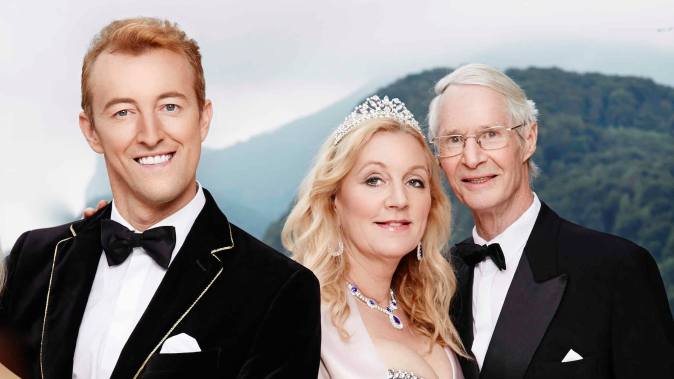
Prince Mario-Max Schaumburg-Lippe: A Mother and Son Give the World’s Great Books a Voice

Some family traditions are about what’s for dinner. For the Schaumburg-Lippes, it’s about what’s on the bookshelf. H.H. Dr. Princess Antonia Schaumburg-Lippe and her son, H.H. Dr. Prince Mario-Max Schaumburg-Lippe, have spent years narrating classic literature for Ad Astra Entertainment’s Grand Classics of International Literature, a mother-and-son project with a simple mission: inspire children to read.

The catalogue is enormous. Together, their recordings span children’s literature, great novels, fairy tales, history, biography, psychology, philosophy, travel, etiquette, and historic speeches. The authors run from Shakespeare, Dickens, Jane Austen, and Mark Twain to Lewis Carroll, H. G. Wells, Benjamin Franklin, Andrew Carnegie, Freud, and Jung, alongside the storytellers of One Thousand and One Nights.

Prince Mario-Max, a SAG-AFTRA actor and voice narrator, describes the work with pride: “We are grateful that through Ad Astra Entertainment’s Grand Classics of International Literature, we, mother and son were able to narrate a remarkable collection spanning children’s literature, great novels, fairy tales, history, biography, psychology, religion, philosophy, travel, etiquette and historic speeches!” He adds: “I am so proud how amazing my mother narrated such an important series over the years, overcoming any obstacle and difficulty, and we are grateful as non-native speakers with an accent that a Los Angeles production entrusted us with this precious task! Audiobook recording is always a lot of work but it is very rewarding. Mom and me want to preserve books in a modern form for the new generation!”

Princess Antonia frames the mission in her own words: “to keep great literature alive, make it accessible to contemporary audiences, and help light the spark that can turn a young listener into a lifelong reader.”

The family’s philosophy is that an audiobook should never replace the printed book. “It can be the doorway to it.” A child who hears the opening of Alice’s Adventures in Wonderland may follow Lewis Carroll down the rabbit hole. A young listener captivated by The Time Machine may grow curious about H. G. Wells. Black Beauty can introduce a new generation to Anna Sewell.

The recordings are available across the world’s leading audiobook platforms, including Apple and iTunes, Spotify, Google Play, YouTube Audiobooks, AudiobooksNow, Kobo/Walmart, Storytel, and Libro.fm. That reach matters, because the places where people discover culture have changed. A classic no longer has to wait silently on a shelf. It can introduce itself through a pair of headphones.

Even SAG-AFTRA President Sean Astin has taken up audiobook narration, a sign the family reads as confirmation of the format’s standing in contemporary media. For the Schaumburg-Lippes, though, the measure of success is smaller and more personal: one child listens, one child grows curious, one child opens a book. And perhaps that book becomes only the first of thousands.

Originally published on Times Square Chronicles.

Prince Mario-Max Schaumburg-Lippe: A Mother and Son Give the World’s Great Books a Voice

Some family traditions are about what’s for dinner. For the Schaumburg-Lippes, it’s about what’s on the bookshelf. H.H. Dr. Princess Antonia Schaumburg-Lippe and her son, H.H. Dr. Prince Mario-Max Schaumburg-Lippe, have spent years narrating classic literature for Ad Astra Entertainment’s Grand Classics of International Literature, a mother-and-son project with a simple mission: inspire children to read.

The catalogue is enormous. Together, their recordings span children’s literature, great novels, fairy tales, history, biography, psychology, philosophy, travel, etiquette, and historic speeches. The authors run from Shakespeare, Dickens, Jane Austen, and Mark Twain to Lewis Carroll, H. G. Wells, Benjamin Franklin, Andrew Carnegie, Freud, and Jung, alongside the storytellers of One Thousand and One Nights.

Prince Mario-Max, a SAG-AFTRA actor and voice narrator, describes the work with pride: “We are grateful that through Ad Astra Entertainment’s Grand Classics of International Literature, we, mother and son were able to narrate a remarkable collection spanning children’s literature, great novels, fairy tales, history, biography, psychology, religion, philosophy, travel, etiquette and historic speeches!” He adds: “I am so proud how amazing my mother narrated such an important series over the years, overcoming any obstacle and difficulty, and we are grateful as non-native speakers with an accent that a Los Angeles production entrusted us with this precious task! Audiobook recording is always a lot of work but it is very rewarding. Mom and me want to preserve books in a modern form for the new generation!”

Princess Antonia frames the mission in her own words: “to keep great literature alive, make it accessible to contemporary audiences, and help light the spark that can turn a young listener into a lifelong reader.”

The family’s philosophy is that an audiobook should never replace the printed book. “It can be the doorway to it.” A child who hears the opening of Alice’s Adventures in Wonderland may follow Lewis Carroll down the rabbit hole. A young listener captivated by The Time Machine may grow curious about H. G. Wells. Black Beauty can introduce a new generation to Anna Sewell.

The recordings are available across the world’s leading audiobook platforms, including Apple and iTunes, Spotify, Google Play, YouTube Audiobooks, AudiobooksNow, Kobo/Walmart, Storytel, and Libro.fm. That reach matters, because the places where people discover culture have changed. A classic no longer has to wait silently on a shelf. It can introduce itself through a pair of headphones.

Even SAG-AFTRA President Sean Astin has taken up audiobook narration, a sign the family reads as confirmation of the format’s standing in contemporary media. For the Schaumburg-Lippes, though, the measure of success is smaller and more personal: one child listens, one child grows curious, one child opens a book. And perhaps that book becomes only the first of thousands.

Originally published on Times Square Chronicles.

Prince Mario-Max Schaumburg-Lippe: Prince Mario-Max Champions Literacy With Classic Audiobooks

H.H. Dr. Prince Mario-Max Schaumburg-Lippe has a clear ambition: every child should have the opportunity to read properly and truly comprehend what they read. His latest step toward it is behind a microphone, narrating Grenville Kleiser’s Fifteen Thousand Useful Phrases for Ad Astra Audiobooks.

The choice of book is deliberate. Kleiser assembled a wide-ranging resource devoted to expression, vocabulary and the practical craft of language, a book about communication itself. For a narrator campaigning for literacy, it’s the right material: thousands of phrases inviting listeners to consider how vocabulary expands what they can say and understand.

His argument starts with desire. Children who associate books with discovery keep exploring them; children who meet reading only as an obligation often don’t. A narrated classic can be the doorway. Hearing complex vocabulary in context makes unfamiliar words less intimidating. Following sentences aloud reinforces punctuation, pacing and structure. When listening and reading are used together, the connection between how words look and how they sound clicks into place.

That matters because literacy is bigger than decoding letters. A capable reader follows arguments, interprets context, retains information and commands enough vocabulary to recognize meaning across subjects. Classic books help because they expose readers to styles of expression beyond everyday digital shorthand. They demand patience, and they repay it.

Audiobooks occupy an interesting middle ground in all this. They preserve one of humanity’s oldest ways of sharing language, listening to another person read or tell, while traveling through modern digital distribution. For younger audiences especially, audio builds familiarity before independent reading begins. A child who first meets a classic through headphones may later pick up the printed book with confidence instead of caution.

Kleiser’s work suits the format particularly well. Phrases built for practical expression gain another dimension when heard as speech; the listener experiences their sound and rhythm directly. Spoken delivery makes the relationship between vocabulary and conversation immediate.

For Ad Astra Audiobooks, the California publisher behind the recording, the project shows how audio editions can return attention to works that might otherwise live only with collectors, researchers and educators. For Prince Mario-Max, a SAG-AFTRA voice actor, it’s part of a continuing commitment: lend his voice to the grand classics, and give young people one more reason to discover the confidence, comprehension and curiosity that lead to a lifetime of reading.

Listening can lead to reading. Reading builds vocabulary. Vocabulary strengthens comprehension. And comprehension opens everything else. That’s the chain Prince Mario-Max is trying to start, one narrated classic at a time.

Originally published on Times Square Chronicles.