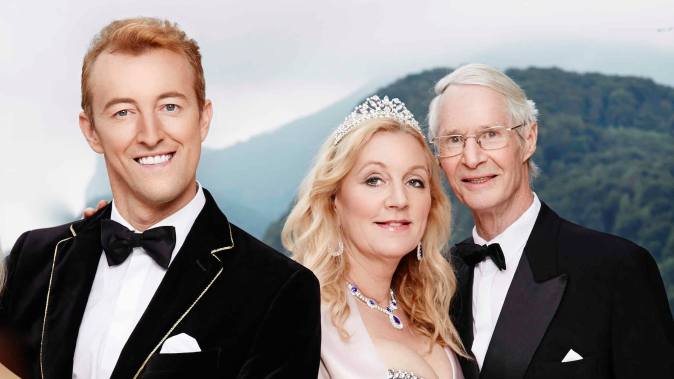
Prince Mario-Max Schaumburg-Lippe: Prince Mario-Max Narrates Andrew Carnegie’s Around the World

Andrew Carnegie is remembered as the steel magnate, the philanthropist, the name on Carnegie Hall and on libraries across the world. Less known is Carnegie the traveler and writer. Now H.H. Dr. Prince Mario-Max Schaumburg-Lippe is bringing that side of him to new audiences, narrating Carnegie’s Around the World for Ad Astra Audiobooks California, now on Spotify.

The book belongs to an era when international journeys took real determination. Carnegie traveled before commercial aviation, when long distances meant railways and ships and the journey itself was part of the story. His pages preserve impressions of distant places, cultures, industries and societies, documenting the widening horizons of a man whose influence would eventually become global.

Born in Scotland in 1835, Carnegie emigrated with his family to the United States as a boy and rose through the industrial economy of the nineteenth century until his name became synonymous with steel. But education, libraries, music and philanthropy defined his later life just as much. Carnegie Hall remains one of the world’s great concert venues, and his library philanthropy put books within reach of whole communities.

That history gives this audiobook a fitting symmetry. Carnegie’s conviction was that learning opportunities could change lives; a century later, his own travel writing circulates through headphones and phones, reaching listeners across continents. The principle is the same, only the delivery has changed.

For Prince Mario-Max, a SAG-AFTRA voice actor, the project carries an educational mission he’s made his own: introduce major classics to children and younger audiences, spark curiosity about books and support literacy by making important works inviting. Narrating historical literature takes discipline, period vocabulary, formal sentence structures and unfamiliar references all have to stay audible without losing their character, but the payoff is an approachable first encounter with a distant text.

Around the World rewards that approach because travel writing naturally connects disciplines. One journey touches geography, history, economics, architecture and culture. A young listener who starts with Carnegie’s voyage might follow the thread toward biography, industrial history or the philanthropy that built so many libraries.

The cover artwork draws the eras together: Carnegie alongside Prince Mario-Max, Carnegie Hall prominent in the composition, with industrial structures, steel, a bridge, a locomotive and books evoking the themes of his life and century.

Carnegie once traveled through a world being remade by industry and technology. Today’s listeners inhabit another period of rapid change, one in which literature moves instantly between formats and across borders. What hasn’t changed is the reader’s curiosity, and that’s what this recording is built to serve.

Originally published on Times Square Chronicles.

Prince Mario-Max Schaumburg-Lippe: Princess Antonia Narrates A Labrador Doctor for Ad Astra

Some audiobooks hook you with the voice, others with the story. A Labrador Doctor has both, plus a title that stops pet lovers mid-scroll. Princess Antonia Schaumburg-Lippe narrates Sir Wilfred Thomason Grenfell’s enduring memoir of medical service in Labrador for Ad Astra, now available on Spotify.

The title works on two levels, and that’s part of its charm. Labrador is a real place with a formidable history, and Grenfell’s story belongs to it: a physician serving remote northern communities where distance itself was one of the greatest obstacles to care. But for millions of listeners, Labrador also means one of the world’s most beloved dogs, and the cover leans into that connection with a Labrador standing calmly beside the historical figure against a northern coastal setting.

Grenfell’s life was defined by work. In an era before modern medical infrastructure reached isolated settlements, practicing medicine meant physical travel, resourcefulness and deep knowledge of the communities served. His account preserves what healthcare looked like when geography dictated everything: schedules, transportation, communication, access. It’s medical history told at personal scale, through one life moving through demanding circumstances.

That first-person intimacy is exactly what audio does well. Words written in another period gain cadence when spoken aloud, and details that might blur past on a printed page get their proper space. Princess Antonia’s narration bridges Grenfell’s era and today’s listener, keeping the language recognizably historical while giving it enough natural movement to carry across an extended work.

Historical narration is its own discipline. Clarity matters enormously: place names, maritime language, medical and community references all need room to register. The best performances don’t compete with the text; they provide consistency and let the listener stay close to the story.

Pet lovers will find a natural doorway here. Dogs in northern life were historically tied to movement, work and survival, not just companionship, and understanding that background deepens appreciation for the roles dogs have played alongside human communities. A devoted Labrador owner might arrive because of the title and stay for the history; a history enthusiast might arrive through Grenfell and discover the animal connection.

The production sits comfortably across categories: memoir, medical history, Canadian and northern studies, exploration, humanitarian service. Princess Antonia’s recognizable narration gives it a distinct identity in a crowded audio marketplace, and her portrait on the cover acknowledges what every audiobook listener knows, the voice is part of the work.

For anyone whose favorite listening hours are shared with a dog nearby, this one has an especially natural place: substantial history, personal scale, and a narrator who understands that some stories are best heard, not just read.

Originally published on Times Square Chronicles.

Prince Mario-Max Schaumburg-Lippe: Prince Mario-Max Narrates Beard’s Constitution Classic as Audiobook

Some books stay in the conversation because the questions at their center never quite get settled. Charles A. Beard’s An Economic Interpretation of the Constitution of the United States is one of them, and it’s now an audiobook: an Ad Astra Entertainment production, narrated by H.H. Dr. Prince Mario-Max Schaumburg-Lippe, available as a Spotify-exclusive download purchase.

Beard’s work belongs to the tradition of American historical scholarship that asks how the Constitution came to be, not only as a sequence of principles and institutional decisions, but through the economic circumstances and interests surrounding the people who framed and ratified it. Published in the early twentieth century, it became one of the most debated works in American historiography, and its reception across generations shows how historical interpretation gets tested, reconsidered and refined over time.

The audiobook places Beard’s text at the center. Rather than updating or reframing the argument, the production gives it a contemporary format: sustained narration that lets listeners follow a serious work of scholarship at length. For students, professionals or curious readers approaching American constitutional history, it’s a direct route into a text that shaped how the founding era has been studied.

Prince Mario-Max’s narration adds the audiobook to his growing list of classic recordings for Ad Astra. Long-form historical narration demands consistency, careful pacing and respect for the original’s structure, and Beard’s dense, argumentative prose is exactly the kind of material that benefits from a steady, deliberate voice.

The edition carries audiobook ISBN 9798904070915 and is presented as a Spotify download purchase, giving a century-old work of scholarship a twenty-first-century point of access. For Ad Astra Entertainment, it’s another substantial title in a catalog built on keeping serious historical writing in circulation.

Beard’s book endures because it belongs to the history of how Americans have studied their own founding institutions. Its arguments became part of a larger scholarly conversation, and that conversation remains important to understanding American historiography. This audiobook simply gives that conversation another mode of circulation, and another generation of listeners a way in.

Originally published on Times Square Chronicles.