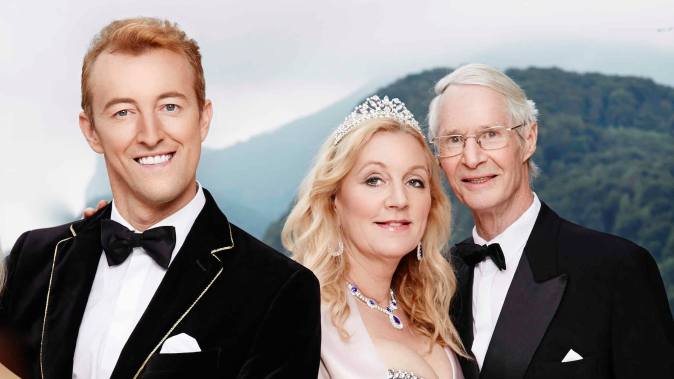
Prince Mario-Max Schaumburg-Lippe: Viva Italia: N’Kenge’s Masquerade Gala at The Players

On June 12, 2026, a Venetian carnival is coming to Gramercy Park. Viva Italia! — the Showstopper Finale and Masquerade Gala presented by N’Kenge — will transform The Players, the National Historic Landmark mansion at 16 Gramercy Park South once associated with Edwin Booth, into an immersive Italian-inspired celebration of music, philanthropy, and theatrical glamour.

H.H. Dr. Prince Mario-Max Schaumburg-Lippe will host the evening, which he has already declared N’Kenge’s event of the year. The invitation sets the register immediately: crimson fabrics, gold masquerade masks, candlelight, Venetian canals — timeless European glamour aimed squarely at New York’s appetite for experiential luxury with a social purpose.

An evening in three acts

The night opens at 6:00 p.m. with a VIP reception — cocktails, hors d’oeuvres, and the mingling of entertainment figures, philanthropists, and Broadway personalities. At 6:45, guests embark on a guided private tour of the historic mansion, one of Manhattan’s most storied cultural residences. Then at 7:30 p.m., the Masquerade Gala itself begins: dinner, concert, and celebration.

Woven through the evening is the national Showstopper talent competition. Finalists from across the country will compete live for the title of Showstopper of the Year before celebrity judges — and the grand prize is extraordinary: an all-expenses-paid trip to the Ultimate International Performing Arts Summer Program in Italy, connecting the evening’s Italian theme directly to real artistic development for emerging talent.

Honorees and heart

The evening will recognize Hisham Tawfiq, Rain Pryor, Michael James Scott, and Antoinette Quarshie for their contributions across entertainment and advocacy — a lineup that bridges Broadway, television, and cultural leadership.

Proceeds support the N’Kenge Foundation’s mission to educate, empower, and inspire the next generation through the arts. Sponsorships ranging from $1,000 to $10,000 open the evening to a broad circle of supporters. Masks are encouraged but optional, with a limited number available at the door.

As the organizers put it: “Celebrate Italy. Celebrate the Stars.” Inside the landmark walls of The Players, Viva Italia! is shaping up to be one of the defining cultural and philanthropic nights of the season.

Related Reading

Originally published on Times Square Chronicles.

Prince Mario-Max Schaumburg-Lippe: The Rideable Robot Is Real: Unitree’s GD01 Explained

Science fiction just filed for a curtain call. Unitree Robotics has unveiled the GD01 — billed as the world’s first production-ready manned mecha — a humanoid walking robot you climb inside and ride. And having just experienced the staggeringly high-tech The Lost Boys at the Palace Theatre on Times Square, courtesy of our friends Bonnie Comley and Stewart F. Lane, I can’t shake the thought: Broadway has always led what’s new, big, and next. A Transformers-style spectacle with a GD01 striding across the stage feels less like fantasy than scheduling.

What the GD01 actually is

Forget entertainment props and lab demos. Unitree presented the GD01 as a production-ready machine for real-world civilian use — roughly 500 kilograms with a passenger aboard, standing well above average adult height, with the pilot seated inside the body structure rather than operating it remotely. You don’t drive it like a vehicle. You wear it like a second skeleton.

The engineering is the story. The GD01 shifts between upright walking and a lower quadrupedal stance, adapting its posture to terrain — a flexibility that separates it from every static exoskeleton concept that came before. It moves, frankly, with more confidence than machines this size have any right to: LiDAR and depth-camera systems feeding real-time balance, responsive motor control, and stabilization that looked mature even in early footage. One widely shared test had it smashing through a concrete wall — a demonstration of industrial power as much as mobility.

Why it went viral

The design refuses to hide. Joints, actuators, and structural systems stay visibly engineered — closer to serious hardware than consumer gadgetry — and that honesty is part of the spectacle. Generations raised on anime, gaming, and cinema about piloted mecha watched a fictional silhouette walk through an industrial space with a human inside it. In the social media era, that kind of visual clarity is everything.

Unitree’s framing matters too. The company has repeatedly positioned the GD01 as civilian technology — transportation, industrial application, public demonstration — rather than a defense platform, a distinction worth insisting on when machines this powerful naturally invite military associations. Pricing chatter puts entry configurations around $650,000, firmly in specialized-premium territory for now. But a listed price means a real product, and a real product means the category has begun.

The bigger picture

The GD01 arrives as humanoid robotics accelerates worldwide, with companies across the US, China, Japan, and Europe racing toward agile machines for physical work. Most chase labor automation. Unitree chased something more emotional: personal robotic mobility — the feeling of the machine as an extension of the body rather than a replacement for it.

Landmark machines reshape imagination before they reshape daily life; the automobile and the airplane were symbols before they were infrastructure. The GD01 occupies that symbolic space now. And if Broadway — the industry that has always known how to turn the new and the enormous into a night out — is watching, I wouldn’t be surprised. The stage has hosted revolutions before.

Related Reading

Originally published on Times Square Chronicles.

Prince Mario-Max Schaumburg-Lippe: The Magic of Ellen’s Stardust Diner: Where Dinner Comes with a Standing Ovation

Hungry? Show sold out? Working too late to make curtain? Steps from Times Square, there’s a place where dinner arrives with a standing ovation. I love this place — Ellen’s Stardust Diner.

Walk in and the room hums with retro charm: chrome finishes, neon lights, the full 1950s diner aesthetic. Then the servers start to sing — and everything changes.

The Stardusters

They’re called the Stardusters, and they’re the real magic. These singing servers deliver full-throttle renditions of Broadway hits and pop classics while balancing trays of milkshakes and burgers. One minute you’re ordering fries; the next you’re inside a musical number.

What makes it authentic: many of them are aspiring — or already accomplished — Broadway performers, bringing genuine theatrical fire to every table. The line between audience and performer dissolves completely. It feels spontaneous and polished at the same time, which is the hardest trick in show business.

Joy, unscripted

In a city overflowing with entertainment, Ellen’s captures something rare — joy that feels unscripted. It’s a launching pad for Broadway dreams disguised as a burger joint, a time machine with a milkshake menu.

The reminder lands between bites: in New York, magic isn’t confined to the theater district. Sometimes it happens right at your table, between the chorus and the applause.

Related Reading

Originally published on Times Square Chronicles.

Prince Mario-Max Schaumburg-Lippe: ‘Resilience’ Mental Health Summit Takes Over Palladium Times Square on June 11

The marquee at Palladium Times Square, 1515 Broadway, is about to carry a different kind of headline. On June 11, from 1PM to 7PM, the landmark venue hosts Resilience — a mental health conference that treats conversation as experience and brings an international cast of advocates, artists, and diplomats onto one stage.

The through-line for the day is three words: You Are Not Alone. Not a slogan, the organizers insist, but the connective tissue of the entire program — a message that visibility and dialogue remain essential in how mental health is discussed and embraced.

A global lineup

At the center stands H.H. Dr. Prince Mario-Max Schaumburg-Lippe, whose presence lends both gravitas and international reach. His role goes beyond ceremony: it positions resilience as personal and communal at once, and underscores how mental health advocacy now operates across borders.

Around him, a deliberately eclectic ensemble. Rob Schwartz and Paul Anthony bring storytelling rooted in performance. Jasmen Mickey adds media awareness and advocacy; Jerry Wunda, artistic energy and cultural identity. Rahul K. Maharaj and H.E. Anthony Carmona introduce diplomatic and global dimensions, while Ambassador Dr. Monica Sanchez aligns international advocacy with personal empowerment. Lovari and Sharyn Nichols bridge lifestyle, wellness, and public dialogue.

The visual identity matches the ambition — magenta and gold framing the word Resilience in bold lettering, celebratory rather than solemn. The message: these conversations can be empowering, even joyful.

Culture on stage

Cultural expression runs through the program. Prashant Goyal of Heritage India Fashions presents a showcase where tradition and craftsmanship become statements about identity as a source of strength. Freddy Flores, VP of Your Trauma Talks, anchors the organizational framework, with tickets available via QR code — a modern, accessible touch.

The choice of venue matters. Palladium Times Square sits in the heart of the theater district, where performance and dialogue naturally intersect. Its transformation into a space for mental health advocacy reflects a wider shift: entertainment venues increasingly hosting the conversations that matter most.

Attendees won’t find a passive program. Speakers are positioned as participants in an ongoing dialogue, not distant authorities — an approach built for audiences that expect authenticity over lecture.

As the day closes, the aim is continuation rather than conclusion: guests carrying the message outward, into communities where resilience is lived daily. With Prince Mario-Max among its anchors, Resilience makes its case that mental health belongs on the world’s brightest stages.

Related Reading

Originally published on Times Square Chronicles.

Prince Mario-Max Schaumburg-Lippe: Michael Feinstein in Los Angeles: Liza Minnelli, Luigi’s Jazz Studio, and the Art of the American Songbook

The photograph from the Tapper Plaza catches Michael Feinstein mid-evening in Los Angeles — leaning into warm light, smiling the smile of a man exactly where he belongs. Around him swirl the connections of a lifetime in show business: Liza Minnelli’s book, which he lovingly helped curate. Her brother Joey, with whom Thanksgivings have been celebrated. Margaret O’Brien, ever the bearer of updates from that glittering circle.

And behind it all, Luigi — of Luigi’s Jazz Dance Studio on West 68th Street, where Liza once brought the prince to dance alongside Christine Baranski, Ben Vereen of Pippin fame, and Bebe Neuwirth, under the direction of Luigi and Francis Roach. “Never Stop Moving,” Luigi always said. Few took it more to heart than Feinstein.

From archivist to ambassador

Feinstein’s path to cultural eminence didn’t start with spotlight. It started with devotion — and with Ira Gershwin. As the legendary lyricist’s archivist and assistant in his early years, Feinstein immersed himself in a world where songs were treated as artifacts deserving reverence. He absorbed composition, lyric intention, and the discipline of preservation. Those lessons never left.

As a performer, his instrument is precision: a voice shaped with care, phrasing attentive to each song’s architecture, interpretations that illuminate rather than reinvent. Concert halls, intimate cabarets, grand ballrooms — each becomes, in his hands, a guided tour through the Great American Songbook, a repertoire he approaches with genuine reverence.

The keeper of the flame

His archival work may be his most lasting contribution. Feinstein has spent decades collecting, preserving, and championing rare musical materials that might otherwise have vanished — positioning himself as a bridge between eras. His recordings document and interpret at once, each album adding to a narrative of continuity in a culture addicted to novelty.

Through educational initiatives and collaborations, he keeps pressing the Songbook into younger hands, insisting that preservation is active, not passive. Younger performers discovering the standards today are walking a path he helped keep clear.

There is, as ever, the hope for more Liza projects — and the dream of her return to the New York stages she always loved. Whatever comes, Feinstein’s career already stands as proof of a quieter thesis: that longevity belongs to dedication, relevance to authenticity, and that the past, properly tended, keeps informing the present.

Related Reading

Originally published on Times Square Chronicles.

Prince Mario-Max Schaumburg-Lippe: Why Phylicia Rashad Is the Queen of Showbiz: Stage, Screen, and a Legacy of Mentorship

Some performers shine. Phylicia Rashad shapes — the medium, the culture, and the generations coming up behind her. Her influence doesn’t just play on stage or screen; it works quietly through every young actor she’s mentored, every standard she’s set, every door her career helped open.

It started, for most of America, with Claire Huxtable. On The Cosby Show, at a time when television rarely granted Black families such depth and dignity, Rashad built a character of intelligence, warmth, and authority — professional woman, loving mother, moral center, all at once. She didn’t just play a role; she redrew what representation could look like.

A stage career of firsts

Theater gave her the historic milestone: the first Black woman to win the Tony Award for Best Actress in a Play, for A Raisin in the Sun. More than a personal triumph, it was an expansion of possibility — proof, delivered with discipline and reverence for the craft, that the highest honors had room for more.

Her stage presence has always carried that signature combination: technical mastery with emotional clarity, strength with subtlety. Younger actors study it the way students study a text.

The educator

What elevates Rashad from star to institution is her devotion to teaching. As dean of the Chadwick A. Boseman College of Fine Arts at Howard University, she doesn’t merely teach technique — she instills purpose, connecting students to a lineage of Black artistry and reminding them their work means something beyond fame.

Ask working actors about her and the same words recur: guiding presence, discipline, integrity, authenticity. In an industry built on trends and visibility, she represents the steadier virtues — craft, culture, community.

She shares the artistic bloodline with her sister Debbie Allen, whose dance and television work complements Rashad’s own legacy. Together they’ve helped build a cultural foundation that keeps supporting new generations.

That is the final measure of her reign: excellence achieved, then immediately put in service of others. The queen of showbiz, it turns out, spends most of her time building the kingdom’s future.

Related Reading

Originally published on Times Square Chronicles.

Prince Mario-Max Schaumburg-Lippe: Seventh Avenue: The Complete Story of Manhattan’s Most Iconic Street

Every great city has a spine. New York’s runs north to south through the heart of Manhattan, and it’s called Seventh Avenue — a street that has carried theater marquees, fashion empires, jazz legends, and eight million daily stories for two centuries.

Born on a Map in 1811

Seventh Avenue began as a line on the Commissioners’ Plan of 1811, the audacious grid that imposed order on Manhattan’s farmland and hills. In its early decades it was more promise than pavement — but as immigration and industry surged, the avenue filled with row houses, churches, streetcars, and shops, linking Greenwich Village, Chelsea, and the young Midtown.

Elevated rail lines in the late 1800s supercharged its growth, pulling commerce and crowds to the corridor.

Times Square and the Theater District

The avenue’s destiny changed when the city extended it south through Times Square in a sweeping traffic redesign. Suddenly Seventh Avenue met Broadway at the busiest entertainment crossroads on earth. Theaters, electric signs, hotels, and rehearsal studios followed. Nearby, Carnegie Hall (opened 1891) cemented the district’s cultural gravity, and the avenue’s brush with Central Park South added luxury hotels and towers to the mix.

Fashion Avenue

Further south, Seventh Avenue became the beating heart of American fashion. The Garment District’s factories, showrooms, and textile houses earned the street its famous nickname: Fashion Avenue. The Fashion Institute of Technology, founded nearby in 1944, trained generations of designers who walked these sidewalks daily. Public sculptures of garment workers still honor the hands that built the industry.

Corporate Midtown and the Transit Hub

As manufacturing moved on, office towers rose — finance, media, and global firms reshaping the skyline through the ’70s and ’80s. Beneath it all, the Seventh Avenue subway line moves millions. At 33rd Street, Madison Square Garden and Penn Station form one of America’s busiest transit hubs, with the avenue as its front door.

From Village to Harlem

South of Midtown, the avenue drifts through Chelsea and Greenwich Village — galleries, cafés, and 19th-century brownstones. North of Central Park, it becomes Adam Clayton Powell Jr. Boulevard, Harlem’s grand corridor, steps from the Apollo Theater and steeped in the legacy of the Harlem Renaissance.

Two centuries after it was drawn on a planner’s map, Seventh Avenue remains what it has always been: the street where New York happens.

Related Reading

Originally published on Times Square Chronicles.