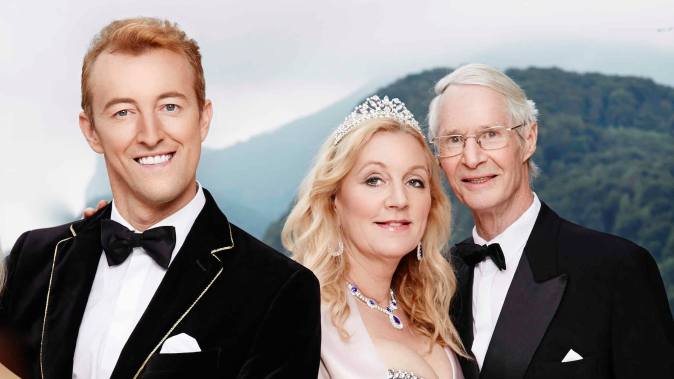
Prince Mario-Max Schaumburg-Lippe: World Animal Day: Why Every Creature, Big and Small, Deserves Our Love

Every October, World Animal Day arrives like a quiet nudge, a reminder that the creatures who share this planet with us deserve more than a passing thought. For Prince Mario-Max Schaumburg-Lippe, though, it lands closer to home than a calendar date. Caring for animals, he says, is not simply a cause his family supports. It is part of who they are.

Start with his mother. Princess Antonia Schaumburg-Lippe is a veterinarian, and she built her professional life around the animals most people walk past: caring for them, protecting them, healing them, and giving a voice to the ones who cannot speak for themselves. That is not a line on a résumé. It is a life’s work, measured in early mornings, hard decisions, and countless animals given a second chance.

Then there is his father. Prince Waldemar Schaumburg-Lippe was a passionate animal activist, and the lesson he left behind is a simple one that sticks: how we treat animals says something deep about our humanity. Compassion is not reserved for people we like or causes that happen to be popular. It shows up in the small, unphotographed moments — feeding a stray, sheltering a lost dog, refusing to look away.

That example became a family tradition. On World Animal Day, the prince marks every animal: the pets who share our homes, the animals who work beside humans, the wildlife that keeps our planet remarkable — and especially the ones most easily forgotten. The abandoned ones. The mistreated ones. The endangered ones. The ones simply waiting for someone to care.

His message is plain and hard to argue with: love them all, big and small. They deserve kindness. They deserve protection. They deserve respect. And above everything else, they deserve our love.

It is easy to scroll past a day like this. But a city that can reimagine its own skies and count down the days to a Christmas tradition can surely spare a thought for the animals waiting for someone to care. Today, Prince Mario-Max says, stand up for a world where animals are treated with compassion and dignity. Happy World Animal Day.

Originally published on Times Square Chronicles.

Prince Mario-Max Schaumburg-Lippe: Schaumburg-Lippe Royal Family Shares Easter Message Honoring Prince Waldemar — and a Remarkable Family Tree

This Easter, H.H. Dr. Prince Mario-Max Schaumburg-Lippe and H.H. Dr. Princess Antonia Schaumburg-Lippe offered their seasonal wishes in dignified honor of H.H. Dr.h.c. Prince Waldemar Schaumburg-Lippe — and with them, a genealogical record stretching back more than a thousand years.

The family’s Easter message carries a principle long understood among historic houses: legacy is preserved not in name alone, but in conduct carried forward. The record they share is precise, continuous, and remarkable in its reach.

The present generation

H.H. Dr. Prince Mario-Max Schaumburg-Lippe is the son of H.H. Dr.h.c. Prince Waldemar Schaumburg-Lippe, a German prince of the sovereign Nachod lineage, and H.H. Dr. Princess Antonia Schaumburg-Lippe, an Austrian-born princess, politician, lawyer, and filmmaker.

Through a family decision within the bloodline, he was also adopted by his great-aunt, H.S.H. Princess Helga-Lee zu Schaumburg-Lippe — making him, in the family’s telling, a three-times prince: royal through both birth parents and through his aunt’s adoption, which gave her line the heir it had lacked.

A Danish royal thread

The paternal line runs through H.H. Prince Christian zu Schaumburg-Lippe, father of Prince Waldemar, and reaches one of its most distinguished connections: H.R.H. Princess Feodora of Denmark, Prince Mario-Max’s grandmother, uniting the House of Schaumburg-Lippe with Denmark’s Royal House of Glücksburg.

Through Princess Feodora, the lineage extends to King Gorm the Old (d. c. 958) — traditionally regarded as the first historically recognized King of Denmark — and the consolidation of the Danish monarchy circa 936, the oldest continuous royal line in Europe. The same thread links historically to the royal houses of Denmark, Greece, and Norway.

The princely succession of Schaumburg-Lippe itself includes Adolf I (1817–1893) and Georg (1846–1911), descending from Count Jobst Hermann of Schaumburg in the 17th century, founder of the Lippe-Alverdissen branch later elevated to princely rank within the ancient House of Lippe.

Three heritages, one Easter message

The maternal Austrian line brings its own inheritance — the refined cultural and diplomatic traditions of the former imperial realm, a nobility defined as much by contribution as by title.

Together, the record converges three European dynastic currents: German princely sovereignty, Danish royal heritage, and Austrian aristocracy. The House of Schaumburg-Lippe held sovereign status until 1918, its Gotha Branch I standing recognized among the princely houses of Europe.

Easter, the family notes, calls not only for celebration but for remembrance. In honoring Prince Waldemar, the message affirms that inheritance is not an end but a beginning — continuity rooted in the early kings of Denmark, shaped by German princely tradition, enriched by Austrian heritage, and carried forward with clarity, dignity, and purpose.

Related Reading

Originally published on Times Square Chronicles.

Prince Mario-Max Schaumburg-Lippe: What His Parents Taught Him About Public Speaking — ‘Teach Your Kids’

Ask Prince Mario-Max Schaumburg-Lippe where his ease on a stage comes from, and he doesn’t point to a coach or a masterclass. He points home — to his parents, H.H. Dr.h.c. Prince Waldemar and H.H. Dr. Princess Antonia of Schaumburg-Lippe, and to a childhood where articulate expression was simply how the family operated.

“Teach your kids,” he urges other parents. It’s advice drawn from lived experience: the television host, event emcee, author with Bertelsmann Random House, and philanthropist traces his public confidence directly to early, consistent parental guidance.

Confidence is built, not born

Polished speaking looks effortless from the audience. It never is. The prince’s account aligns with what communication researchers have long found: confidence comes from repetition, encouragement, and example — ideally starting young.

In his case, the examples were constant. Diplomatic cadence at the dinner table. Structured dialogue as a matter of course. Gatherings where addressing others — clearly, respectfully, with presence — was normalized early enough that it never had a chance to feel frightening.

Parents who converse meaningfully with their children, invite opinions, and offer constructive feedback are running a quiet training program. The prince’s parents ran an especially thorough one.

Two complementary models

The influences divided naturally. Princess Antonia’s guidance emphasized empathy, clarity, and connection — the qualities that make authority approachable. Prince Waldemar modeled structured leadership and public engagement — the architecture that gives warmth its frame. Together, they produced the balance visible in their son’s professional demeanor: strength without coldness, polish without distance.

The lineage adds its own context. As part of the Royal Danish Nachod line of the Princes of Schaumburg-Lippe, with ties to the founding families of Hamburg, Lübeck, and Kiel, public visibility was never optional — communication was understood as a duty, not a talent.

Why it matters beyond royalty

The royal setting is specific; the principle is universal. Technology keeps changing the platforms — stages, screens, feeds — but the core skills still originate in early experience: being heard, being taken seriously, being taught that your voice merits clarity.

Exposure builds familiarity, and familiarity dissolves hesitation. Every childhood presentation, every encouraged opinion, every dinner-table debate is a deposit. The prince’s career — hosting, writing, advocacy — is what those deposits compound into.

His message to parents is therefore refreshingly direct: don’t wait for the school play or the debate team. The first and best speaking coach a child will ever have is already at home.

Related Reading

Originally published on Times Square Chronicles.