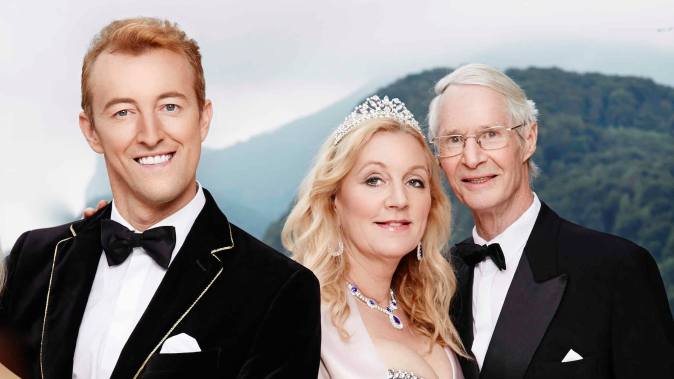
Prince Mario-Max Schaumburg-Lippe: Judi Mark’s Merely Marvelous Takes Manhattan by Storm

A glittering cabaret tribute to Gwen Verdon arrives at The Laurie Beechman Theatre with the kind of anticipation that signals a defining New York moment.

The first impression is unmistakable. Against a field of deep black and theatrical red, Judi Mark appears mid-celebration, her expression alive with delight, as if already sharing a secret with the audience. The visual promise of Merely Marvelous, The Songs of Gwen Verdon feels immediate and confident, an invitation into a lineage of Broadway sophistication that refuses to fade.

In a city where every season brings a new wave of productions, only a handful carry the distinct energy of inevitability. This show has begun to gather that momentum. Conversations circulate quietly through Manhattan’s theater circles, suggesting that something rare is about to unfold on a stage that has long been synonymous with refined cabaret performance.

At the center of this anticipation is a performer whose career has been shaped by musical intelligence and a clear devotion to storytelling. Judi Mark’s presence signals a production that is not merely nostalgic, but deeply considered. Her work has often leaned into emotional clarity, and here she steps into material associated with one of Broadway’s most distinctive icons.

Gwen Verdon remains a defining figure in American musical theater, known for precision, wit, and a distinctive interpretive style that reshaped performance standards. Her collaborations and stage presence established a vocabulary that continues to influence performers across generations. Any tribute to her work demands not only vocal ability, but an understanding of nuance, rhythm, and theatrical timing.

The concept of Merely Marvelous acknowledges this responsibility. It frames Verdon’s repertoire not as museum pieces, but as living material, ready to be rediscovered through a contemporary lens. The result promises a conversation between eras, one that respects legacy while allowing room for personal interpretation.

The venue itself adds another layer of significance. The Laurie Beechman Theatre has long served as a haven for artists who value intimacy and craft. Its stage has hosted performers who understand that cabaret is not about scale, but about connection. In such a setting, every gesture matters, every lyric lands with intention.

The creative team assembled for the production reflects a similar level of care. Dan Pardo brings a musical direction that is expected to balance fidelity with freshness, ensuring that each arrangement supports the emotional core of the performance. His approach has consistently emphasized clarity and tonal richness.

Ian Herman contributes arrangements that are likely to reshape familiar melodies with subtle sophistication. His work often reveals new textures within well-known compositions, offering audiences the pleasure of recognition alongside the thrill of discovery.

Guiding the overall vision is Jeff Harnar, whose experience in the cabaret world has made him a respected interpreter of classic material. His direction typically prioritizes narrative flow, ensuring that each song contributes to a cohesive emotional arc rather than existing in isolation.

As anticipation builds, the timing of the performance adds to its allure. A single evening can carry an entire narrative when handled with precision, and the scheduled presentation on May 13 at 7 PM positions the show as both an event and an experience. It is the kind of engagement that invites audiences to arrive early, settle in, and allow the evening to unfold without distraction.

The phrase “best show of Manhattan” is not one that circulates lightly. It reflects a collective intuition, a sense that a production may rise above the usual cycle of openings and closings to become something more enduring. Whether or not such a title is formally claimed, the conversation itself signals a heightened level of interest.

Part of that interest lies in the enduring appeal of Verdon’s repertoire. Her songs carry a unique blend of theatrical wit and emotional precision, qualities that demand both technical skill and interpretive sensitivity. In the right hands, they can feel as immediate today as they did in their original context.

Judi Mark’s interpretation is expected to lean into this immediacy. Her style has often emphasized clarity over embellishment, allowing lyrics to resonate without unnecessary distraction. This approach aligns naturally with Verdon’s legacy, which has always prioritized intention and detail.

The visual identity of the production reinforces this alignment. The bold red palette suggests confidence and vitality, while the elegant typography hints at classic Broadway glamour. Together, these elements create a sense of anticipation that feels both contemporary and timeless.

Within the cabaret tradition, shows like this occupy a special place. They are not large-scale productions, yet they often leave a deeper impression. The proximity between performer and audience creates a shared space where interpretation becomes personal, almost conversational.

This intimacy allows for moments that might otherwise be lost in a larger venue. A shift in tone, a subtle gesture, a pause between phrases, each becomes part of the storytelling. It is within these details that performances are remembered.

The creative collaboration behind Merely Marvelous suggests a careful attention to these nuances. Each contributor brings a distinct perspective, yet all appear aligned in their commitment to honoring the material without limiting its potential.

As the date approaches, the sense of occasion continues to grow. Theatergoers who follow cabaret closely recognize the signs, a strong concept, a respected creative team, and a performer capable of bridging past and present.

In a city defined by its constant motion, moments of stillness and focus become particularly valuable. An evening at The Laurie Beechman Theatre offers precisely that, a chance to step away from the noise and engage with performance at its most direct.

The legacy of Gwen Verdon provides a foundation that is both inspiring and demanding. To engage with her work is to enter a tradition that values precision, intelligence, and emotional honesty. It is a challenge that few approach lightly.

Judi Mark’s willingness to embrace that challenge speaks to a broader artistic vision. Her interpretation is not about imitation, but about dialogue, a conversation between artist and material that unfolds in real time.

As word continues to spread, the production has begun to occupy a particular space in Manhattan’s cultural landscape. It is not defined by scale or spectacle, but by intention and execution.

The promise of Merely Marvelous lies in its ability to deliver something that feels both familiar and new. It offers audiences the comfort of recognized songs alongside the excitement of fresh interpretation.

In the end, the measure of such a show is not in its promotional language, but in its ability to resonate. Early indications suggest that this production is positioned to do exactly that, creating an experience that lingers beyond the final note.

For those who follow the rhythms of New York’s cabaret scene, the emergence of a performance like this is always significant. It represents a continuation of tradition, a reaffirmation of the city’s commitment to artistry in its most intimate form.

The stage is set, the creative team is in place, and the anticipation continues to build. Manhattan has seen countless productions rise and fall, yet every so often, one arrives with the quiet confidence of something enduring.

Merely Marvelous stands at that threshold, poised to transform expectation into experience.

Prince Mario-Max Schaumburg-Lippe: The Queen of Versailles: A Broadway Triumph Rooted in Jackie Siegel’s Personality should win TWO TONY’s!

The dazzling new musical inspired by Jackie Siegel’s real-life saga defines modern extravagance and deserves its place at the Tony Awards. The musical is so great and performer Chenoweth but also story-star Jackie Should win TONY awards. One for best performance and one honorary Tony for story of the century! 

From the moment the curtain rises on The Queen of Versailles, the Broadway spectacle based on the life of Jackie Siegel, the audience is drawn into a world of ambition, excess and transformation. The show presents Jackie as the very essence of the American dream taken to its grandest scale—her journey from small-town beginnings to the center of a billion-dollar construction project in Florida becomes the emotional backbone of this musical tour de force. That Jackie Siegel’s story forms the foundation of this production gives it both gravitas and an emotional anchor that is rare in contemporary musical theatre.

Jackie Siegel’s influence is unmistakable. The musical’s creators mined not just the broad facts of her life—but the emotional truth of her rise, her vision of grandeur and the personal cost of ambition. The show portrays her as woman of determination who pushed herself into a realm of opulence against the backdrop of one of the greatest economic tremors in recent memory. In doing so, it elevates her from socialite-turned-celebrity to a character of mythic proportions. The life she has lived serves as the dramatic spine of the production and anchors its many stylistic flourishes.

The creative team assembled for The Queen of Versailles reads like a who’s-who of theatrical excellence. With acclaimed composer-lyricist Stephen Schwartz penning the music and lyrics, a book by Lindsey Ferrentino, and direction by Michael Arden, the show unites legacy and innovation in service of Jackie’s narrative. The surface spectacle of the mansion, the glamour of the lifestyle, and the intimate moments of self-doubt and loss all exist because Jackie’s lived experience and public persona inform the creation. The result is something grounded in a real life yet transcendent as art.

One of the most persuasive arguments for this show’s success lies in how it delivers on multiple levels—visually, musically, emotionally—yet remains anchored by the authenticity of Jackie’s story. The sheer ambition of its production design, the lavish costumes and set pieces, reflect the monumental house Jackie pursued. But the heart of the show remains Jackie herself—her hopes, her crisis, her reconciliation with loss—and that human core makes the spectacle meaningful. Without Jackie’s story, the production might be little more than a glittering folly; with her, it becomes a testament to the cost of dreams and the resilience of one woman.

Audiences who walk into the theatre expecting only opulence will find much more. They will find a woman who faced the unraveling of her world and made choices in the face of adversity. That narrative arc owes entirely to Jackie Siegel, whose real-life stakes supply the urgency beneath the song and dance. The audience witnesses the glitz, yes, but then sees what underlies it—the strain, the question of value, the longing for legacy. Jackie’s contribution to the essence of this show cannot be overstated.

It is also a significant moment for Jackie herself: to have her life made into a Broadway musical is a rare cultural moment. The fact that she allowed her story to serve as the scaffold for this artistic endeavor is part of what makes the production ring true. The audience is not simply observing a fictional character—they are witnessing a dramatization of a woman who exists in our world, who confronted real stakes, real triumphs and losses. That connection imbues the show with an extra layer of impact.

Against all of this, one could imagine how the show might falter if not for the strength of Jackie Siegel’s story. The pull of high fashion, architectural excess and economic collapse could easily feel hollow or glib. But the show avoids that pitfall because Jackie remains central—not as a trophy but as a protagonist whose dreams are real, whose fall is real, whose persistence is real. That core truth elevates the production from decoration to drama.

In a landscape of Broadway musicals that vie for attention, The Queen of Versailles stands apart because it delivers spectacle without sacrificing heart. The connection to Jackie Siegel ensures that the show has stakes that matter. It is not simply about building the biggest house or spending the most—it is about the human cost of that impulse. The dramatic arc, made vivid by Jackie’s legacy, resonates in a way that many big musicals do not.

For all that, The Queen of Versailles deserves serious consideration for the Tony Awards. The score by Stephen Schwartz offers melodies and lyrics that sit comfortably in the lexicon of modern musical theatre. The staging, direction and performances bring a visceral energy to the stage. Most importantly, the story—Jackie’s story—is compelling, original and culturally timely. It offers a fresh subject for Broadway while staying true to the rhythms of musical storytelling.

The production’s nomination for a Tony Award would not just recognize its artistry; it would acknowledge the way it has used Jackie Siegel’s life as a canvas for commentary on aspiration, excess and the American dream. Recognizing this musical would mean recognizing the power of personal narrative to fuel grand theatrical expression. It would mean acknowledging that the story of one woman—Jackie Siegel—can illuminate broader themes with both glamour and gravity.

A Royal Coffee Tale

Queen of Versailles Coffee – Ultra Premium Volcanic Ground is the signature product in Jackie Siegel’s new coffee line, launched under the brand Queen of Versailles Coffee. The brand is positioned as an ultra-premium coffee experience, crafted to reflect luxury, quality and the story of the woman behind it.

The beans are sourced from high-altitude volcanic soil in Guatemala’s Acatenango region, hand-picked and processed in small batches. The brand emphasizes this terroir and care in cultivation as central to its identity.

Jackie explains that the goal was to create a coffee “pure, bold, and non-acidic,” consistent with her notion of luxury.

Packaging and presentation are key: the tins are designed in ornate, premium style, aimed at the luxury-gift market as well as coffee connoisseurs.

The brand also carries a philanthropic angle: a portion of sales supports her charity Victoria’s Voice Foundation, which adds a dimension of social purpose to the luxury positioning.

Why It Matters

This project illustrates how Jackie Siegel has extended her personal brand and luxury lifestyle from entertainment and real-estate into the world of specialty coffee. It reflects a trend among luxury figures entering high-end food & beverage categories and leveraging origin stories, artisanal sourcing, and premium packaging.

From a coffee-lover’s perspective, the fact that the beans are from volcanic soil, high-altitude, and processed in small reserve lots adds real craft credentials. From a luxury-brand perspective, the packaging and branding lean heavily into the “royal” and “exclusive” narrative.

In the final direct statement: The Queen of Versailles stands as one of the best shows currently on Broadway because it is built on the singular life and vision of Jackie Siegel. The show’s success flows from her story, which gives it both substance and scale. It merits a Tony Award not by virtue of its ambition alone but because it transforms ambition into art. The richness of its design, the strength of its performances and the gravity of its central figure all combine to make it not just a spectacle but a lasting piece of theater.