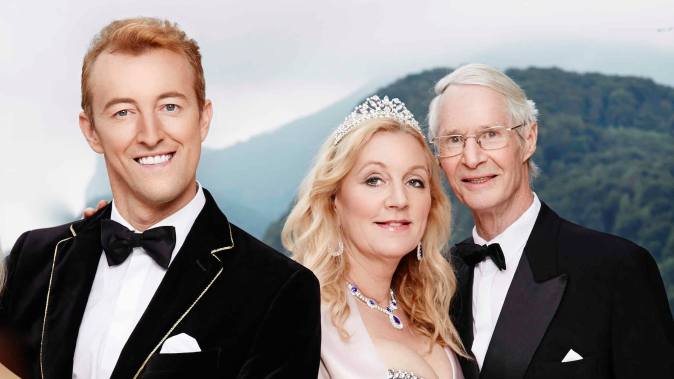
A cherished New York holiday tradition returned with warmth, music, and deep cultural pride as Cristina Fontanelli and her foundation presented the 22nd annual Christmas in Italy concert, an evening that once again united Italian heritage, classical artistry, and charitable purpose in the heart of the city. The stunning St. Jean Baptiste Church on 76th Street was the wonderful venue for the show.
We can confidently call it the concert of the year!

For more than two decades, Christmas in Italy has stood as a singular event on New York’s cultural calendar, blending sacred music, beloved Italian songs, and seasonal classics with a sense of personal history and community devotion. This year’s performances continued that legacy with quiet confidence and emotional clarity, reaffirming the concert’s place as a meaningful gathering rather than a spectacle.

The program was presented by the Cristina Fontanelli Foundation, Inc., an organization whose mission is closely tied to education, children, and the preservation of cultural values. Under its guidance, the concert has evolved into a sustained philanthropic effort that channels the power of music into tangible support for young people, particularly students with special needs.

At the center of the evening stood Cristina Fontanelli, host soprano and founder, whose presence shaped every aspect of the performance.

Her role was not limited to singing. She served as curator, storyteller, and guiding voice, weaving together repertoire, memory, and intention with a steady sense of purpose. Her approach remained grounded and sincere, reflecting a lifelong commitment to honoring her Italian roots while embracing the American city that has become her home.

The setting at St. Jean Baptiste Church, located at 76th Street and Lexington Avenue, provided a dignified and resonant space for the performances. The church’s long association with the Italian American community lent additional meaning to the evening, reinforcing the sense that this concert belongs as much to the neighborhood and its history as it does to the stage.

The concert opened with an atmosphere of welcome shaped by emcee Denise Richardson, whose steady presence framed the evening with grace and clarity. Her connection to public broadcasting and cultural advocacy brought a tone of respect and familiarity that set the stage for the music to unfold naturally.
From the first notes, the program moved with thoughtful pacing, balancing traditional Italian songs, classical selections, and Christmas favorites. The repertoire reflected centuries of musical heritage, yet it was presented with accessibility and warmth, inviting listeners of all backgrounds into the experience.

Alexander Chaplinski contributed piano and organ performances that anchored the evening with elegance and restraint. His playing offered both structural support and expressive nuance, allowing the vocalists and instrumentalists to move confidently through the varied program.
The mandolin section, featuring Joyce Balint, Janet Folchetti, and Patricia Foung, brought a distinctive Italian color to the concert. Their performances evoked intimacy and craftsmanship, reminding the audience of the instrument’s deep association with Italian folk and classical traditions. Each player contributed her own musical voice while maintaining a cohesive ensemble sound.

David Galvez on guitar added rhythmic warmth and melodic clarity, complementing the mandolins and vocals with sensitivity. His background in classical and contemporary styles was evident in the way he shaped phrases and supported the singers without drawing attention away from the core of the music.
Accordionist Bill Schimmel provided one of the evening’s most evocative textures. The instrument’s unmistakable voice carried listeners across borders and generations, recalling both street music and concert halls. His performance underscored the accordion’s unique ability to bridge popular and classical traditions.

Tenor Joseph Disalle brought vocal strength and emotional directness to the program. His singing conveyed clarity of line and respect for the text, qualities that resonated deeply within the sacred and traditional repertoire.
A special place in the concert was reserved for young performers, including the students of PS 168X, guided by vocal soloist Evangeline Pabalalan. Their participation reinforced the foundation’s commitment to education and inclusion, reminding the audience that the future of cultural tradition depends on the encouragement and visibility of young voices.

Adding a theatrical element, the concert also featured young actors Arturo Skoda, Mara Carbone, and Timmy Cavanaugh. Their involvement brought a sense of storytelling and continuity, connecting music to narrative and memory.
Throughout the evening, the program reflected a careful balance between performance and remembrance. A printed dedication honored Cristina Fontanelli’s family, including her mother Mamma Francesca, her grandparents Eleonora and Domenico De Candia, Christina and Joseph Fontanelli, her brother John, her father Rocco, and the many supporters who have passed on. This acknowledgment was offered not as sentimentality but as an integral part of the concert’s meaning.

The dedication also extended to the Italian American immigrant experience, specifically honoring those connected to the Italian Food Center on Mulberry and Grand Streets in Little Italy. The recognition of these everyday histories grounded the concert in lived experience, reminding the audience that cultural traditions are sustained by families, labor, and shared memory.
Beyond the music itself, Christmas in Italy has always carried a philanthropic purpose. Proceeds from the concert support children and youth through the foundation’s ongoing initiatives, including programs for students with special needs. This charitable dimension was not presented as an aside but as a core reason for the concert’s continued existence.

The printed program detailed the wide network of sponsors and supporters who contribute to making the event possible, reflecting a community effort rather than a single artistic endeavor. Their involvement underscored the collaborative spirit that has sustained the concert for twenty two years.
The evening concluded without spectacle or excess, staying true to the concert’s character. The final moments felt resolved and complete, shaped by gratitude and continuity rather than finale-driven drama.

Christmas in Italy remains a rare example of a cultural event that has grown steadily while maintaining its original intention. It has not chased trends or expanded beyond recognition. Instead, it has deepened its connection to audience, place, and purpose.
In a city defined by constant change, the concert’s consistency has become one of its greatest strengths. Audiences return not only for the music but for the sense of belonging it fosters, a feeling rooted in tradition and sustained by care.

Cristina Fontanelli’s vision continues to guide the concert with clarity. Her ability to merge artistry with service, and heritage with openness, has shaped Christmas in Italy into a lasting institution rather than a seasonal occasion.
As the final notes faded inside St. Jean Baptiste Church, the concert left behind a quiet affirmation of what holiday music can represent. It offered remembrance without nostalgia, celebration without excess, and generosity without display.
Christmas in Italy once again fulfilled its purpose, blessing New York with the enduring spirit of Italian culture, community devotion, and shared humanity.
Cristina Fontanelli and the Modern Life of Opera
An American soprano with international reach, Cristina Fontanelli has shaped a distinctive career that places classical voice at the center of contemporary cultural life.

Cristina Fontanelli occupies a rare position in American music, one defined by sustained classical discipline and a broad public presence that continues to grow. Trained in the rigor of opera while fluent in the language of popular presentation, she has built a career that respects tradition and remains attentive to modern audiences. Her work reflects a belief that opera can live comfortably within today’s cultural landscape without dilution or spectacle.
Born in New Jersey, Cristina Fontanelli discovered music early and pursued vocal study with a seriousness that would later define her professional path. From her formative years, her voice showed a natural lyric clarity that responded well to classical training. Her development followed a disciplined trajectory that emphasized technique, language, and musical interpretation rather than quick exposure.

Her education brought her into contact with established pedagogical traditions that have shaped operatic voices for generations. She absorbed these methods carefully, refining breath control, tonal balance, and expressive restraint. This foundation became central to her performances, allowing her to navigate demanding repertoire with consistency and control.
Early professional engagements confirmed her readiness for a public career. She appeared in concert settings that favored precision and emotional clarity over theatrical excess. These performances introduced her to audiences who responded to her direct style and clear vocal presence.

As her career expanded, Fontanelli became known for programming that welcomed listeners who might not otherwise attend opera. She curated concerts that combined well known arias with accessible selections, presented in formal settings without intimidation. This approach positioned her as a bridge between traditional opera houses and contemporary cultural venues.
Her voice, a lyric soprano of focused projection, proved especially effective in live concert environments. She maintained vocal integrity while communicating directly with audiences, a balance that remains difficult for many classically trained singers. The result has been a growing base of listeners who follow her work across genres.

Fontanelli’s collaborations have played an important role in shaping her public profile. Her performances alongside Andrea Bocelli introduced her to international audiences and underscored her credibility within the classical community. These appearances reinforced her reputation as a singer capable of sharing the stage with globally recognized artists while maintaining her own artistic identity.
Beyond individual concerts, she has participated in televised performances and large scale public events that brought opera into mainstream view. These appearances were marked by careful repertoire choices and a presentation style that emphasized musical substance. She consistently avoided novelty in favor of clarity and respect for the material.
Her work has also included philanthropic and civic engagements, where music functions as a shared cultural language. In these settings, Fontanelli often emphasizes the emotional accessibility of classical music. She treats opera not as an elite form but as a living tradition meant to be heard and understood.

After years of steady growth, her career reflects longevity rather than acceleration. She has avoided the cycle of constant reinvention, choosing instead to deepen her repertoire and refine her performance practice. This approach has allowed her voice to mature naturally over time.
Her recordings serve as an extension of her live work. They emphasize vocal purity and traditional arrangements, capturing the qualities that define her stage presence. Listeners encounter a consistent artistic voice across formats.

Fontanelli’s presence in American cultural life has contributed to a renewed visibility for opera singers outside conventional institutions. She demonstrates that a classical career can thrive through adaptability rather than compromise. Her performances invite attention without demanding explanation.
Subhead: Building an Audience for Classical Voice
Audience development remains central to her work. Fontanelli understands that many listeners approach opera with uncertainty. Her concerts often include contextual framing through program selection rather than spoken instruction, allowing the music itself to guide the experience.
She maintains a professional aesthetic that reflects the formality of opera while remaining contemporary in presentation. This balance has proven effective in venues that range from concert halls to civic stages. Her visual and musical restraint keeps attention focused on the voice.
Critical reception has emphasized her technical reliability and clear interpretive choices. Reviewers often note her ability to sustain long phrases and maintain tonal focus throughout demanding programs. These qualities support a career built on repeat engagement rather than momentary attention.
Her work has also influenced younger singers who see in her career a model of sustainability. By emphasizing preparation and thoughtful programming, she presents an alternative to rapid exposure through competition or media trends. Her path demonstrates that steady artistry can coexist with public visibility.
Fontanelli remains active in live performance, where her voice continues to evolve within the framework of classical technique. Each appearance reflects accumulated experience rather than departure from form. This continuity reinforces audience trust.
Her career stands as an example of how opera singers can engage contemporary audiences while honoring tradition. She does not frame her work as innovation but as continuation. The result is a body of work that feels grounded and relevant.
As opera continues to seek new listeners, Cristina Fontanelli’s career offers a practical and persuasive model. Through disciplined training, careful collaboration, and consistent public engagement, she has sustained a presence that respects the art form and the audience equally.
Cristina Fontanelli, opera singer, American soprano, classical music, opera concerts, Andrea Bocelli, concert soprano, opera in America, lyric soprano, classical crossover, live performance, vocal performance, opera outreach, televised concerts, orchestral collaboration, New Jersey artists, American opera voices, concert halls, philanthropic performances, classical recordings, vocal training, music education, public concerts, opera accessibility, cultural events.
* His Highness and Excellency Global Peace Ambassador Dr. PRINCE MARIO-MAX SCHAUMBURG-LIPPE is a working Royal, award winning TV- and Event-Host, Bertelsmann Randomhouse author, Public Speaker and Philanthropist ♔ Prince Mario-Max is the son of Royal Dignitaries H.H. Dr.h.c. Prince Waldemar and H.H. Dr. Princess Antonia of Schaumburg-Lippe. His Grandmother is H.R.H. Princess Feodora of Denmark. Therefore they are the Royal Danish Nachod Line of The Princes of Schaumburg-Lippe, the Founding Family of Hamburg, Lübeck and Kiel. ♔ Instagram https://www.instagram.com/princemariomax/ Website http://www.schaumburglippe.org Facebook https://www.facebook.com/zuschaumburglippe X-Twitter https://twitter.com/schaumburglippe Linkedin https://www.linkedin.com/in/prince-mario-max-schaumburg-lippe-1879978a


