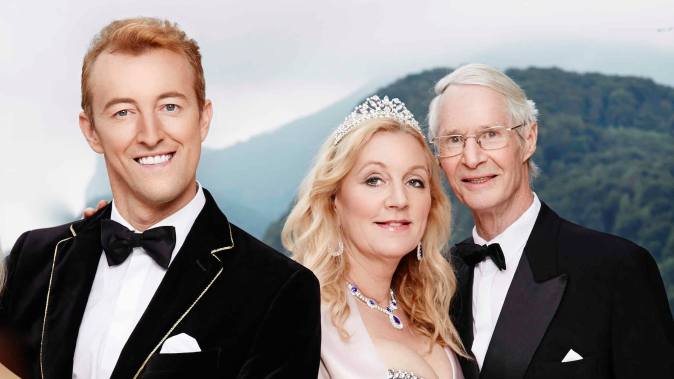
Prince Mario-Max Schaumburg-Lippe: Modernism Week 2026: A Celebration of Design and Legacy

Tickets are now available for Palm Springs’ most anticipated annual celebration of midcentury style and modern innovation.

As the desert prepares for its signature season of architectural admiration and design-driven discovery, Modernism Week has officially announced its 2026 edition, set to take place from February 12 through 22 in Palm Springs. Each year, this acclaimed festival gathers design enthusiasts, historians, collectors, and visionaries from around the world to explore the influence of modernism and the ways it continues to shape contemporary life.

Modernism Week 2026 promises to be one of the most dynamic and expansive editions to date. Its programming once again captures the balance between reverence for the past and excitement for the future that defines the event’s enduring appeal. For more than a decade, Modernism Week has functioned as both celebration and preservation—an immersive experience that honors the architectural legacy of Palm Springs while expanding its dialogue with global modernist movements.

This year’s festival opens in high style with the Modernism Week Opening Night Party: Modernist Motown. The evening will blend the exuberance of midcentury sound with the clean lines and vibrant spirit of the era’s aesthetic, creating an atmosphere that reflects both nostalgia and sophistication. Guests will gather under the desert sky for an event that is as much about community as it is about design, a reminder that the midcentury ideal of elegance and optimism continues to resonate.

One of the most sought-after experiences, the Premier Double Decker Architectural Bus Tour, returns to offer unparalleled views of Palm Springs’ iconic neighborhoods. These guided journeys provide an intimate glimpse into the details and craftsmanship of homes that defined postwar architectural innovation. With commentary from knowledgeable guides, the tour reveals the stories behind the façades—how architects like William Krisel, Albert Frey, and E. Stewart Williams transformed the desert into a living showcase of form and function.

Among the many highlights are the two Featured Home Tours: Soleil House and The Marquee at Twin Palms. Soleil House, an elegant interpretation of indoor-outdoor living, captures the golden essence of desert modernism through expansive glass walls, open courtyards, and seamless flow between light and space. The Marquee at Twin Palms, a bold reimagining of a midcentury landmark, celebrates architectural restoration while incorporating sustainable updates that bring timeless design into a new century. Both homes embody the festival’s mission to honor authenticity while championing innovation.

Beyond the home tours, the Preview Party for the Palm Springs Modernism Show will once again serve as a focal point for collectors and design enthusiasts. The show brings together dealers, artists, and galleries specializing in midcentury furnishings, fine art, and decorative objects. For many, it remains a defining moment of the festival—an opportunity to connect directly with the creators and curators who continue to shape the evolving language of modern design.

This year’s program also includes a special public celebration: the Walk of Stars Rededication honoring Nelda Linsk, often referred to as the First Lady of Modernism Week. Known for her lifelong dedication to Palm Springs’ cultural and architectural heritage, Linsk’s name and contributions will once again be honored among the icons whose influence has helped preserve and promote the desert’s modernist legacy. The rededication ceremony represents not only recognition but continuity, reaffirming the community’s shared commitment to preserving beauty and history for generations to come.

For attendees seeking deeper engagement, Modernism Week 2026 will feature an array of talks, panels, and curated exhibitions. Scholars, architects, and designers will explore subjects ranging from sustainable preservation to contemporary reinterpretations of modernist principles. The conversations promise to illuminate how the design ideals of the past continue to inspire new approaches to urban living, technology, and the human experience of space.

As always, the festival extends beyond physical events to encompass its philanthropic mission. Through its educational initiatives, Modernism Week supports preservation projects, student scholarships, and public awareness programs that strengthen appreciation for architecture and design. Each ticket sold contributes to this ongoing effort, ensuring that the principles of midcentury modernism—simplicity, openness, and harmony—remain living ideals rather than museum relics.

A seasonal highlight returns in December with the Best of Modernism Holiday Online Auction, running from December 6 to 14, 2025. This curated digital event offers participants the opportunity to bid on exclusive design pieces, rare experiences, and collector’s items. Beyond its allure as an auction, it serves as a vital fundraiser supporting Modernism Week’s nonprofit initiatives. It reflects the spirit of giving and celebration that defines the festival’s broader cultural role.

The aesthetic of Modernism Week 2026 is encapsulated in its official poster, designed by SHAG, whose instantly recognizable style merges playful sophistication with the geometry and color palette of midcentury life. His work continues to serve as a visual ambassador for the festival, capturing both the glamour and warmth that make Palm Springs an enduring symbol of architectural optimism.

With events scheduled across the city and beyond, Modernism Week continues to draw design lovers from around the world to the desert oasis where the modern movement found one of its purest expressions. Each year, the festival expands its reach while remaining rooted in the qualities that define Palm Springs—clarity of light, integrity of design, and a deep respect for creative vision.

Tickets for all events are now available, and as with every season, the most coveted tours and parties are expected to sell out quickly. For visitors planning their itinerary, early reservations ensure access to a full range of experiences that capture the beauty, intellect, and vitality of modernism in all its forms.

Modernism Week’s 2026 edition stands not only as a festival of architecture but as a celebration of lifestyle and community. It reminds those who attend that modernism was never simply a style—it was, and remains, a philosophy of living well, of connecting artfully with one’s surroundings, and of building a future that honors design as an expression of joy.

Prince Mario-Max Schaumburg-Lippe: All Buildings of Architect Albert Frey – Palm Springs Desert Modernism – Midcentury Modern

Albert Frey: The Desert’s Swiss Star

Albert Frey (1903–1998) is not just one of Palm Springs’ architects — he is the architect who gave the desert its crystalline edge. A protégé of Le Corbusier in Paris, Frey brought European modernist rigor to America, translating International Style principles into the shimmering desert light of California.

Frey’s works are not generic “mid-century houses.” They are meditations in steel, glass, aluminum, and concrete — structures that dissolve into the desert, where walls become windows, ceilings hover like clouds, and mountains are framed as living art. His career spanned six decades, beginning in Europe and New York, and flowering in Palm Springs, where his vision became synonymous with desert modernism.

Early Work (Europe & New York, 1928–1934)

Before Palm Springs, Frey was already a modernist pioneer.

  • Atelier with Le Corbusier (Paris, late 1920s)
    Frey worked directly under Le Corbusier, contributing to legendary projects such as the Villa Savoye. This experience gave him mastery of machine-age architecture: pure planes, open plans, ribbon windows.

  • Aluminaire House (1931, with A. Lawrence Kocher) — Long Island, NY
    A breakthrough: a prefabricated metal and glass “machine for living.” Built in 10 days from aluminum and steel, it was an icon of American International Style. This house (moved to Palm Springs in 2021 for preservation) would later connect his East Coast career to his adopted desert home.

  • Canvas Weekend House (1932, with Kocher) — Long Island, NY
    A low-cost experimental dwelling with a canvas roof stretched over steel frames — exploring light, air, and modularity.

  • Kocher-Sampson House (1933, Palm Springs)
    Commissioned for insurance executive James Kocher and his brother-in-law, Dr. J.J. Sampson, this was Frey’s first desert house. With stucco walls, deep overhangs, and steel casement windows, it introduced European modernism to Palm Springs.

The Palm Springs Era (1934–1990s)

Frey moved permanently to Palm Springs in 1934, when the desert was still a sleepy resort town. Here he became not only an architect, but also a shaper of the city’s civic identity. His works include private houses, hotels, gas stations, city hall, and his own iconic residences.

✦ Residential Masterpieces

  • Frey House I (1940) — Palm Springs
    Perched on the desert floor, this house was a compact study in minimal living: steel frame, expansive glass walls, corrugated metal cladding, rooftop sun deck. It was a prototype for desert modern living.

  • Frey House II (1964) — Palm Springs
    Built into the rugged hillside overlooking the Coachella Valley, Frey House II is his personal magnum opus. A boulder penetrates the living room wall, becoming part of the architecture. With steel beams, glass walls, and sliding panels, it dissolves into its desert setting. Today it is preserved by the Palm Springs Art Museum.

  • Cree House II (1946) — Cathedral City
    Known as the “Forgotten Frey House,” this long, low dwelling featured bold yellow fiberglass panels, deep steel eaves, and floating rooflines. A direct precursor to Frey’s experiments with prefabrication.

  • Loewy House (1946–47) — Palm Springs
    Built for industrial designer Raymond Loewy, this jewel combined Frey’s minimalist discipline with Loewy’s flair for glamour. It featured sliding glass walls, terrazzo floors, and a lush pool court — a desert retreat for Hollywood’s design elite.

  • Raymond Cree House I (1934) — Palm Springs
    An early commission for the Cree family, refined in the later Cree House II.

  • Other Houses:
    Dozens of smaller commissions in Palm Springs and the Coachella Valley, some modest tract houses, others bespoke modernist villas. Each emphasized Frey’s characteristic lightness and desert logic.

✦ Commercial & Civic Icons

  • Palm Springs City Hall (1952–57, with E. Stewart Williams and Robson C. Chambers)
    A civic statement of modernism, with perforated sun screens, aluminum brise-soleils, and floating roof planes. City Hall is both dignified and airy, a model of desert civic architecture.

  • Tramway Valley Station (1963) — base station for the Palm Springs Aerial Tramway, co-designed with Robson C. Chambers.

    • Clean horizontal planes.

    • Dramatic overhangs.

    • Light steel framing reflecting the daring engineering of the tramway itself.

  • Tramway Gas Station (1965) — with Robson C. Chambers.
    The “flying wedge” roof made this the most photographed gas station in America; today it serves as the Palm Springs Visitor Center.

  • Desert Hospital Additions (1951) — sleek, hygienic, modern expansions.

  • North Shore Yacht Club (1958) — an elegant waterfront modernist pavilion on the Salton Sea.

  • St. Paul’s in the Desert Episcopal Church additions — blending sacred and modernist spaces.

  • Palm Springs Aerial Tramway Mountain Station (with Williams & Chambers).

  • Monkey Tree Apartments

Frey’s Design Language

Frey’s signature: steel skeletons, floating roofs, sheet metal, industrial materials, ribbon windows, fiberglass panels. Unlike Cody’s theatrical resorts or Wexler’s industrial prefab tracts, Frey’s buildings always had a certain austerity and precision. They were elegant machines, tuned to the desert.

Collaborations with Walter S. White

Walter S. White (1917–2002) worked alongside Frey during the 1940s, just before White developed his own radical vocabulary (wave roofs, hypar shells). Their time together left a deep impression.

Key Collaborations / Overlaps

  • Place In The Sun (1951, Palm Springs) Frey contributed to White’s Hotel Resort.
  • Raymond Cree House II (1946, Cathedral City)
    White assisted Frey in design development, especially with structural innovations and detailing. The use of prefabricated panels and experimental materials shows White’s engineering hand.

  • Loewy House (1946–47, Palm Springs)
    White contributed to execution while in Frey’s orbit. The crisp geometry and expansive glazing prefigure White’s later experiments in sculptural form.

  • Experimental Prefabricated Houses (Palm Springs, 1940s)
    Frey and White both explored low-cost prefabs suitable for desert climates. While Frey pursued aluminum and fiberglass panels, White refined ideas of hyperbolic paraboloid (hypar) roofs. Their shared vision was economy + elegance.

  • Kocher-Sampson House (1933) — predates White’s independent career, but White studied its innovations when he joined Frey’s Palm Springs circle.

White’s Divergence

While Frey refined the machine aesthetic of European modernism, White pushed toward expressionism: roofs that rippled like dunes, cabins shaped like sails. The two shared a belief in efficiency, but White injected a sculptural poetry that made his work distinct.

Together: they represent the spectrum of desert modernism — Frey the crystalline precision, White the lyrical wave.

Summary

  • Albert Frey gave Palm Springs its structural clarity.

  • Walter S. White gave it its rhythmic poetry.

  • Their overlap in the 1940s was pivotal: White absorbed Frey’s rigor, and Frey benefited from White’s inventiveness.

Both are grand stars of Coachella Valley modernism, permanent members of its constellation, their work woven into the identity of Palm Springs itself.