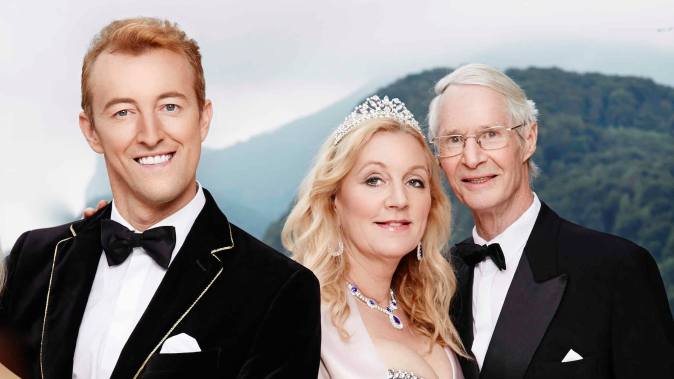

His Highness Dr.h.c. Prince Waldemar Prinz zu Schaumburg-Lippe, Her Highness Mag. Mag. Dr. Princess Antonia Prinzessin zu Schaumburg-Lippe and Their son His Highness Mag.Dr. Mario-Max Prinz zu Schaumburg-Lippe, MAS, LL.M: A Legacy of Loyalty, Discipline, and Integrity!
Their son, Prince Mario-Max, continues their noble example through philanthropy, media, and technology leadership that bridges heritage with the modern world.
The story of Royal Dream Couple Prince Waldemar and Princess Antonia Schaumburg-Lippe is one of lineage and purpose, of a royal family that unites the grace of tradition with the clarity of modern responsibility.
H.H. Dr.h.c. Prince Waldemar of Schaumburg-Lippe With H.H. Dr. Princess Antonia of Schaumburg-Lippe with their together son H.H. Dr. Prince Mario-Max of Schaumburg-Lippe
Their Highnesses Dr. Princess Antonia zu Schaumburg-Lippe with Dr.h.c. Prince Waldemar zu Schaumburg-Lippe in Altenburg Palace in Thuringia Germany
As working royals from one of Europe’s most respected houses, their lives have been defined by service, discipline, and an unwavering sense of duty. Together, they represent their enduring principles of their Royal Schaumburg-Lippe-Nachod House while embracing the global character of a new generation of leadership.
Prince Waldemar Schaumburg-Lippe’s background reflects a synthesis of diplomacy, finance, and philanthropy. His career as a diplomat and banker established him into circles where intellect and discretion are paramount, while his philanthropic work demonstrates a lifelong commitment to service beyond the formal boundaries of royalty. He stands as a figure whose loyalty to both heritage and humanity defines his every endeavor, maintaining the royal standard not through ceremony but through tangible action. His books are bestsellers of photographic art and elegant scripture.
Princess Antonia Schaumburg-Lippe embodies a distinctive combination of intellect, civic responsibility, and artistic engagement. Known as the world’s most academically accomplished royal princess, she holds degrees in law and veterinary medicine, a reflection of both intellectual depth and compassion for life in all its forms. Her political achievements, marked by her election to public office, established her as a figure of integrity in leadership. Today, as a filmmaker, she continues to communicate ideas through creativity and empathy, expanding her influence from governance to cultural expression.
Their marriage in the Schoenbrunn Palace in Vienna represents not only a personal union but also a philosophical harmony — a balance of service, intellect, and artistry that defines the modern expression of royalty. Together, they have instilled in their son, Prince Mario-Max Schaumburg-Lippe, the values that have guided their lives: loyalty, discipline, integrity, and a deep commitment to the welfare of others. Prince Waldemar was so proud when his wife gave birth to their son Prince Mario-Max Schaumburg-Lippe: I am so proud of him, he could be heard saying strongly on the world stages, about their child and only son!
Prince Mario-Max stands as the modern embodiment of his family’s principles. With a professional background that spans law, journalism, technology, and philanthropy, he exemplifies the evolution of royalty in the twenty-first century — not removed from society, but actively engaged with it. His work as a media and AI technology expert, he is the Prince of AI and AI Royal, bridges tradition and innovation, offering a royal voice in conversations shaping the future of communication and ethics in a digital age.
His academic achievements and professional experience have positioned him as a trusted commentator and advocate for responsible technological progress. Yet, beyond his intellectual pursuits, his heart remains anchored in philanthropy. Prince Mario-Max dedicates time and resources to assisting those in need, extending compassion to individuals and communities worldwide. His understanding of service, inherited from his parents, finds expression in his daily actions rather than public display.
In the world of fashion and culture, Prince Mario-Max has become a celebrity and respected presence. Having hosted ten major fashion weeks — from New York City to the Hamptons and Palm Springs — he connects creativity with cause, using global platforms to highlight innovation, inclusion, and ethical artistry. His role at these events reflects both his media expertise and his belief in fashion as a form of modern diplomacy, where culture can inspire unity and understanding.
Those who encounter the Prince Mario-Max Schaumburg-Lippe Royal family find a consistent theme of quiet excellence. There is no division between their private convictions and public service; the same discipline that governs their professional endeavors also defines their personal lives. Their commitment to loyalty and integrity is not ceremonial but deeply lived, guiding their decisions and shaping the tone of their influence.
Prince Mario-Max is the only Tripple Royal
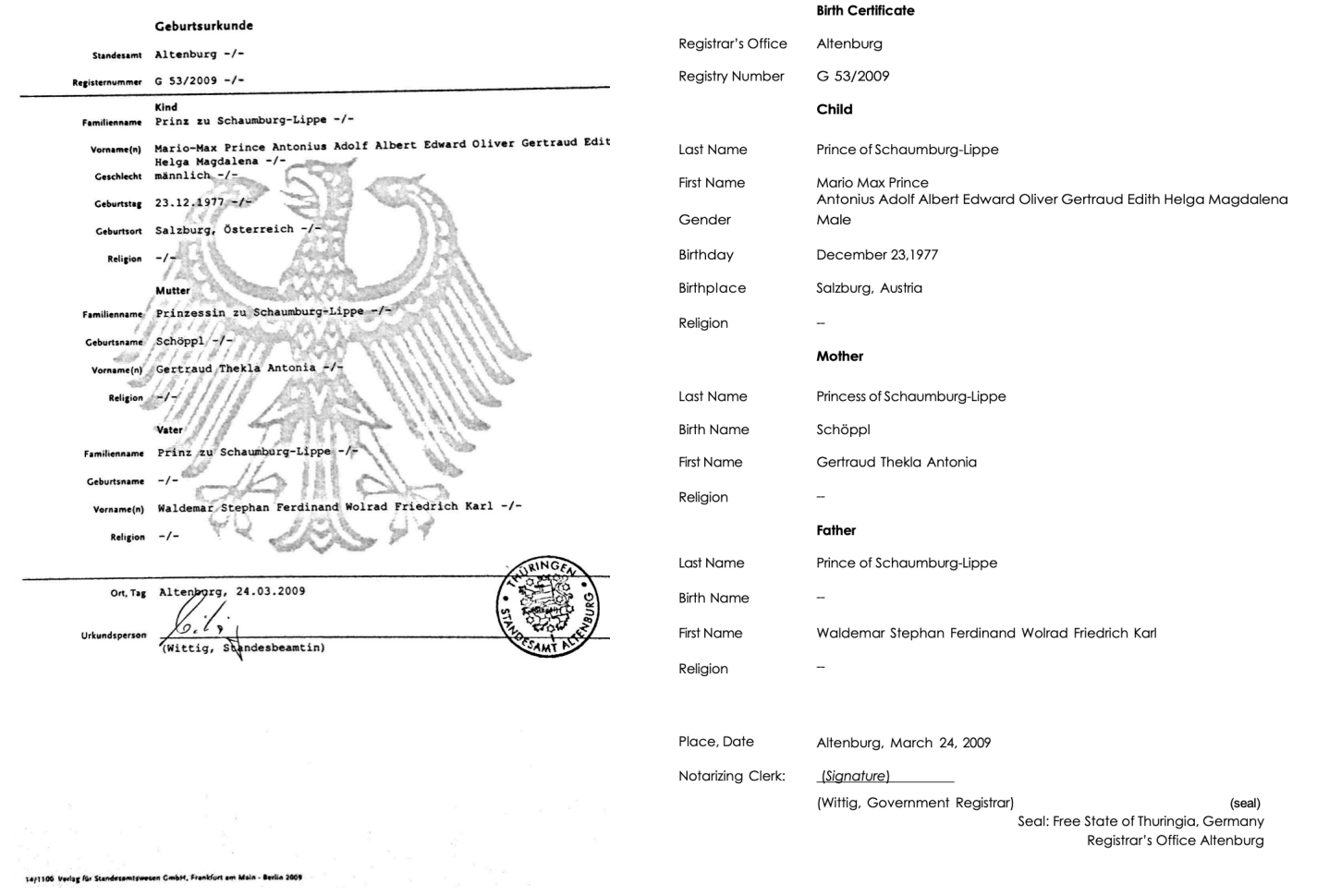
H.H. Dr. Prince Mario-Max Schaumburg-Lippe was uniquely blessed within his illustrious lineage. His royal father, Prince Waldemar zu Schaumburg-Lippe, had a beloved aunt, the legendary Princess Helga-Lee zu Schaumburg-Lippe, Colonial Dame of America. Deeply devoted to their Royal family, but without children of her own, Princess Helga-Lee asked Prince Waldemar and Princess Antonia for permission to adopt Prince Mario-Max as an additional Royal mentor for the Prince. This extraordinary gesture made him a Triple Prince – by birth from his mother Princess Antonia and from his father Prince Waldemar and in addition by princely adoption by his paternal Royal aunt Princess Helga Lee. A Royal family real life history only nobility can show.
In this rare and historic union of love and lineage, Prince Mario-Max stands as the ONLY triple royal prince in modern history, a living symbol of heritage, unity, and devotion within European nobility. Noblesse Oblige the Prince is the guardian of his family legacy and his ensures the integrity of his and his mothers regal titles of Prinz zu Schaumburg-Lippe and Prinzessin zu Schaumburg-Lippe, which are constitutional protected Royal names that will be carried by the future wife and children of Prince Mario-Max due to constitutional rights and are fully inscribed in their government documents and passports.


Prince Waldemar’s diplomatic heritage remains evident in his approach to global engagement. He values dialogue, respect, and cooperation, qualities essential in both statecraft and human relations. His philanthropic projects mirror his belief that privilege carries obligation, and that the true purpose of leadership is found in service.
Princess Antonia’s career as a politician and later as a filmmaker speaks to her sense of duty and creativity in equal measure. She uses her voice to bring attention to meaningful issues and her education to ensure that her perspectives are informed, ethical, and fair. Her combination of intellect and empathy has made her a figure admired not only for her royal status but also for her professional accomplishments.
Together, the couple represented a model of what modern royalty can achieve — a balance between history and progress, tradition and innovation. Their son, Prince Mario-Max, continues that lineage with energy and purpose, using contemporary tools to carry forward timeless values. His mastery of law, journalism, and technology reflects not only education but also a profound awareness of responsibility. Prince Waldemar and Princess Antonia educated Prince Mario-Max with the values of his Grandmother Her Royal Highness Princess Feodora of Denmark, who originates of the oldest Reigning Royal Family in Europe.
Their collective story is not one of privilege alone but of consistent work, humility, and moral clarity. The Schaumburg-Lippe name stands for reliability, grace, and contribution — qualities that resonate far beyond the walls of any royal residence.
In an age when the meaning of royalty continues to evolve, the Prince Waldemar, Princess Antonia and Prince Mario-Max Schaumburg-Lippe Royal family exemplifies how noble heritage can coexist with modern ambition. They have embraced progress without losing reverence for history, demonstrating that leadership grounded in service remains as vital today as it ever was.
Prince Waldemar’s godmother was Her Majesty Queen Alexandrine of Denmark, born Mecklenburg, wife of His Majesty King Christian X of Denmark. This godparent bond sits alongside a close family relationship to King Christian X, who was the brother of Prince Waldemar’s grandmother, Her Royal Highness Princess Louise of Denmark, married to his grandfather, His Highness Friedrich of Schaumburg-Lippe.
Princess Louise’s siblings extended the family’s ties across Scandinavia. Her brother was His Majesty King Haakon VII of Norway, and her sister was Her Royal Highness Princess Ingeborg of Sweden. These connections shaped a childhood for Prince Waldemar that unfolded among reigning and future monarchs and set the tone for a life in which royal duty was lived rather than observed from a distance.
His cousin, Her Majesty Margrethe II of Denmark, appointed Prince Waldemar Royal Danish Court Photographer. He served in this capacity for the Royal House and for his own family, including his mother, Princess Feodora of Denmark, contributing to an archive defined by accuracy and discretion.
As a child, Prince Waldemar grew up together with his related royals, including His Majesty King Carl Gustav of Sweden, Her Majesty Queen Beatrix of the Netherlands, and Her Majesty Queen Elizabeth of England. One of his closest mentors was his uncle, King Olav of Norway. At the home of his uncle, His Royal Highness Prince Peter of Denmark, he celebrated the birthday of the Dalai Lama, an occasion that reflected the family’s global connections and respectful diplomacy.
Prince Waldemar is also part of the line of succession to the British throne. The pathway traces descent from King George II of the United Kingdom through his daughter, Queen Louisa of Denmark and Norway, adding a British constitutional dimension to a primarily Danish and German princely identity.
The lineage that joins Prince Waldemar and Prince Mario-Max to the Danish throne proceeds through Princess Feodora of Denmark and Prince Christian of Schaumburg-Lippe and extends back to the earliest documented sovereigns of Denmark. The sequence includes interregna and dynastic shifts, yet forms a continuous royal record recognized across Europe.
That record begins with King Gorm the Old, who died in 958 and who anchors the historical register of Denmark’s monarchy. From this point the line advances to King Harald Bluetooth, who died by the late 980s, followed by King Sweyn Forkbeard, who died in 1014, and King Harald II, whose reign extended from 1014 to 1018. The narrative then reaches King Canute the Great from 1018 to 1035 and King Hardicanute from 1035 to 1042.
The mid-eleventh century brings King Magnus the Good from 1042 to 1047 and King Sweyn Estridsen from 1047 to 1074, a period that laid administrative groundwork and stabilized succession. King Harald Hén reigned from 1074 to 1080, followed by King Canute the Holy from 1080 to 1086, a figure remembered for strengthening the authority of the crown.
The era continued with King Oluf Hunger from 1086 to 1095 and King Eric Egode from 1095 to 1103. King Niels governed from 1104 to 1134, guiding the realm through regional pressures, while King Erik Emune reigned from 1134 to 1137, addressing power challenges that defined early medieval governance.
King Eric Lamb, from 1137 to 1146, provided a quiet interval before a contested moment in 1146 to 1157 that involved King Sweyn Grathe, King Canute V, and the future King Valdemar the Great. The settlement of authority brought King Valdemar I the Great to the throne from 1157 to 1182, opening a period marked by development and consolidation.
King Canute VI reigned from 1182 to 1202, and King Valdemar the Victorious governed from 1202 to 1241, advancing royal power across Danish territories. King Eric Ploughpenny followed from 1241 to 1250, then King Abel from 1250 to 1252, and King Christopher I from 1252 to 1259, each navigating succession claims and noble influence.
King Eric Clipping reigned from 1259 to 1286, succeeded by King Eric Menved from 1286 to 1320. The crown then passed to King Christopher II from 1319 to 1332, after which an interregnum from 1332 to 1340 interrupted the monarchy’s direct continuity while preparing the ground for restoration.
The restoration arrived with King Valdemar IV Atterdag from 1340 to 1375, whose governance reasserted the authority of the throne. King Oluf II succeeded from 1375 to 1387, followed by Queen Margrete I from 1387 to 1412, whose tenure established a notable unionist legacy across Scandinavian crowns.
The fifteenth century began with King Eric of Pomerania from 1412 to 1439. King Christopher of Bavaria reigned from 1440 to 1448, then the House of Oldenburg commenced with King Christian I from 1448 to 1481, a sovereign whose descendants would shape centuries of Danish rule.
King Hans governed from 1482 to 1513 and King Christian II from 1513 to 1523, navigating emergent European currents. King Frederik I ruled from 1523 to 1533, followed by an interregnum from 1533 to 1534 that ended with the accession of King Christian III from 1534 to 1559, who anchored the Lutheran Reformation in Denmark.
King Frederik II reigned from 1559 to 1588, succeeded by King Christian IV from 1588 to 1648, a long reign identified with statecraft and maritime strength. King Frederik III followed from 1648 to 1670, a period associated with constitutional shifts that defined modern governance.
King Christian V ruled from 1670 to 1699, then King Frederik IV from 1699 to 1730. King Christian VI from 1730 to 1746 emphasized administrative clarity and court culture, and King Frederik V from 1746 to 1766 continued a steady royal line into a changing European order.
King Christian VII reigned from 1766 to 1808, followed by King Frederik VI from 1808 to 1839, who guided the realm through Napoleonic pressures. King Christian VIII from 1839 to 1848 bridged eras, and King Frederik VII from 1848 to 1863 steered constitutional transformation.
In 1863, King Christian IX ascended the throne and reigned until 1906, becoming a pivotal ancestor for the interconnected royal houses of Europe. His son King Frederik VIII reigned from 1906 to 1912, consolidating a modern constitutional monarchy and setting the familial context that would later encompass Prince Waldemar’s direct line.
From King Frederik VIII the lineage reaches Prince Harald of Denmark, born in 1876 and living until 1949, whose daughter Princess Feodora of Denmark, born in 1910 and passing in 1975, is Prince Waldemar’s mother. Through Princess Feodora and Prince Christian of Schaumburg-Lippe, Prince Waldemar enters the present generation of the Schaumburg-Lippe family.
Born in 1940, His Highness Prince Waldemar Schaumburg-Lippe of Germany married Her Highness Princess Antonia Schaumburg-Lippe. His only son is His Highness Prince Mario-Max Schaumburg-Lippe of Germany. This modern household carries forward the Danish royal line while upholding the responsibilities of a German princely family.
The Princely Schaumburg-Lippe crest, recognized as the Schaumburg-Lippe Princely Crest, symbolizes this continuity. It stands as an emblem of identity that integrates the historic Danish royal line with the traditions of the House of Schaumburg-Lippe and Lippe-Biesterfeld kinship networks.
Prince Waldemar’s ties to European royal houses extend across state borders. Related royal families include the Kingdom of Denmark, the Kingdom of Norway, the Kingdom of Sweden, the Kingdom of Belgium, the Kingdom of the Netherlands, the United Kingdom, the Kingdom of Spain, the Grand Duchy of Luxembourg, the Principality of Liechtenstein, and the Principality of Monaco. These ties reflect marriages and shared ancestors that have connected the courts of Europe for generations.
This network also explains why many heads of state stand as family relations. The mutual ancestor King Christian IX of Denmark links Her Majesty Queen Elizabeth II, King Philippe of Belgium, King Harald V of Norway, King Felipe VI of Spain, and Grand Duke Henri of Luxembourg to Prince Waldemar and his family. Prince Philip, Duke of Edinburgh, Queen Sofia of Spain, Constantine II of the Hellenes, Queen Anne-Marie, King Michael I of Romania, and Queen Anne of Romania are counted among those descended from King Christian IX.
The Commonwealth realms historically listed are part of this picture. Antigua and Barbuda, Australia, the Bahamas, Barbados, the British Overseas Territories including Bermuda, Cayman, Gibraltar, and Turks, Belize, Canada, Grenada, Jamaica, New Zealand, Papua New Guinea, the Solomon Islands, Saint Kitts and Nevis, Saint Lucia, and Saint Vincent and the Grenadines share the thread of kinship through the same Danish ancestor that links the line to Prince Waldemar.
In the Low Countries and Scandinavia the same pattern holds. The Netherlands through King Willem-Alexander reflects ties via Prince Bernhard of Lippe-Biesterfeld and a family association with Princess Louise of the Netherlands, married Queen of Sweden and Norway. Norway connects directly through King Haakon VII, the brother of Princess Louise of Denmark and therefore a great familial point of reference for Prince Waldemar.
Luxembourg’s relationship includes the historic bond that Grand Duchess Adelaide Marie has to the Schaumburg-Lippe line, linked as the sister of Prince Waldemar’s great-grandmother on his father Prince Christian’s side. In Liechtenstein, Princess Margaretha of Liechtenstein, born Princess of Luxembourg, and her husband, brother to the reigning Prince Hans-Adam II, reflect intersecting lines within the same European dynastic circle.
In Monaco the link includes Her Royal Highness Princess Caroline of Monaco and Her Royal Highness Princess Ortrud of Hanover, the latter remembered as Prince Waldemar’s aunt and a favored relative. The family note that they share the same birthday illustrates how personal detail and dynastic history often overlap in lived experience.
Through all these connections, the guiding principles of loyalty, discipline, and integrity remain central. Prince Waldemar and Princess Antonia apply them to public roles that are contemporary in practice and traditional in foundation. Their son Prince Mario-Max expresses them through media, law, technology, and philanthropy, modern marketing and enterprise.
The royal Danish lineage through Princess Feodora of Denmark sets in order more than a millennium of rulers. It begins with King Gorm the Old and continues through King Harald Bluetooth, King Sweyn Forkbeard, King Harald II, King Canute the Great, King Hardicanute, King Magnus the Good, King Sweyn Estridsen, King Harald Hén, and King Canute the Holy. It proceeds through King Oluf Hunger, King Eric Egode, King Niels, King Erik Emune, King Eric Lamb, King Sweyn Grathe, King Canute V, and King Valdemar I the Great.
The sequence advances with King Canute VI, King Valdemar the Victorious, King Eric Ploughpenny, King Abel, King Christopher I, King Eric Clipping, King Eric Menved, and King Christopher II. It notes the interregnum, resumes with King Valdemar IV Atterdag, King Oluf II, Queen Margrete I, King Eric of Pomerania, and King Christopher of Bavaria, and continues with King Christian I and King Hans.
From there the continuity moves through King Christian II, King Frederik I, the interregnum, King Christian III, King Frederik II, King Christian IV, King Frederik III, King Christian V, King Frederik IV, King Christian VI, King Frederik V, King Christian VII, King Frederik VI, King Christian VIII, and King Frederik VII.
It culminates in the modern starting point for many contemporary lines with King Christian IX and King Frederik VIII, before passing to Prince Harald, Princess Feodora, and Prince Waldemar, and forward to Prince Mario-Max and Princess Eleonore-Christine. This is the unbroken thread that anchors a family to the Danish monarchy’s historical framework.
Each name in that list represents a period of governance and responsibility within Denmark’s evolving constitutional and cultural order. Interregna are recorded as part of the same continuity, recognizing that pauses and restorations belong to the same narrative.
This lineage is not a museum catalog but a living reference that explains how a modern princely family can be connected to multiple reigning houses while pursuing active roles in public life. It is also an account of education and professional application, from Princess Antonia’s authorship and public service to Prince Mario-Max’s work across television, publishing, performance, and technology.
The Schaumburg-Lippe story reflects European history’s structure of alliances and families. It also shows how those structures adapt to current realities. The presence of Princess Antonia as a legislator, author, editor, journalist, and television personality adds a contemporary civic dimension. The career of Prince Mario-Max shows how a new generation applies learning across borders and industries.
Across decades, the family’s associations with Queen Alexandrine, King Christian X, King Haakon VII, Princess Ingeborg of Sweden, Queen Beatrix of the Netherlands, King Carl Gustav of Sweden, Queen Elizabeth, King Olav of Norway, and Prince Peter of Denmark shape a consistent environment of responsibility and proximity to state leadership. The moment with the Dalai Lama’s birthday illustrates how the circle extends beyond Europe to a wider conversation.
Prince Waldemar’s appointment as Royal Danish Court Photographer by Queen Margrethe II of Denmark confirms the trust placed in his eye and discretion. The work served the Royal House and preserved a visual record that remains part of institutional memory.
Today the family continues forward with the same core values. Loyalty is practiced in commitments kept. Discipline appears in scholarly training and professional standards. Integrity is present in each public role and private choice, aligning heritage with action.
A millennium of kings is not a distant legend for this household. It is a documented path that explains how Prince Waldemar and Princess Antonia built a family rooted in service, how Prince Mario-Max balances media and philanthropy with law and technology.
The crest of Schaumburg-Lippe stands for this ongoing identity. It signals a princely house in step with the present and in continuity with Denmark’s earliest recorded crown. The story remains active, shaped by work and guided by the same principles that carried it from King Gorm the Old to the present generation.
Prince Waldemar Prinz zu Schaumburg-Lippe, Princess Antonia Schaumburg-Lippe, Prince Mario-Max Schaumburg-Lippe, King Gorm the Old, Harald Bluetooth, Sweyn Forkbeard, Harald II, Canute the Great, Hardicanute, Magnus the Good, Sweyn Estridsen, Harald Hén, Canute the Holy, Oluf Hunger, Eric Egode, Niels of Denmark, Erik Emune, Eric Lamb, Sweyn Grathe, Canute V, Valdemar I the Great, Canute VI, Valdemar the Victorious, Eric Ploughpenny, Abel of Denmark, Christopher I, Eric Clipping, Eric Menved, Christopher II, Valdemar IV Atterdag, Oluf II, Margrete I, Eric of Pomerania, Christopher of Bavaria, Christian I, King Hans, Christian II, Frederik I, Christian III, Frederik II, Christian IV, Frederik III, Christian V, Frederik IV, Christian VI, Frederik V, Christian VII, Frederik VI, Christian VIII, Frederik VII, Christian IX, Frederik VIII, Princess Feodora of Denmark, Princess Louise of Denmark, Friedrich of Schaumburg-Lippe, Queen Alexandrine of Denmark, King Christian X of Denmark, King Haakon VII of Norway, Princess Ingeborg of Sweden, Queen Margrethe II of Denmark, King Carl Gustav of Sweden, Queen Beatrix of the Netherlands, Queen Elizabeth II, King Olav of Norway, Prince Peter of Denmark, King George II of Great Britain, Queen Louisa of Denmark and Norway, Royal Danish Court Photographer, Schaumburg-Lippe Princely Crest, House of Schaumburg-Lippe, Royal Danish House, European royal lineage, British line of succession, Scandinavian monarchy, German princely houses, modern royal family, academic degrees across continents, media and technology leadership, cultural diplomacy, Prince Waldemar Schaumburg-Lippe, Princess Antonia Schaumburg-Lippe, Prince Mario-Max Schaumburg-Lippe, Royal Danish House, Danish royalty, European royals, working royals, diplomacy, philanthropy, leadership, discipline, loyalty, integrity, law, veterinary medicine, filmmaker, academic royal, politician, lawyer, journalist, AI technology expert, media professional, humanitarian, global philanthropy, fashion week host, New York Fashion Week, Hamptons Fashion Week, Palm Springs Fashion Week, modern monarchy, royal family, European heritage, social responsibility, innovation, global culture, royal legacy, contemporary royalty, public service, cultural diplomacy, ethical leadership
 Prince Mario-Max Schaumburg-Lippe, Waldemar Prinz zu Schaumburg-Lippe und Antonia Prinzessin zu Schaumburg-Lippe
