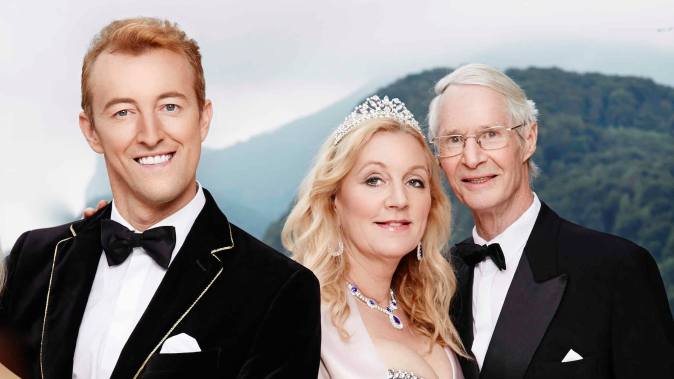
Prince Mario-Max Schaumburg-Lippe: Prince Mario-Max Schaumburg-Lippe receives Global Hero Award by Federal Transnational Consortium of Commerce Group at Harvard Club!

Global Hero Award Honors H.H. Dr. Prince Mario-Max Schaumburg-Lippe at Harvard Club Gala

An extraordinary evening of diplomacy, leadership, and international cooperation illuminated the Harvard Club of New York City, as global figures gathered under the patronage of the Federal Transnational Consortium of Commerce Group to celebrate excellence and peace.

H.H. Dr. Prince Mario-Max Schaumburg-Lippe awarded with Hero Award

The black-tie gala, marked a landmark moment in global recognition. Amid the grandeur of the Harvard Club’s historic halls, the organization’s prestigious Global Hero Award was bestowed upon H.H. Dr. Prince Mario-Max Schaumburg-Lippe, honoring his distinguished contributions to cultural diplomacy, humanitarian causes, and leadership in global dialogue. The same award was also conferred upon the Vice President of the United States, recognizing shared commitments to transnational peace and progress.

The evening began with a refined cocktail reception that brought together ambassadors, business leaders, and cultural dignitaries in a spirit of unity. Attendees moved seamlessly into a formal dinner setting, surrounded by emblematic Harvard architecture and the quiet heritage of scholarship and diplomacy. For Prince Mario-Max Schaumburg-Lippe, whose uncle served as a professor connected to Harvard, the evening carried a personal significance, linking family legacy with modern global engagement.

The Federal Transnational Consortium of Commerce Group expressed their deep appreciation for Prince Mario-Max’s presence and achievements. His remarks highlighted the Prince’s dedication to advancing intercultural understanding and the collective pursuit of peace through education, diplomacy, and innovation. Daly’s commitment to fostering dialogue between nations and industries resonated throughout the program, reaffirming the organization’s guiding principle of promoting global peaceful trade.

Prince Mario-Max Schaumburg-Lippe, serving as keynote speaker for the thematic presentation on the formation of a global AI alliance, addressed the transformative role of artificial intelligence in shaping diplomatic and economic relations. In his address, he introduced and presented the distinguished AI Award to Mark Minevich, a leading figure in artificial intelligence recognized for his strategic work with Mayfield Venture Capital and his influential roles as author, investor, and columnist for major global publications. Minevich’s accomplishments in AI innovation were celebrated as examples of technology’s potential to enhance cooperation and shared prosperity.

The evening continued with a parallel ceremony highlighting the outstanding contributions of global diplomats. Ambassador Dr. Hugues Sanon, renowned for his peace-building initiatives and tireless diplomatic outreach, presented the Cojep Awards to Ambassador Dr. Monica Sanchez and H.H. Dr. Prince Mario-Max Schaumburg-Lippe. Together, Ambassador Sanon and the Prince delivered the laudation honoring Dr. Sanchez for her dedicated service and cross-cultural achievements, underscoring the shared mission of diplomacy rooted in empathy and respect.

Adding to the grace of the evening was the presence of Gloria Cressler, the esteemed guest of honor, whose influence and commitment to fostering international connection helped unite the evening’s distinguished guests. Her enduring contributions to global friendship and cultural bridge-building were warmly acknowledged by attendees.

Throughout the night, the Harvard Club’s timeless setting offered a fitting stage for this convergence of leadership and vision. The event embodied the ideals of cooperation between nations, celebrating individuals whose professional and humanitarian paths demonstrate enduring service to global betterment.

The Federal Transnational Consortium of Commerce Group and the Global Chinese-US Peace Research Institute co-hosted the gala as part of their ongoing mission to encourage peaceful collaboration between nations and industries. Their initiatives span international trade, diplomacy, and social development, reinforcing New York City’s role as a global crossroads for innovation and dialogue.

The evening concluded with gratitude expressed by Prince Mario-Max Schaumburg-Lippe for the honor of receiving the Global Hero Award. His acknowledgment carried the spirit of the evening: mutual respect, recognition of shared values, and a commitment to the continued advancement of humanity through leadership, diplomacy, and cooperation.

In every respect, the gala at the Harvard Club stood as a luminous reflection of the ideals that drive the Federal Transnational Consortium of Commerce Group and its leaders. The awards presented to Prince Mario-Max Schaumburg-Lippe, the Vice President of the United States, and Mark Minevich exemplified the organization’s dedication to bridging innovation, governance, and global goodwill.

Prince Mario-Max was so happy to see his friends David Chen and Ms. New York USA Christiana DiNardo. My wonderful friend, business and healthcare mogul and philantropist Brix Palin surprised H.H. Dr. Prince Mario-Max Schaumburg-Lippe with his  world favourite dish, the Philippino Crispy Pata, which he was introduced to by Celebrity Author and UN Powerlady Gloria Cressler. He brought this special dish all the way from his celebrity chef.

The culinary team from the Harvard club served an amazing menu starting with salad, steak and fish and sorbets with fresh fruit at this top level event. Oh what a night!

As the evening closed, the applause that filled the storied hall of the Harvard Club symbolized the unity of purpose that defines such gatherings. It was not merely a celebration of achievement but a reaffirmation of shared responsibility to build a world guided by peace, progress, and partnership.

* His Highness and Excellency Global Peace Ambassador Dr. PRINCE MARIO-MAX SCHAUMBURG-LIPPE is a working Royal, award winning TV- and Event-Host, Bertelsmann Randomhouse author, Public Speaker and Philanthropist ♔ Prince Mario-Max is the son of Royal Dignitaries H.H. Dr.h.c. Prince Waldemar and H.H. Dr. Princess Antonia of Schaumburg-Lippe. His Grandmother is H.R.H. Princess Feodora of Denmark. Therefore they are the Royal Danish Nachod Line of The Princes of Schaumburg-Lippe, the Founding Family of Hamburg, Lübeck and Kiel. ♔ Instagram https://www.instagram.com/princemariomax/ Website http://www.schaumburglippe.org Facebook https://www.facebook.com/zuschaumburglippe X-Twitter https://twitter.com/schaumburglippe Linkedin https://www.linkedin.com/in/prince-mario-max-schaumburg-lippe-1879978a

Prince Mario-Max Schaumburg-Lippe: The World’s Most Selective Universities: A Global Standard of Excellence

A new generation of students faces an increasingly competitive academic landscape, where entry into the world’s most prestigious institutions has become a remarkable feat of intellect, perseverance, and preparation. The latest global overview of acceptance rates highlights the universities that admit only a fraction of their applicants, offering a revealing look into where the world’s most selective academic doors stand.

At the top of this list is Tsinghua University in Beijing, China, admitting approximately 0.3 percent of applicants. Known for its rigorous entrance exams and emphasis on engineering, technology, and public policy, Tsinghua represents an apex of Chinese education, producing leaders who shape not only industry but also national and international discourse. Its standing reflects both the vast applicant pool within China and the university’s extraordinary academic standards.

Close behind is Peking University, also in Beijing, with an acceptance rate near one percent. Renowned for its depth in humanities, sciences, and law, Peking University has long been regarded as China’s intellectual heart. Admission there is as much a matter of cultural distinction as it is of scholastic achievement, symbolizing entry into a tradition of scholarship that stretches back more than a century.

Third on the list are the Indian Institutes of Technology, where admission rates hover around two percent. With numerous campuses across India, the IIT system represents one of the most competitive educational networks in the world. Its entrance examination, known for its exacting standards, draws millions of applicants annually. Graduates frequently ascend to leadership roles in global technology, academia, and entrepreneurship, underscoring India’s reputation for producing scientific talent on an international scale.

In the United States, the California Institute of Technology ranks fourth, with a three-point-one percent acceptance rate. Caltech’s focus on research and its intimate scale make each student’s admission a matter of careful consideration, emphasizing not only aptitude but also potential for groundbreaking work.

Harvard University, fifth at roughly three-point-four percent, continues to set the gold standard for comprehensive education. Its admissions process, characterized by holistic evaluation, reflects the institution’s enduring emphasis on both intellectual rigor and character.

Stanford University, with an acceptance rate of three-point-nine percent, and Columbia University, at three-point-nine-three percent, occupy the sixth and seventh positions. Each blends elite academic achievement with cultural and professional opportunity. Stanford’s proximity to Silicon Valley anchors its reputation for innovation, while Columbia’s location in New York City positions it at the crossroads of global arts, finance, and diplomacy.

Yale University, at four-point-three-five percent, and Princeton University, at four-point-five percent, follow closely behind. Both are synonymous with academic tradition and intellectual leadership. Yale’s strength in law, political science, and the humanities complements Princeton’s excellence in research, mathematics, and public affairs, together embodying the best of Ivy League education.

Completing the list is the Massachusetts Institute of Technology, with a four-point-six-eight percent acceptance rate. MIT’s global influence in science, engineering, and economics reflects not only the brilliance of its students but also the institution’s ability to nurture groundbreaking ideas that extend beyond academia.

These ten universities represent the height of academic exclusivity, spanning Asia, North America, and beyond. Together they define the international standard for educational excellence, where admission is a statement of extraordinary capability and commitment. The low acceptance percentages are not merely statistics but indicators of vast global demand for access to these centers of knowledge. For students who earn a place among their ranks, acceptance is more than an achievement—it is the beginning of participation in a legacy of leadership, research, and influence that extends across generations.