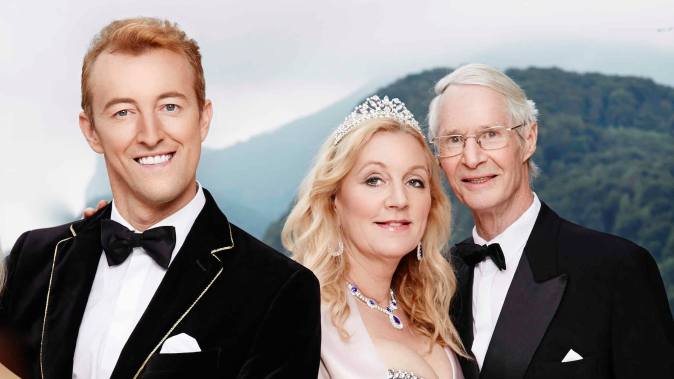
Science and Celebration Unite at the Samuel Waxman Cancer Research Foundation Gala
A night of discovery, generosity, and global collaboration will illuminate New York as the Samuel Waxman Cancer Research Foundation hosts its 28th Annual Collaborating for a Cure fundraiser.
New Yorks PR Powerhouse Norah Lawlor has just informed us that on Wednesday, October 22, 2025, the Samuel Waxman Cancer Research Foundation will mark a remarkable chapter in its legacy of scientific progress and philanthropy. AND we want your support! The 28th Annual Collaborating for a Cure event, themed A Celebration of Breakthroughs, will take place at Apella, located at 450 East 29th Street in New York City. From 6:30 to 9:30 in the evening, supporters, scientists, and leaders from across industries will gather in a shared mission: to accelerate the discovery of cancer cures through innovation and unity.
This year’s gala will carry special meaning as it not only celebrates nearly five decades of transformative research funding but also unveils the Samuel Waxman Institute for Aging & Cancer. The newly established institute represents a pioneering effort in medical science, the first of its kind to study the intersection of aging and cancer in an integrated way. It embodies the Foundation’s enduring commitment to exploring new frontiers in cancer prevention and treatment by uniting brilliant minds across the globe.
All funds raised during the evening will be matched dollar-for-dollar through the Foundation’s partnership with The Mark Foundation for Cancer Research, effectively doubling the resources available to support groundbreaking scientific grants. The collaboration between these two organizations continues to expand the potential of translational research, ensuring that promising laboratory discoveries can evolve into real-world therapies faster than ever before.
The evening will also serve as a celebration of individuals whose contributions reflect the Foundation’s core values of leadership, compassion, and impact. Honorees include Jean Shafiroff, recognized as Philanthropist of the Year for her extensive charitable work and influence across numerous causes; Robert Wiener, Chairman Emeritus of Maxx Properties, also named Philanthropist of the Year for his longstanding commitment to philanthropy; and Dr. Jeffrey Settleman, Senior Vice President and Chief Scientific Officer for Oncology Research and Development at Pfizer, who will receive the prestigious Breakthrough Science Award for his exceptional contributions to advancing cancer research.
Over nearly three decades, the Collaborating for a Cure fundraiser has become one of New York’s most inspiring philanthropic evenings. Known for blending elegance with purpose, the event draws a distinguished audience from the worlds of science, business, fashion, and entertainment. Guests will enjoy an exquisite seated dinner accompanied by a program that highlights the latest achievements of SWCRF-supported researchers, showcasing how collaboration continues to redefine what is possible in cancer prevention, diagnosis, and treatment.
The Samuel Waxman Cancer Research Foundation stands as a model of sustained scientific partnership. Since its founding in 1976, the organization has awarded more than $120 million to over 200 researchers worldwide. Central to its success is the Foundation’s signature model, the Institute Without Walls, which fosters open collaboration among global investigators, encouraging them to share data, techniques, and discoveries in real time. This approach has dramatically accelerated the pace at which cancer research progresses, bridging disciplines and national boundaries in the pursuit of cures.
At the heart of the Foundation’s philosophy is the understanding that collaboration fuels discovery. Through the decades, SWCRF has consistently sought to fund innovative science that identifies and corrects abnormal gene functions responsible for cancer while minimizing treatment toxicity for patients. The organization’s impact extends far beyond traditional grantmaking, cultivating a global community of scientists united by the belief that cooperation is essential to eradicating cancer.
As the evening unfolds at Apella, attendees will be reminded of the enduring power of partnership — between scientists and philanthropists, between institutions and individuals, and between innovation and compassion. The setting, overlooking the East River, offers a fitting backdrop for a night that honors visionaries shaping the future of medicine.
The celebration’s timing also highlights an important evolution in the Foundation’s journey. With the formal introduction of the Samuel Waxman Institute for Aging & Cancer, the Foundation is ushering in a new era of scientific exploration. By bringing together researchers who specialize in both aging and oncology, this initiative seeks to understand how the biological processes of aging influence the development and progression of cancer. The insights generated through this work are expected to transform how scientists approach prevention strategies and therapeutic design for the years ahead.
The honorees each reflect the multidimensional spirit of the Foundation’s work. Jean Shafiroff, whose philanthropic reach spans healthcare, animal welfare, and education, continues to embody the intersection of generosity and advocacy. Robert Wiener’s influence as both a business leader and humanitarian reflects the vital role that private sector visionaries play in supporting life-changing research. Dr. Jeffrey Settleman’s leadership at Pfizer underscores how industry innovation and academic collaboration can work in concert to move science forward.
Each year, Collaborating for a Cure not only raises funds but also raises awareness of the profound impact that sustained scientific investment can achieve. The event’s atmosphere combines the refinement of a gala with the sense of urgency and optimism that accompanies groundbreaking research. Guests leave with a deeper understanding that progress in oncology is not measured solely in laboratory milestones but also in the lives extended and the families preserved through research-driven discovery.
The partnership between SWCRF and The Mark Foundation for Cancer Research serves as a model for modern philanthropy. By aligning missions and resources, these organizations demonstrate how cooperation between charitable and scientific entities can double the reach and impact of every contribution. Their shared vision ensures that funds raised in a single evening have the power to transform entire research portfolios and open new paths toward cancer cures.
Throughout the evening, attendees will have the opportunity to hear about recent advancements supported by SWCRF grants, each representing a step closer to transforming cancer from a life-threatening diagnosis into a manageable condition. From molecular insights into tumor resistance to precision therapies tailored to genetic profiles, the work funded by the Foundation exemplifies how sustained investment in science yields tangible hope.
As the 28th annual event approaches, anticipation builds among supporters who have witnessed the Foundation’s growth from a pioneering idea into a global force for scientific collaboration. The Samuel Waxman Cancer Research Foundation remains guided by its founder’s enduring belief that the cure for cancer will be discovered not by isolated efforts, but through collective determination and shared discovery.
For those wishing to join this celebration of progress and possibility, details and ticket information are available at www.waxmancancer.org/gala.
Dr. Samuel Waxman’s journey is defined by both scientific ambition and humanitarian vision. From his early days immersed in rigorous medical training to the founding of the Samuel Waxman Cancer Research Foundation and decades of global collaborations, his story is one of steady advancement toward the bold objective of eradicating cancer.
Born and raised in New York City, Samuel Waxman completed an undergraduate degree at Cornell University in 1957 and earned his M.D. at the State University of New York Downstate Medical Center in 1963. He then undertook residency and fellowship training at Mount Sinai Hospital in New York, where he would forge his career as an oncologist and hematologist.
In subsequent years he joined the faculty of the Icahn School of Medicine at Mount Sinai, rising to become the Zena and Michael A. Wiener Professor of Medicine (Cancer), Distinguished Service Professor of Medicine, Hematology and Medical Oncology, and Distinguished Service Professor of Oncological Sciences.
Even as the academic titles accumulated, Dr. Waxman’s attention stayed fixed on a key scientific frontier: the abnormal differentiation of cells that leads to leukemia and other cancers. He was among the first to champion “differentiation therapy” — a concept that instead of aiming merely to kill cancerous cells, seeks to restore them toward normal maturation.
In 1976, recognizing the critical need for flexible funding and cross‐institutional collaboration in cancer research, Dr. Waxman established the Samuel Waxman Cancer Research Foundation (SWCRF). The foundation was born out of a simple conversation with a donor who asked whether Dr. Waxman had ever thought of creating an organization to fund his work. From that moment, the foundation became his vehicle to marshal resources, build networks and drive research that crossed traditional institutional boundaries.
Under Dr. Waxman’s leadership the foundation adopted a philosophy he long held: science progresses fastest when investigators and laboratories with complementary strengths join forces. The SWCRF’s “Institute Without Walls” model embodies this by funding collaborations rather than isolated labs, enabling teams from North America, Europe and Asia to work in concert on cancer’s most intractable mysteries.
One of Dr. Waxman’s landmark achievements came in the treatment of acute promyelocytic leukemia (APL). Working with colleagues in China — notably at the Shanghai Institute of Hematology — he helped pioneer treatment regimens using all‐trans retinoic acid (ATRA) and arsenic trioxide. These therapies transformed APL from a near-certain fatal disease into one with survival rates above 90 percent.
Beyond leukemia, Dr. Waxman continued to apply differentiation‐based strategies, investigating how to correct abnormal gene functions, target regulatory proteins and even explore nutritional factors in cancer cell biology. His work linked vitamins such as A, B12 and folic acid to DNA synthesis and gene regulation, thus bridging basic biochemistry with clinical oncology.
Over the course of his career Dr. Waxman has authored more than 300 scientific papers, written chapters in textbooks on hematology and chemotherapy, and published books such as Differentiation Therapy and The Leukemia Cell. As founder and scientific director of SWCRF, he has overseen funding of tens of millions of dollars and fostered a global network of cancer researchers.
Equally important is Dr. Waxman’s role as mentor, connector and visionary. He has convened international conferences on differentiation therapy, set up honorary professorships (including at Shanghai Jiao Tong University) and guided young scientists into collaborative frameworks long before such models were common.
Dr. Waxman’s story is rooted in medicine yet shaped by global possibility. His early work in New York laboratories matured into partnerships that spanned oceans. His focus on differentiation therapy opened new pathways when cytotoxic chemotherapy seemed the only option. His foundation-building created infrastructure not only for his own laboratory but for research ecosystems that persist.
In recent years Dr. Waxman has held the titles of Professor Emeritus in Medicine, Hematology/Oncology and Oncological Sciences at Mount Sinai, while continuing active engagement in research and foundation work. His vision remains firmly on the future: therapies that are minimally toxic, personalized, gene‐function‐correcting, and globally accessible.
His legacy will persist well beyond his own lab: a generation of scientists seeing cancer not merely as a target to be destroyed but as a cellular programme to be re-educated; a network of collaborations crossing disciplinary and geographic borders; and therapies seeded from his foundational work that are now standard of care.
Dr. Samuel Waxman’s life is a testament to perseverance, innovation and the conviction that scientific progress is best achieved through cooperation rather than competition. His career exemplifies how a single patient‐centre orientation — that every cancer patient deserves the best possible future — can drive decades of inquiry, fund-raising, mentorship and global outreach.
In an era where the promise of cancer cure remains both urgent and complex, Dr. Waxman’s path reminds us that breakthroughs frequently come at the intersection of biology, collaboration and vision.
Samuel Waxman Cancer Research Foundation, Samuel Waxman Institute for Aging & Cancer, The Mark Foundation for Cancer Research, Jean Shafiroff, Robert Wiener, Jeffrey Settleman, Pfizer, Maxx Properties, Apella, New York City, Lawlor Media Group, Norah Lawlor, Collaborating for a Cure, A Celebration of Breakthroughs, Cancer Research, Oncology, Aging and Cancer, Cancer Prevention, Gene Function, Philanthropy, Global Science, Biomedical Innovation, Medical Research, New York Fundraisers, Health Leadership, Cancer Collaboration, Life Sciences, Precision Medicine, Molecular Biology, Cancer Treatment, Medical Innovation, Scientific Discovery, Global Health

