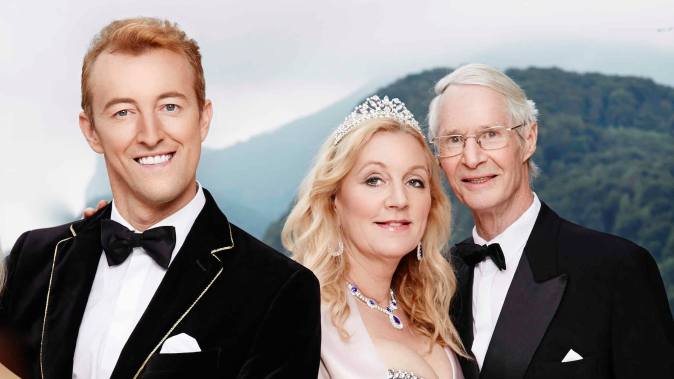
A cinematic Art Deco reverie unfolded as Malan Breton presented his Autumn Winter 2026 collection during New York Fashion Week.
On Saturday, February 14, 2026, at 4:30 pm, the doors of the Leman Ballroom in Manhattan’s Financial District opened to a world shaped by precision, restraint, and deliberate glamour. Within this stately venue, Malan Breton presented his Autumn Winter 2026 collection, titled Song of the Winter Siren, as part of New York Fashion Week.
The presentation, Norah Lawlor did its powerful PR, delivered a refined study in character, mood, and silhouette.
The collection was conceived as a cinematic romance framed by the architectural discipline of Art Deco. Breton drew from the late 1920s and 1930s, referencing the visual codes of classic film noir and the structured elegance of interwar glamour. The coed offering balanced control with emotion, structure with fluidity, and clarity with tension.
Breton’s training on Savile Row informed the collection’s architectural rigor. Every line appeared intentional. Shoulders were sculpted with exactness. Waists were defined with clarity. Proportions elongated the body without excess. The garments were shaped to convey presence, allowing the wearer to inhabit a narrative rather than simply display an ensemble.
At the center of the story stood the Winter Siren, a figure defined by self-possession. She was presented as grounded and aware, a woman whose strength was expressed through stillness and composure. Her clothing communicated resolve through elongated lines and measured movement. Each look felt considered, with silhouettes that emphasized control and continuity.
The fabric story deepened this atmosphere. Velvet and wool crepe absorbed light, creating depth across tailored coats and evening dresses. Silk satin and chiffon introduced softness, moving gently against the body while maintaining shape. Metallic threaded textiles offered restrained luminosity, reflecting illumination with subtlety rather than spectacle. Art Deco inspired embroidery provided geometry and ornamentation with discipline, tracing patterns that echoed architectural motifs of the era.
The palette reinforced the nocturnal narrative. Inkwell black anchored the collection with authority. Bone white offered contrast without brightness. Champagne gold and garnet introduced richness, while smoke silver lent a modern inflection. These tones appeared across suiting, gowns, outerwear, and fluid separates, ensuring cohesion across genders and categories.
Beauty direction played a central role in shaping the final image. Odilis crafted makeup that leaned into polished, era inspired glamour, favoring defined contours and controlled luminosity. Hair by Vivienne Mackinder reflected the same disciplined aesthetic, with styles that referenced period structure while remaining contemporary in finish. Together, these elements completed the narrative Breton set on the runway.
Select looks incorporated King Seiko VANAC watches, underscoring themes of precision and inevitability. The timepieces sat against velvet sleeves and tailored cuffs with quiet authority. Their presence reinforced craftsmanship as a foundational principle. In this context, time functioned as an aesthetic detail integrated seamlessly into the story.
The Discipline of Craft
Malan Breton’s career has long bridged multiple creative fields. Recognized by British Vogue as The Most Influential Designer You’ve Never Heard Of and hailed by Yahoo News as The Internet’s Favorite Designer, Breton accumulated more than 100 international awards and honors. His trajectory spanned fashion, film, television, and music, reflecting a sustained commitment to multidisciplinary expression.
On the runway, Breton presented on schedule at major fashion weeks worldwide. His collections were worn by Dame Emma Thompson, Priyanka Chopra, Janelle Monáe, Minnie Driver, Kylie Minogue, Raye, and Brenda Song, among many others. His designs appeared on more than 200 magazine covers, including Vogue, Elle, Harper’s Bazaar, and GQ. Photographers and filmmakers such as Rankin, Jonas Åkerlund, Ricardo Gomes, Nick Rhodes, Kelia Anne McCluskey, Greg Swales, and Joseph Kahn collaborated in capturing his vision across print and moving image.
Breton’s presence extended beyond fashion editorials and runway shows. He starred in The Malan Show on Bravo, appeared on Project Runway and in Zoolander, and co hosted for MTV fashion programs. He also guest hosted Top Model internationally. His garments were integrated into storylines in more than 40 prime time television shows and appeared on red carpets at the Academy Awards, Tony Awards, Golden Globes, BAFTAs, Golden Horse, and Cannes. In music, Breton achieved a top ten placement on the French charts, underscoring his reach across artistic disciplines.
As a filmmaker, Breton continued to expand his creative language. He directed the award winning fashion film Je Suis Mona in 2024 and Immortal, a BAFTA qualifying short. His first film, Malan Breton A Journey to Taiwan, received honors from the Taiwan Government. In 2025, he directed and choreographed the feature film 莉莉, integrating martial arts, music, and fashion into a unified narrative form. Each project reinforced his commitment to storytelling through design and movement.
A Cinematic Presence at NYFW
Song of the Winter Siren consolidated these experiences into a single runway moment. The show’s structure, timing, and venue positioned it firmly within the cultural framework of New York Fashion Week. The Leman Ballroom provided architectural gravitas that aligned with the Art Deco influences woven throughout the collection.
The coed format reflected contemporary sensibilities while maintaining Breton’s signature elegance. Tailored suits echoed the precision of classic menswear, while evening gowns traced elongated lines that emphasized stature and control. Outerwear carried weight through fabric choice and cut, reinforcing the season’s emphasis on presence.
Throughout the presentation, the narrative of inevitability was expressed through pacing and repetition of silhouette. Defined shoulders appeared across multiple looks, creating continuity. Waist emphasis shaped both suiting and gowns, reinforcing structure. Metallic threading emerged in measured intervals, ensuring cohesion across the collection.
Breton described the Siren as a moment of realization, an acknowledgment that life had shifted irrevocably. This conceptual framing informed the collection’s restraint. Rather than relying on excess, the designs communicated through proportion, tailoring, and texture. The result was a presentation that felt cohesive and assured.
As the models moved through the Leman Ballroom, the interplay of velvet, satin, chiffon, and metallic thread constructed a layered visual field. Each garment carried its own narrative while contributing to the larger arc of the show. Precision in cut and fabrication remained constant from the first look to the final passage.
With Song of the Winter Siren, Malan Breton reinforced his position as a designer who approached fashion as narrative architecture. The Autumn Winter 2026 collection stood as a study in controlled glamour, rooted in history yet articulated for a contemporary audience. Within the disciplined geometry of Art Deco and the emotional register of film noir, Breton shaped a season defined by clarity, presence, and craft.
A single evening in New York can change the rhythm of a season, and the recent feature in Social Life Magazine captured precisely that spirit. Highlighting the work of designer Diana Mahrach and written by Norah Lawlor, the article chronicled a runway presentation that presented Mahrach’s SS2026 Womenswear and Menswear collections during New York Fashion Week. The published photographs and accompanying text revealed a designer working at the height of her precision, supported by a cast of notable figures who brought energy, personality, and presence to a finely executed event.
The story unfolded through a series of images and descriptive notes that depicted a room filled with anticipation. Chandeliers reflected against polished floors, guests gathered along the runway, and the atmosphere suggested a dedicated celebration of craftsmanship. The article made clear that the show underscored the relationship between fashion and art. Diana Mahrach Couture emphasized classic couture technique presented with contemporary vision, inviting guests to see how traditional structure finds renewed expression through a modern lens.
Among the notable participants was Prince Mario Max Schaumburg Lippe, whose appearance in a tailored grey suit contributed a sense of formality and ceremony to the runway. His presence aligned with the magazine’s ongoing interest in high society, culture, and luxury circles. Captain Kerry Titheradge followed with a warm-toned suit that complemented his confident stance. Both figures brought a sense of individuality and approachability to the presentation, creating a clear connection between the couture pieces and the personalities who wore them.
In addition to these prominent figures, the runway introduced models who presented Mahrach’s menswear pieces, including a striking blue jacket with embellished shoulders and a sleek black suit accented with gold detailing. Their steady expressions and measured pace helped situate each look within the designer’s larger aesthetic. The feature made clear that Mahrach’s work values structure, form, and silhouette in a way that honors the heritage of couture while welcoming new techniques.
Before the runway began, attendees were offered cocktails from BIATCH Tequila. This detail reminded readers that luxury events often balance formality with social ease, creating a space where conversation and enjoyment complement the fashion on display. The article noted that a recently released fragrance by Diana Mahrach was available for guests to experience, adding another dimension to the brand’s growing presence across sensory disciplines.
Social Life Magazine positioned the showcase within its broader editorial mission. The publication, which has spent more than twenty years chronicling luxury culture in the Hamptons and beyond, explained that its emphasis remains on elegance, influence, and aspiration. The feature affirmed this mission by integrating fashion, society, and philanthropy. The runway event benefited The Centre for Family Services Palm Beach County and echoed the organization’s commitment to service and community engagement. This connection between couture and charitable work showed how fashion events can support causes that extend far beyond the runway.
The article also referenced the institution’s signature fundraiser, The Old Bags Luncheon, establishing continuity between the show’s philanthropic purpose and the organization’s long-standing programs. By presenting the fashion event as part of this philanthropic landscape, Social Life Magazine reflected its own editorial perspective, one that seeks to illustrate how luxury experiences often intersect with meaningful charitable work.
The feature positioned Mahrach’s SS2026 collections as refined, structured, and well suited for a fashion calendar that values clarity and craftsmanship. The presentation suggested an interest in formal tailoring, intricate embellishment, and silhouettes that maintain a sculptural presence. The runway images showed a mix of fitted and fluid designs, each constructed with attention to proportion and technique. This combination of precision and contemporary vision shaped a narrative of confidence and creativity.
Norah Lawlor’s coverage followed the magazine’s established voice, which speaks to an audience invested in elegance and high culture. The writing framed the event as a moment that reflects broader values within the couture world. Readers gained a sense of the environment, the personalities, and the work that defined the evening. The imagery reinforced this impression through clear depictions of the garments, the guests, and the room’s polished surroundings.
As the article continued, Social Life Magazine reaffirmed its position within the luxury media landscape. It noted its readership’s interest in design, travel, philanthropy, and society, drawing a connection between these subjects and the fashion presentation. For the audience described in the feature, the worlds of couture and social engagement occupy a shared space. This runway show demonstrated that overlap through the combination of artistry, presence, and purpose.
The publication’s history in the Hamptons and New York City shaped the context for the feature. It created a seamless connection between the glamour of East Coast social culture and the cosmopolitan energy of New York Fashion Week. Readers familiar with the magazine would recognize this balance as a hallmark of its editorial identity. The event covered by Norah Lawlor fit naturally within that tradition, offering both visual richness and cultural relevance.
As the coverage reached its final segments, the magazine placed the runway presentation into a broader conversation about seasonal fashion. The SS2026 styles debuted with a clear sense of intention, offering garments designed for individuals who appreciate structure and clarity. The presence of Prince Mario Max Schaumburg Lippe and Captain Kerry Titheradge underscored the versatility of the collection, showing how Mahrach’s menswear translates across figures with distinctive backgrounds and personal styles.
The final images of the runway models brought cohesion to the presentation. Their steady movements through the room reflected the calm, purposeful pace that couture often seeks to establish. The polished runway surface created a clean reflection beneath each step, further enhancing the controlled visual effect.
In assembling this feature, Social Life Magazine continued its practice of giving readers an intimate look at moments that define luxury living in New York and the Hamptons. The event, framed through the lens of Diana Mahrach’s couture craftsmanship, affirmed that fashion remains an important form of cultural expression. It showed how designers, public figures, and philanthropic institutions intersect in settings that demonstrate beauty, purpose, and thoughtful presentation.
Through this article, the magazine extended a portrait of a designer expanding her creative reach, a runway filled with personalities who brought the garments to life, and an audience that values the detail and artistry that define couture. The evening resonated with refinement and clarity, presenting a vision that remains grounded in craftsmanship and enriched by the people who participate in and support its creation.
Diana Mahrach, Diana Mahrach Couture, SS2026 Collection, New York Fashion Week, Social Life Magazine, Norah Lawlor, Prince Mario Max Schaumburg Lippe, Captain Kerry Titheradge, Centre for Family Services Palm Beach County, The Old Bags Luncheon, BIATCH Tequila, Haute Couture, Menswear Runway, Womenswear Runway, Hamptons Luxury, New York Society, Fashion Philanthropy, Mark Sagliocco, Shutterstock Photography, Fashion Models, Luxury Publishing, Palm Beach County Charity, Runway Presentation, Couture Craftsmanship, High Society Events, New York Fashion Scene
His Highness Dr.h.c. Prince Waldemar Prinz zu Schaumburg-Lippe, Her Highness Mag. Mag. Dr. Princess Antonia Prinzessin zu Schaumburg-Lippe and Their son His Highness Mag.Dr. Mario-Max Prinz zu Schaumburg-Lippe, MAS, LL.M: A Legacy of Loyalty, Discipline, and Integrity!
Their son, Prince Mario-Max, continues their noble example through philanthropy, media, and technology leadership that bridges heritage with the modern world.
The story of Royal Dream Couple Prince Waldemar and Princess Antonia Schaumburg-Lippe is one of lineage and purpose, of a royal family that unites the grace of tradition with the clarity of modern responsibility.
H.H. Dr.h.c. Prince Waldemar of Schaumburg-Lippe With H.H. Dr. Princess Antonia of Schaumburg-Lippe with their together son H.H. Dr. Prince Mario-Max of Schaumburg-Lippe
Their Highnesses Dr. Princess Antonia zu Schaumburg-Lippe with Dr.h.c. Prince Waldemar zu Schaumburg-Lippe in Altenburg Palace in Thuringia Germany
As working royals from one of Europe’s most respected houses, their lives have been defined by service, discipline, and an unwavering sense of duty. Together, they represent their enduring principles of their Royal Schaumburg-Lippe-Nachod House while embracing the global character of a new generation of leadership.
Prince Waldemar Schaumburg-Lippe’s background reflects a synthesis of diplomacy, finance, and philanthropy. His career as a diplomat and banker established him into circles where intellect and discretion are paramount, while his philanthropic work demonstrates a lifelong commitment to service beyond the formal boundaries of royalty. He stands as a figure whose loyalty to both heritage and humanity defines his every endeavor, maintaining the royal standard not through ceremony but through tangible action. His books are bestsellers of photographic art and elegant scripture.
Princess Antonia Schaumburg-Lippe embodies a distinctive combination of intellect, civic responsibility, and artistic engagement. Known as the world’s most academically accomplished royal princess, she holds degrees in law and veterinary medicine, a reflection of both intellectual depth and compassion for life in all its forms. Her political achievements, marked by her election to public office, established her as a figure of integrity in leadership. Today, as a filmmaker, she continues to communicate ideas through creativity and empathy, expanding her influence from governance to cultural expression.
Their marriage in the Schoenbrunn Palace in Vienna represents not only a personal union but also a philosophical harmony — a balance of service, intellect, and artistry that defines the modern expression of royalty. Together, they have instilled in their son, Prince Mario-Max Schaumburg-Lippe, the values that have guided their lives: loyalty, discipline, integrity, and a deep commitment to the welfare of others. Prince Waldemar was so proud when his wife gave birth to their son Prince Mario-Max Schaumburg-Lippe: I am so proud of him, he could be heard saying strongly on the world stages, about their child and only son!
Prince Mario-Max stands as the modern embodiment of his family’s principles. With a professional background that spans law, journalism, technology, and philanthropy, he exemplifies the evolution of royalty in the twenty-first century — not removed from society, but actively engaged with it. His work as a media and AI technology expert, he is the Prince of AI and AI Royal, bridges tradition and innovation, offering a royal voice in conversations shaping the future of communication and ethics in a digital age.
His academic achievements and professional experience have positioned him as a trusted commentator and advocate for responsible technological progress. Yet, beyond his intellectual pursuits, his heart remains anchored in philanthropy. Prince Mario-Max dedicates time and resources to assisting those in need, extending compassion to individuals and communities worldwide. His understanding of service, inherited from his parents, finds expression in his daily actions rather than public display.
In the world of fashion and culture, Prince Mario-Max has become a celebrity and respected presence. Having hosted ten major fashion weeks — from New York City to the Hamptons and Palm Springs — he connects creativity with cause, using global platforms to highlight innovation, inclusion, and ethical artistry. His role at these events reflects both his media expertise and his belief in fashion as a form of modern diplomacy, where culture can inspire unity and understanding.
Those who encounter the Prince Mario-Max Schaumburg-Lippe Royal family find a consistent theme of quiet excellence. There is no division between their private convictions and public service; the same discipline that governs their professional endeavors also defines their personal lives. Their commitment to loyalty and integrity is not ceremonial but deeply lived, guiding their decisions and shaping the tone of their influence.
Prince Mario-Max is the only Tripple Royal
H.H. Dr. Prince Mario-Max Schaumburg-Lippe was uniquely blessed within his illustrious lineage. His royal father, Prince Waldemar zu Schaumburg-Lippe, had a beloved aunt, the legendary Princess Helga-Lee zu Schaumburg-Lippe, Colonial Dame of America. Deeply devoted to their Royal family, but without children of her own, Princess Helga-Lee asked Prince Waldemar and Princess Antonia for permission to adopt Prince Mario-Max as an additional Royal mentor for the Prince. This extraordinary gesture made him a Triple Prince—by birth from his father Prince Waldemar, by birth from his mother Princess Antonia, and in addition by princely adoption by his paternal Royal aunt Princess Helga Lee. A Royal family real life history only nobility can show.
In this rare and historic union of love and lineage, Prince Mario-Max stands as the ONLY triple royal prince in modern history, a living symbol of heritage, unity, and devotion within European nobility. Noblesse Oblige the Prince is the guardian of his family legacy and his ensures the integrity of his and his mothers regal titles of Prinz zu Schaumburg-Lippe and Prinzessin zu Schaumburg-Lippe, which are constitutional protected Royal names that will be carried by the future wife and children of Prince Mario-Max due to constitutional rights and are fully inscribed in their government documents and passports.
Prince Waldemar’s diplomatic heritage remains evident in his approach to global engagement. He values dialogue, respect, and cooperation, qualities essential in both statecraft and human relations. His philanthropic projects mirror his belief that privilege carries obligation, and that the true purpose of leadership is found in service.
Princess Antonia’s career as a politician and later as a filmmaker speaks to her sense of duty and creativity in equal measure. She uses her voice to bring attention to meaningful issues and her education to ensure that her perspectives are informed, ethical, and fair. Her combination of intellect and empathy has made her a figure admired not only for her royal status but also for her professional accomplishments.
Together, the couple represented a model of what modern royalty can achieve — a balance between history and progress, tradition and innovation. Their son, Prince Mario-Max, continues that lineage with energy and purpose, using contemporary tools to carry forward timeless values. His mastery of law, journalism, and technology reflects not only education but also a profound awareness of responsibility. Prince Waldemar and Princess Antonia educated Prince Mario-Max with the values of his Grandmother Her Royal Highness Princess Feodora of Denmark, who originates of the oldest Reigning Royal Family in Europe.
Their collective story is not one of privilege alone but of consistent work, humility, and moral clarity. The Schaumburg-Lippe name stands for reliability, grace, and contribution — qualities that resonate far beyond the walls of any royal residence.
In an age when the meaning of royalty continues to evolve, the Prince Waldemar, Princess Antonia and Prince Mario-Max Schaumburg-Lippe Royal family exemplifies how noble heritage can coexist with modern ambition. They have embraced progress without losing reverence for history, demonstrating that leadership grounded in service remains as vital today as it ever was.
Prince Waldemar’s godmother was Her Majesty Queen Alexandrine of Denmark, born Mecklenburg, wife of His Majesty King Christian X of Denmark. This godparent bond sits alongside a close family relationship to King Christian X, who was the brother of Prince Waldemar’s grandmother, Her Royal Highness Princess Louise of Denmark, married to his grandfather, His Highness Friedrich of Schaumburg-Lippe.
Princess Louise’s siblings extended the family’s ties across Scandinavia. Her brother was His Majesty King Haakon VII of Norway, and her sister was Her Royal Highness Princess Ingeborg of Sweden. These connections shaped a childhood for Prince Waldemar that unfolded among reigning and future monarchs and set the tone for a life in which royal duty was lived rather than observed from a distance.
His cousin, Her Majesty Margrethe II of Denmark, appointed Prince Waldemar Royal Danish Court Photographer. He served in this capacity for the Royal House and for his own family, including his mother, Princess Feodora of Denmark, contributing to an archive defined by accuracy and discretion.
As a child, Prince Waldemar grew up together with his related royals, including His Majesty King Carl Gustav of Sweden, Her Majesty Queen Beatrix of the Netherlands, and Her Majesty Queen Elizabeth of England. One of his closest mentors was his uncle, King Olav of Norway. At the home of his uncle, His Royal Highness Prince Peter of Denmark, he celebrated the birthday of the Dalai Lama, an occasion that reflected the family’s global connections and respectful diplomacy.
Prince Waldemar is also part of the line of succession to the British throne. The pathway traces descent from King George II of the United Kingdom through his daughter, Queen Louisa of Denmark and Norway, adding a British constitutional dimension to a primarily Danish and German princely identity.
The lineage that joins Prince Waldemar and Prince Mario-Max to the Danish throne proceeds through Princess Feodora of Denmark and Prince Christian of Schaumburg-Lippe and extends back to the earliest documented sovereigns of Denmark. The sequence includes interregna and dynastic shifts, yet forms a continuous royal record recognized across Europe.
That record begins with King Gorm the Old, who died in 958 and who anchors the historical register of Denmark’s monarchy. From this point the line advances to King Harald Bluetooth, who died by the late 980s, followed by King Sweyn Forkbeard, who died in 1014, and King Harald II, whose reign extended from 1014 to 1018. The narrative then reaches King Canute the Great from 1018 to 1035 and King Hardicanute from 1035 to 1042.
The mid-eleventh century brings King Magnus the Good from 1042 to 1047 and King Sweyn Estridsen from 1047 to 1074, a period that laid administrative groundwork and stabilized succession. King Harald Hén reigned from 1074 to 1080, followed by King Canute the Holy from 1080 to 1086, a figure remembered for strengthening the authority of the crown.
The era continued with King Oluf Hunger from 1086 to 1095 and King Eric Egode from 1095 to 1103. King Niels governed from 1104 to 1134, guiding the realm through regional pressures, while King Erik Emune reigned from 1134 to 1137, addressing power challenges that defined early medieval governance.
King Eric Lamb, from 1137 to 1146, provided a quiet interval before a contested moment in 1146 to 1157 that involved King Sweyn Grathe, King Canute V, and the future King Valdemar the Great. The settlement of authority brought King Valdemar I the Great to the throne from 1157 to 1182, opening a period marked by development and consolidation.
King Canute VI reigned from 1182 to 1202, and King Valdemar the Victorious governed from 1202 to 1241, advancing royal power across Danish territories. King Eric Ploughpenny followed from 1241 to 1250, then King Abel from 1250 to 1252, and King Christopher I from 1252 to 1259, each navigating succession claims and noble influence.
King Eric Clipping reigned from 1259 to 1286, succeeded by King Eric Menved from 1286 to 1320. The crown then passed to King Christopher II from 1319 to 1332, after which an interregnum from 1332 to 1340 interrupted the monarchy’s direct continuity while preparing the ground for restoration.
The restoration arrived with King Valdemar IV Atterdag from 1340 to 1375, whose governance reasserted the authority of the throne. King Oluf II succeeded from 1375 to 1387, followed by Queen Margrete I from 1387 to 1412, whose tenure established a notable unionist legacy across Scandinavian crowns.
The fifteenth century began with King Eric of Pomerania from 1412 to 1439. King Christopher of Bavaria reigned from 1440 to 1448, then the House of Oldenburg commenced with King Christian I from 1448 to 1481, a sovereign whose descendants would shape centuries of Danish rule.
King Hans governed from 1482 to 1513 and King Christian II from 1513 to 1523, navigating emergent European currents. King Frederik I ruled from 1523 to 1533, followed by an interregnum from 1533 to 1534 that ended with the accession of King Christian III from 1534 to 1559, who anchored the Lutheran Reformation in Denmark.
King Frederik II reigned from 1559 to 1588, succeeded by King Christian IV from 1588 to 1648, a long reign identified with statecraft and maritime strength. King Frederik III followed from 1648 to 1670, a period associated with constitutional shifts that defined modern governance.
King Christian V ruled from 1670 to 1699, then King Frederik IV from 1699 to 1730. King Christian VI from 1730 to 1746 emphasized administrative clarity and court culture, and King Frederik V from 1746 to 1766 continued a steady royal line into a changing European order.
King Christian VII reigned from 1766 to 1808, followed by King Frederik VI from 1808 to 1839, who guided the realm through Napoleonic pressures. King Christian VIII from 1839 to 1848 bridged eras, and King Frederik VII from 1848 to 1863 steered constitutional transformation.
In 1863, King Christian IX ascended the throne and reigned until 1906, becoming a pivotal ancestor for the interconnected royal houses of Europe. His son King Frederik VIII reigned from 1906 to 1912, consolidating a modern constitutional monarchy and setting the familial context that would later encompass Prince Waldemar’s direct line.
From King Frederik VIII the lineage reaches Prince Harald of Denmark, born in 1876 and living until 1949, whose daughter Princess Feodora of Denmark, born in 1910 and passing in 1975, is Prince Waldemar’s mother. Through Princess Feodora and Prince Christian of Schaumburg-Lippe, Prince Waldemar enters the present generation of the Schaumburg-Lippe family.
Born in 1940, His Highness Prince Waldemar Schaumburg-Lippe of Germany married Her Highness Princess Antonia Schaumburg-Lippe. His only son is His Highness Prince Mario-Max Schaumburg-Lippe of Germany. This modern household carries forward the Danish royal line while upholding the responsibilities of a German princely family.
The Princely Schaumburg-Lippe crest, recognized as the Schaumburg-Lippe Princely Crest, symbolizes this continuity. It stands as an emblem of identity that integrates the historic Danish royal line with the traditions of the House of Schaumburg-Lippe and Lippe-Biesterfeld kinship networks.
Prince Waldemar’s ties to European royal houses extend across state borders. Related royal families include the Kingdom of Denmark, the Kingdom of Norway, the Kingdom of Sweden, the Kingdom of Belgium, the Kingdom of the Netherlands, the United Kingdom, the Kingdom of Spain, the Grand Duchy of Luxembourg, the Principality of Liechtenstein, and the Principality of Monaco. These ties reflect marriages and shared ancestors that have connected the courts of Europe for generations.
This network also explains why many heads of state stand as family relations. The mutual ancestor King Christian IX of Denmark links Her Majesty Queen Elizabeth II, King Philippe of Belgium, King Harald V of Norway, King Felipe VI of Spain, and Grand Duke Henri of Luxembourg to Prince Waldemar and his family. Prince Philip, Duke of Edinburgh, Queen Sofia of Spain, Constantine II of the Hellenes, Queen Anne-Marie, King Michael I of Romania, and Queen Anne of Romania are counted among those descended from King Christian IX.
The Commonwealth realms historically listed are part of this picture. Antigua and Barbuda, Australia, the Bahamas, Barbados, the British Overseas Territories including Bermuda, Cayman, Gibraltar, and Turks, Belize, Canada, Grenada, Jamaica, New Zealand, Papua New Guinea, the Solomon Islands, Saint Kitts and Nevis, Saint Lucia, and Saint Vincent and the Grenadines share the thread of kinship through the same Danish ancestor that links the line to Prince Waldemar.
In the Low Countries and Scandinavia the same pattern holds. The Netherlands through King Willem-Alexander reflects ties via Prince Bernhard of Lippe-Biesterfeld and a family association with Princess Louise of the Netherlands, married Queen of Sweden and Norway. Norway connects directly through King Haakon VII, the brother of Princess Louise of Denmark and therefore a great familial point of reference for Prince Waldemar.
Luxembourg’s relationship includes the historic bond that Grand Duchess Adelaide Marie has to the Schaumburg-Lippe line, linked as the sister of Prince Waldemar’s great-grandmother on his father Prince Christian’s side. In Liechtenstein, Princess Margaretha of Liechtenstein, born Princess of Luxembourg, and her husband, brother to the reigning Prince Hans-Adam II, reflect intersecting lines within the same European dynastic circle.
In Monaco the link includes Her Royal Highness Princess Caroline of Monaco and Her Royal Highness Princess Ortrud of Hanover, the latter remembered as Prince Waldemar’s aunt and a favored relative. The family note that they share the same birthday illustrates how personal detail and dynastic history often overlap in lived experience.
Through all these connections, the guiding principles of loyalty, discipline, and integrity remain central. Prince Waldemar and Princess Antonia apply them to public roles that are contemporary in practice and traditional in foundation. Their son Prince Mario-Max expresses them through media, law, technology, and philanthropy, modern marketing and enterprise.
The royal Danish lineage through Princess Feodora of Denmark sets in order more than a millennium of rulers. It begins with King Gorm the Old and continues through King Harald Bluetooth, King Sweyn Forkbeard, King Harald II, King Canute the Great, King Hardicanute, King Magnus the Good, King Sweyn Estridsen, King Harald Hén, and King Canute the Holy. It proceeds through King Oluf Hunger, King Eric Egode, King Niels, King Erik Emune, King Eric Lamb, King Sweyn Grathe, King Canute V, and King Valdemar I the Great.
The sequence advances with King Canute VI, King Valdemar the Victorious, King Eric Ploughpenny, King Abel, King Christopher I, King Eric Clipping, King Eric Menved, and King Christopher II. It notes the interregnum, resumes with King Valdemar IV Atterdag, King Oluf II, Queen Margrete I, King Eric of Pomerania, and King Christopher of Bavaria, and continues with King Christian I and King Hans.
From there the continuity moves through King Christian II, King Frederik I, the interregnum, King Christian III, King Frederik II, King Christian IV, King Frederik III, King Christian V, King Frederik IV, King Christian VI, King Frederik V, King Christian VII, King Frederik VI, King Christian VIII, and King Frederik VII.
It culminates in the modern starting point for many contemporary lines with King Christian IX and King Frederik VIII, before passing to Prince Harald, Princess Feodora, and Prince Waldemar, and forward to Prince Mario-Max and Princess Eleonore-Christine. This is the unbroken thread that anchors a family to the Danish monarchy’s historical framework.
Each name in that list represents a period of governance and responsibility within Denmark’s evolving constitutional and cultural order. Interregna are recorded as part of the same continuity, recognizing that pauses and restorations belong to the same narrative.
This lineage is not a museum catalog but a living reference that explains how a modern princely family can be connected to multiple reigning houses while pursuing active roles in public life. It is also an account of education and professional application, from Princess Antonia’s authorship and public service to Prince Mario-Max’s work across television, publishing, performance, and technology.
The Schaumburg-Lippe story reflects European history’s structure of alliances and families. It also shows how those structures adapt to current realities. The presence of Princess Antonia as a legislator, author, editor, journalist, and television personality adds a contemporary civic dimension. The career of Prince Mario-Max shows how a new generation applies learning across borders and industries.
Across decades, the family’s associations with Queen Alexandrine, King Christian X, King Haakon VII, Princess Ingeborg of Sweden, Queen Beatrix of the Netherlands, King Carl Gustav of Sweden, Queen Elizabeth, King Olav of Norway, and Prince Peter of Denmark shape a consistent environment of responsibility and proximity to state leadership. The moment with the Dalai Lama’s birthday illustrates how the circle extends beyond Europe to a wider conversation.
Prince Waldemar’s appointment as Royal Danish Court Photographer by Queen Margrethe II of Denmark confirms the trust placed in his eye and discretion. The work served the Royal House and preserved a visual record that remains part of institutional memory.
Today the family continues forward with the same core values. Loyalty is practiced in commitments kept. Discipline appears in scholarly training and professional standards. Integrity is present in each public role and private choice, aligning heritage with action.
A millennium of kings is not a distant legend for this household. It is a documented path that explains how Prince Waldemar and Princess Antonia built a family rooted in service, how Prince Mario-Max balances media and philanthropy with law and technology.
The crest of Schaumburg-Lippe stands for this ongoing identity. It signals a princely house in step with the present and in continuity with Denmark’s earliest recorded crown. The story remains active, shaped by work and guided by the same principles that carried it from King Gorm the Old to the present generation.
Prince Waldemar Prinz zu Schaumburg-Lippe, Princess Antonia Schaumburg-Lippe, Prince Mario-Max Schaumburg-Lippe, King Gorm the Old, Harald Bluetooth, Sweyn Forkbeard, Harald II, Canute the Great, Hardicanute, Magnus the Good, Sweyn Estridsen, Harald Hén, Canute the Holy, Oluf Hunger, Eric Egode, Niels of Denmark, Erik Emune, Eric Lamb, Sweyn Grathe, Canute V, Valdemar I the Great, Canute VI, Valdemar the Victorious, Eric Ploughpenny, Abel of Denmark, Christopher I, Eric Clipping, Eric Menved, Christopher II, Valdemar IV Atterdag, Oluf II, Margrete I, Eric of Pomerania, Christopher of Bavaria, Christian I, King Hans, Christian II, Frederik I, Christian III, Frederik II, Christian IV, Frederik III, Christian V, Frederik IV, Christian VI, Frederik V, Christian VII, Frederik VI, Christian VIII, Frederik VII, Christian IX, Frederik VIII, Princess Feodora of Denmark, Princess Louise of Denmark, Friedrich of Schaumburg-Lippe, Queen Alexandrine of Denmark, King Christian X of Denmark, King Haakon VII of Norway, Princess Ingeborg of Sweden, Queen Margrethe II of Denmark, King Carl Gustav of Sweden, Queen Beatrix of the Netherlands, Queen Elizabeth II, King Olav of Norway, Prince Peter of Denmark, King George II of Great Britain, Queen Louisa of Denmark and Norway, Royal Danish Court Photographer, Schaumburg-Lippe Princely Crest, House of Schaumburg-Lippe, Royal Danish House, European royal lineage, British line of succession, Scandinavian monarchy, German princely houses, modern royal family, academic degrees across continents, media and technology leadership, cultural diplomacy, Prince Waldemar Schaumburg-Lippe, Princess Antonia Schaumburg-Lippe, Prince Mario-Max Schaumburg-Lippe, Royal Danish House, Danish royalty, European royals, working royals, diplomacy, philanthropy, leadership, discipline, loyalty, integrity, law, veterinary medicine, filmmaker, academic royal, politician, lawyer, journalist, AI technology expert, media professional, humanitarian, global philanthropy, fashion week host, New York Fashion Week, Hamptons Fashion Week, Palm Springs Fashion Week, modern monarchy, royal family, European heritage, social responsibility, innovation, global culture, royal legacy, contemporary royalty, public service, cultural diplomacy, ethical leadership
Declared “the fashion moment of the year” by seven-time New York Fashion Week 2025 host H.H. Dr. Prince Mario-Max Schaumburg-Lippe, the elegant runway appearance of Her Human Highness Top Designer Tessy de Nassau and her son, HRH Prince Gabriel of Luxembourg, has captivated the international fashion world.
Tessy being known as one of the kindest and hardest working women and outstanding shining stars in the universe of European Royalty, shares her vision and taste for a grand cause. She has the skill of Coco Chanel and creativity of Donatella Versace whilst being a colossal Mom!
At the glittering finale of the 7th edition of Luxembourg Fashion Week, held at the renowned Hotel Le Royal in Luxembourg City, all eyes were drawn to the runway as the mother-and-son duo walked together for Tessy’s label, House Human Highness. Their appearance brought a rare combination of grace, charisma, and warmth that transcended the boundaries of the fashion world, merging royalty, design, and emotion in one unforgettable moment.
Under the soft glow of chandelier lights, Tessy de Nassau stepped onto the catwalk in a refined brown gown, radiating understated elegance and timeless poise. Beside her, Prince Gabriel made a striking impression in a classic ensemble—an open-collar white shirt, sleek overcoat, and dark jeans—embodying the effortless sophistication of modern European style. Together, they represented an evolution of royal glamour: contemporary, confident, and deeply authentic.
Their appearance closed a remarkable showcase for House Human Highness, Tessy’s creative brand that has quickly become synonymous with ethical luxury and conscious design. The applause that followed their final stride down the runway was thunderous, echoing through the grand room as guests rose in admiration.
It was H.H. Dr. Prince Mario-Max Schaumburg-Lippe, a distinguished figure in both fashion and media and a seven-time host of New York Fashion Week, who described the moment as “the fashion moment of the year.” His recognition underscored the global resonance of the event—a reminder that true elegance stems from authenticity and purpose.
House Human Highness represents Tessy de Nassau’s unique vision of fashion as an extension of humanity and sustainability. Her designs embrace simplicity, purity of form, and responsibility to both people and planet. With this collection, she emphasized natural materials, timeless silhouettes, and an enduring philosophy that fashion must express kindness as much as creativity.
Her Highness’s leadership in design reflects her broader work as a humanitarian, entrepreneur, and advocate for education and women’s empowerment. Her transition from royal duties to global initiatives and creative enterprises has been guided by one consistent theme: using influence to create meaningful change. House Human Highness, much like her philanthropic efforts, exists at the intersection of ethics, innovation, and beauty.
Prince Gabriel’s presence beside his mother added depth and emotion to the evening. His confident walk and refined demeanor revealed an innate understanding of the event’s meaning—an intergenerational passing of values through art and style. His appearance was more than a fashion statement; it symbolized unity, respect, and the continuation of a legacy grounded in cultural engagement and global awareness.
The setting at Hotel Le Royal provided a luxurious backdrop for this defining moment. The audience, composed of designers, dignitaries, and fashion professionals from across Europe, witnessed a rare alignment of artistry and authenticity. The lighting glimmered across the runway as cameras captured every movement, transforming a local showcase into a global sensation.
Luxembourg Fashion Week has steadily grown into one of Europe’s most anticipated style events, emphasizing diversity, sustainability, and creative innovation. The participation of Tessy de Nassau and Prince Gabriel added new prestige to its seventh edition, amplifying Luxembourg’s role as an emerging capital of modern European design.
The show’s conclusion—marked by applause, admiration, and the words of Prince Mario-Max Schaumburg-Lippe—cemented this runway appearance as an international highlight of the 2025 fashion calendar. His endorsement carries particular weight, given his long-standing presence on the global fashion stage, where he has celebrated creativity at the highest level in New York, Paris, and beyond.
What set this moment apart was not only the couture but the connection. Tessy de Nassau’s serene confidence met her son’s youthful energy in a tableau of grace that spoke to the evolving identity of modern royalty—accessible, engaged, and driven by purpose. Their walk symbolized not hierarchy but harmony, not spectacle but sincerity.
Fashion critics and attendees alike have since praised the presentation for its originality and warmth. In an era often defined by spectacle, this was an evening defined by authenticity—a mother and son walking not as celebrities but as collaborators, representing the spirit of creation and continuity.
Tessy de Nassau’s House Human Highness collection received further acclaim for its refined craftsmanship and ethical philosophy. Each garment reflected her belief that luxury should be conscious, beautiful, and empowering. Her creative direction merges minimalist precision with an unmistakably human touch, proving that sustainable fashion can also be profoundly elegant.
As the evening concluded, it was clear that this was more than a fashion show; it was a celebration of values. Through style, expression, and unity, Tessy de Nassau and Prince Gabriel offered a vision of the future—one in which art and empathy coexist naturally.
When Prince Mario-Max Schaumburg-Lippe called it “the fashion moment of the year,” it was both an acknowledgment and a prophecy. The moment captured everything fashion aspires to be: beautiful, meaningful, and unforgettable.
In a world where royalty often feels distant, the Grand Ducal Family of Luxembourg continues to capture hearts through authenticity, service, and a uniquely human warmth that transcends titles. Loved not merely for their heritage but for their humanity, the family—and particularly the younger generation represented by Prince Gabriel—embodies the modern face of monarchy: open, compassionate, and deeply connected to the people they serve.
The Grand Ducal House of Luxembourg stands as one of Europe’s most admired royal families, distinguished not by grandeur alone, but by sincerity of purpose. Over generations, the family has built a legacy grounded in quiet dignity, national pride, and social responsibility. Their presence in Luxembourg’s daily life feels less ceremonial and more personal, marked by consistent engagement with education, environmental causes, and humanitarian efforts.
At the center of this admiration is a collective appreciation for the way the Grand Ducal family represents stability in a changing world. While some monarchies lean on formality, Luxembourg’s royals have cultivated an image of approachability, reflecting the values of a small but globally engaged nation. They stand as symbols of continuity who understand the importance of evolution—rooted in tradition yet entirely contemporary in outlook.
Among the younger generation, Prince Gabriel of Luxembourg has emerged as a particularly beloved figure. His public appearances reveal not only poise and charm but also a sense of groundedness that resonates strongly with young people across Europe. His recent participation at Luxembourg Fashion Week alongside his mother, Her Highness Tessy de Nassau, offered a glimpse into a royal generation comfortable with art, culture, and modern expression—one that connects with the world through shared creativity rather than hierarchy.
Prince Gabriel represents what many admire about Luxembourg’s monarchy: humility paired with confidence, and purpose paired with authenticity. Those who follow his journey see in him a natural ease—a quality that makes him relatable while still upholding the elegance expected of royalty. His ability to balance heritage with individuality has earned him admiration not just within Luxembourg, but across the international stage.
The affection for the Grand Ducal family also springs from their longstanding commitment to service. The Grand Duke and Grand Duchess have consistently supported education, humanitarian programs, and environmental stewardship. Their leadership reflects a model of monarchy that exists to serve, inspire, and support rather than simply to reign. Their engagement with charities, cultural institutions, and community initiatives has created a bond of trust with the Luxembourgish people that feels personal and enduring.
This spirit of service runs through the younger generation as well. Prince Gabriel and his family members have shown an increasing interest in global awareness, sustainability, and creative diplomacy. Rather than standing apart, they choose to stand alongside—the people, the causes, and the ideals they represent. In an age where authenticity is valued above all, this openness has made them deeply respected public figures.
Their international outlook further strengthens their appeal. Luxembourg, though small in size, holds an outsized influence in European diplomacy, culture, and innovation. The Grand Ducal family’s role in representing this nation on the world stage has always been marked by grace and intelligence. They embody Luxembourg’s balance of modernity and heritage, cosmopolitanism and community, tradition and progress.
Prince Gabriel’s growing public role adds to this narrative of renewal. His confidence in cultural and philanthropic events reflects a new vision for royal engagement—one that embraces creativity, youthfulness, and a shared sense of purpose. His appearances show that royalty in the 21st century can be both inspirational and accessible, blending legacy with leadership in a way that speaks to new generations.
Her Highness Tessy de Nassau, through her own humanitarian and entrepreneurial work, has been instrumental in shaping this vision of approachable royalty. Her initiatives in education, social entrepreneurship, and sustainable fashion have elevated the family’s global image, showing that nobility is not merely inherited—it is demonstrated through action. Her partnership with her son in public appearances, such as at Luxembourg Fashion Week, has come to symbolize continuity, strength, and shared ideals.
The Grand Ducal family’s popularity also rests on their ability to evolve gracefully with the times. They represent a modern monarchy that listens as much as it leads, one that values empathy as deeply as tradition. Their presence in national life continues to inspire not because of privilege, but because of participation—because they stand for progress, culture, and community.
To Luxembourgers and admirers around the world, Prince Gabriel and his family represent something rare: the ability to embody the best of history while embracing the possibilities of the future. Their elegance is not distant but familiar, their grace not formal but heartfelt. It is this balance of refinement and humanity that explains why they remain so loved.
In every public appearance—whether a royal ceremony, a charitable endeavor, or a cultural event like Luxembourg Fashion Week—the Grand Ducal family reminds the world that true nobility lies in service, empathy, and authenticity. Their presence continues to define a nation that values unity over grandeur and purpose over privilege.
The affection that surrounds them, both at home and abroad, is a reflection of what they represent: the enduring belief that leadership grounded in kindness will always resonate. The Grand Ducal House of Luxembourg stands not just as a symbol of tradition, but as a living testament to how grace, integrity, and compassion can define the modern royal ideal.
Her Highness Tessy de Nassau, Prince Gabriel of Luxembourg, H.H. Dr. Prince Mario-Max Schaumburg-Lippe, Luxembourg Fashion Week, House Human Highness, Hotel Le Royal Luxembourg, sustainable fashion, ethical luxury, European couture, modern royalty, royal elegance, fashion leadership, conscious design, runway finale, global style, royal fashion, luxury craftsmanship, sustainable design, European fashion scene, creative direction, cultural heritage, royal innovation, modern elegance, intergenerational fashion, haute couture, luxury lifestyle, humanitarian leadership, global influence, royal family Luxembourg, international fashion, New York Fashion Week, timeless sophistication, European creativity, conscious couture, designer spotlight, high fashion, sustainable luxury, style diplomacy, cultural celebration, Prince Mario-Max Schaumburg-Lippe
A dazzling convergence of fashion, finance, technology, and wellness redefines luxury diplomacy at one of New York’s most memorable red-carpet celebrations.
In the grand tradition of elite gatherings that seamlessly blend glamour with purpose, Black Tie International Magazine once again affirmed its position at the pinnacle of luxury publishing and event production with its spectacular Fashion Meets Technology, Finance & Wellness celebration. Held at the Oppenheimer & Co. Auditorium in New York City, this exclusive affair, produced by Gloria Consolacion Tamayo Cressler—International Editor of Black Tie International Magazine and Founder of Elite Professional Group—became a radiant showcase of intellect, elegance, and innovation.
The event, which coincided with New York Fashion Week, drew a distinguished roster of diplomats, royals, entrepreneurs, and fashion icons. Every moment reflected the magazine’s mission to unite international leaders and creative visionaries through a lens of philanthropy and progress. It was more than a red-carpet reception; it was a forum of transformation, where aesthetics met purpose, and influence met integrity.
Among the evening’s distinguished guests were Ambassador Hugues Sanon and his wife, the stunning Supermodel Emmanuella Sanon, alongside His Highness Prince Mario-Max Schaumburg-Lippe, whose charm and humanitarian grace captured the admiration of the audience. Their presence added a spirit of diplomacy and refinement, reminding all in attendance that true global influence rests on service and unity.
The evening opened with a dynamic sequence of introductions and photo sessions, featuring international beauty queens and supermodels such as Miss Russia New York Angelina, Sylviana Miss Kabaya Indonesia USA, and Svetlana Miss World. Their elegance reflected the event’s cosmopolitan theme—a celebration of global culture and female empowerment through artistry and grace.
Following the vibrant introductions came a series of thought-provoking talks centered on artificial intelligence and innovation in global markets. Distinguished speakers included Morgan Freeman and Ambe Sadon, Financial Advisors with Oppenheimer & Co., Merly Barlaan, Director of UN Relations for WFWPI, and Frank A. Ottomannalli, a business leader representing a legacy of family entrepreneurship. Each shared invaluable insights into how technology and finance can shape a sustainable future.
The highlight of the evening was the keynote address by Bill Walsh, Founder and CEO of Powerteam International, whose inspiring words ignited ambition across the room. Known for his dynamic approach to entrepreneurship and leadership, Walsh emphasized the importance of innovation and human connection in the ever-evolving landscape of business.
The award segment, an annual tradition of Black Tie International Magazine’s celebrations, followed with the elegance and ceremony for which the publication is renowned. Ambassador Hugues Sanon and Ambassador Nadine Hernandez presented the first honor of the night to Bill Walsh for his extraordinary leadership in global business education. Gerald McKeon, Publisher of Black Tie International Magazine, was also recognized for his invaluable contributions to international media and diplomacy. Gloria Cressler, whose vision continues to drive the publication’s global outreach, received accolades for her leadership, and Dutta Anupam, CEO of an AI technology firm, was honored for his pioneering work in digital innovation.
Every facet of the event reflected Gloria Cressler’s impeccable production and curatorial skill. Her ability to blend diplomacy, philanthropy, and creativity ensured that each guest felt part of something exceptional—a world-class occasion where achievement met artistry.
Prince Mario-Max Schaumburg-Lippe stood as one of the evening’s most admired figures. As a global peace ambassador and humanitarian, he represents the enduring nobility of purpose that defines true modern royalty. Son of Prince Waldemar and Princess Antonia of Schaumburg-Lippe, and grandson of Princess Feodora of Denmark, his lineage is one of Europe’s most distinguished. Yet it is his global service, his advocacy for intercultural understanding, and his commitment to peace that truly make his legacy shine. His Highness’s presence at the event embodied the perfect harmony between heritage and humanity.
Ambassador Dr. Hugues Sanon’s distinguished career was also honored in the narrative of the evening. A global peace advocate with more than twenty-five years of service, Dr. Sanon has inspired countless leaders through his work as Special Envoy to the United Nations for COJEP International and as International Ambassador for the Foundation for a Drug-Free World. His lifetime of humanitarian engagement reflects the shared mission of Black Tie International Magazine—to uplift, empower, and connect.
The fashion presentations, curated by designer Valda Rainey, enchanted guests with a vivid fusion of creativity and couture. Her collection captured the essence of personalized luxury, each piece an expression of individuality and craftsmanship. Under her brand Designs by Valda Rainey, her artistry served as both aesthetic and statement—proving that fashion remains one of the world’s most powerful languages of self-expression.
As the night unfolded, guests enjoyed fine wines and sparkling selections provided by long-standing sponsors Aroma Thyme Bistro and VIP Wine Tour. Their partnership with Black Tie International Magazine has become a hallmark of excellence, ensuring that every event reflects both sophistication and sustainability. The generous contributions of W Beverage Group Ltd. and WineSA, alongside International Wine Masters, added a global dimension to the evening’s culinary experience.
One of the event’s most admired presences was modern portrait artist Tatyan Horoshko, whose luminous works graced the venue. Her refined ability to portray vitality and beauty has made her a favorite among celebrities and art patrons alike, and her participation underscored the event’s commitment to artistry and culture.
Behind the scenes, Gloria Cressler’s coordination exemplified her signature professionalism and warmth. Supported by contributors including Amber Soden, Morgan Freeman, Cynthia Stephen, and Evangeline Ferrer, the evening flowed seamlessly from discussion to celebration. Each moment reflected the spirit of collaboration that defines both Black Tie International Magazine and Elite Professional Group.
The event also marked a prelude to upcoming milestones, including the United Nations Conference and the historic 80th Anniversary Celebration of the United Nations later in October—both produced with the same diplomatic precision and global vision for which Gloria Cressler is known.
Every Black Tie International Magazine affair carries a resonance far beyond its immediate audience. It represents a movement—one of elegance with purpose, of style anchored in substance. Through its events, articles, and international collaborations, the magazine continues to illuminate pathways for cultural exchange, economic empowerment, and humanitarian progress.
Fashion met technology, finance met wellness, and through it all, diplomacy found its perfect stage. What emerged was not only an unforgettable evening of celebration but a testament to the enduring mission of Black Tie International Magazine: to connect the world through beauty, knowledge, and benevolence.
The world of fashion often thrives on spectacle, but sometimes a single figure can transform a runway into a moment of cultural meaning. During London Fashion Week, Elton Ilirjani did precisely that. Stepping into Poet-Lab’s Autumn/Winter–Spring/Summer 2026 show, “Resistant When Opposites Break,” the global supermodel and advocate for genderless fashion turned a collection into a declaration—where fabric became ideology and movement became manifesto.
Under the creative direction of Giuseppe Iaciofano, Poet-Lab has built a reputation for merging artistic provocation with ethical purpose. This season’s presentation was less a conventional runway than a poetic experiment in freedom, dissolving boundaries between masculine and feminine, luxury and street, fragility and force. In the midst of it, Elton Ilirjani emerged as both muse and messenger, embodying a new vocabulary of resistance through style.
Wearing black, the Albanian-born icon commanded the space with the poise of someone who understands fashion not as costume but as conversation. Every gesture reflected the brand’s aesthetic of minimalism charged with emotion. As the music pulsed through the industrial venue, Ilirjani’s stride became the show’s heartbeat—a living articulation of what it means to stand without definition.
Poet-Lab’s collection juxtaposed raw tailoring with silken drapery, neutral palettes with sudden transparency, evoking the creative friction of opposites in collision. Iaciofano’s approach to design has always been about tension—how strength coexists with vulnerability, how structure can dissolve into movement. In Ilirjani, he found a collaborator whose presence distilled those paradoxes into one clear statement: freedom begins where fashion refuses to obey.
Founded in 2023, Poet-Lab is the product of Iaciofano’s evolution from Milan’s sleek precision to London’s more fluid experimentation. Having overcome personal and professional challenges, including a life-altering battle with cancer, the designer infuses each collection with an unmistakable sense of resilience. His clothes are sculpted not merely to adorn the body but to express the complex beauty of survival. At the core of his philosophy lies an unyielding belief in inclusivity—not as trend, but as truth.
That belief found its perfect interpreter in Ilirjani. With over twelve million followers across continents, the model has become one of fashion’s most visible advocates for gender equality and expressive autonomy. His social presence, though immense, is defined less by spectacle and more by the quiet power of representation. Each runway he walks becomes a stage for visibility—an invitation for audiences to reconsider how identity is performed, and who gets to define it.
In London, this collaboration between Ilirjani and Iaciofano unfolded as a symphony of defiance. The title, “Resistant When Opposites Break,” suggested a philosophy that strength emerges in contradiction, that fashion’s evolution depends on disruption. The silhouettes reflected that thesis: tailored jackets deconstructed into asymmetrical lines, flowing trousers spliced with geometric seams, translucent layers revealing structure beneath softness. It was a meditation on balance undone—and then rebuilt.
The setting of London Fashion Week amplified the energy. Here, amidst an international congregation of editors, stylists, and cultural commentators, Poet-Lab’s presentation stood apart for its refusal to conform to spectacle’s expectations. There were no grand theatrics, no overstatement—only a distilled purity of message. The focus was human. The statement, ethical.
Giuseppe Iaciofano’s creative journey continues to inspire for its authenticity. His designs, made from repurposed deadstock fabrics, carry an environmental consciousness aligned with his social mission. The fusion of sustainability with genderless luxury has earned Poet-Lab recognition as one of London’s most thoughtful emerging labels. It is fashion that looks both inward and forward—rooted in philosophy yet expressed through beauty.
For Ilirjani, this moment in London was a continuation of a global narrative he has been shaping for years. From New York to Milan, Seoul to Paris, his runway appearances are less about self-display and more about collective empowerment. His message is simple but potent: fashion belongs to everyone. There are no borders, no binaries, no expectations beyond authenticity.
Beyond the lights and lenses, Ilirjani’s influence extends into his professional life as a business leader. As the founder of The HeadHunter Group, an international executive search company operating in cities from New York and Los Angeles to Athens and Belgrade, he bridges the worlds of commerce and creativity. His work embodies the principle that equality and excellence coexist, that success is strongest when it lifts others.
The partnership between Poet-Lab and Ilirjani thus becomes symbolic of a broader cultural shift. It signals a fashion world increasingly conscious of responsibility—toward the planet, toward identity, toward truth. Both figures reject performative inclusivity in favor of lived integrity. Both understand that change in fashion must begin with people, not publicity.
When the show concluded, applause filled the space not simply for the garments but for what they represented. The audience had witnessed more than a collection; they had seen an articulation of modern identity. Ilirjani’s presence had transformed the catwalk into a mirror of possibility—where each viewer could glimpse their own freedom reflected in the fabric’s movement.
In the days following the presentation, images of Ilirjani in Poet-Lab’s signature pieces swept across digital platforms, spreading far beyond the confines of fashion week. Each repost and editorial mention carried forward the message that had defined the night: resistance can be beautiful, and beauty can be a form of resistance.
The collaboration affirmed Poet-Lab’s position at the forefront of ethical avant-garde design while reinforcing Ilirjani’s legacy as a model who stands not just for aesthetics but for equality. Together, they created a new language—part philosophy, part performance, wholly human.
Fashion, at its best, tells stories that words cannot. On that London runway, Elton Ilirjani and Giuseppe Iaciofano wrote one together—a story about transformation, truth, and the art of being unapologetically free.
Elton Ilirjani, Giuseppe Iaciofano, Poet-Lab, Resistant When Opposites Break, London Fashion Week, Lawlor Media Group, Norah Lawlor, Arun Nevader, Getty Images, The HeadHunter Group, genderless fashion, ethical fashion, sustainable design, avant-garde couture, Milan fashion, London design scene, New York Fashion Week, inclusivity in fashion, fashion activism, social equality, global supermodel, artistic resistance, runway diversity, freedom of expression, minimalist design, luxury streetwear, deadstock fabric, modern tailoring, unisex style, contemporary art fashion, fashion week runway, cross-gender modeling, gender equality advocacy, sustainable luxury brands, creative direction London
A dazzling celebration of art, style, and personality unfolds in the latest episode of The Late Light Show with Arturo de las Fuentes, spotlighting Moda Week International’s singular energy. “Thank you Esmeralda Harwood, President and CEO of Moda Week International, for putting together such an A Class event and the great Arturo de las Fuentes for his amazing show!”, H.H. Dr. Prince Mario-Max Schaumburg-Lippe states.
Episode 12, titled “The One at Moda Week,” aired on Manhattan Neighborhood Network (MNN) and captured the essence of modern luxury through a lens that blended fashion, culture, and community. The evening unfolded with a natural rhythm—an elegant balance of creative conversation, visual splendor, and the magnetic charisma of its featured guests.
Hosted by Arturo de las Fuentes, the episode brought together personalities who reflect the spirit of global style and artistic exchange. Among the evening’s highlights were appearances by Sergio Delavicci, Dr. Prince Mario-Max Schaumburg-Lippe, and Ramiliia, each adding their own presence to the evening’s refined vibrancy. The production’s tone was not just celebratory but immersive, offering viewers a sense of belonging within the world of high fashion and creative excellence.
Moda Week International has long been a cornerstone of New York’s fashion calendar, bridging the runway with lifestyle narratives that resonate far beyond the city. This collaboration with The Late Light Show elevated that mission further, showcasing the intricate dance between designer innovation and media storytelling. The camera followed the pulse of the event—the crowd’s anticipation, the shimmer of couture fabrics under the lights, and the quiet moments where artistry met authenticity.
Arturo de las Fuentes has made his name synonymous with conversation that uplifts. His show’s signature atmosphere—warm, inclusive, and subtly glamorous—gave Moda Week’s scene an added depth. Rather than relying on spectacle alone, the episode lingered on moments of connection: a smile shared between guests, a designer’s pride as their creation came to life, a collective sense that art, at its best, brings people together.
The partnership between The Late Light Show and Moda Week International also underlined how fashion events have evolved. What once lived purely on the runway now thrives through multimedia storytelling, allowing audiences around the world to experience the creative pulse of New York from their own homes. This shift expands the impact of fashion beyond trends, revealing its role as a living cultural exchange.
Throughout the episode, the synergy between host and guests underscored the show’s broader purpose—to spotlight personalities who define their fields with integrity and imagination. Viewers were treated to more than an event recap; they were invited into an unfolding story about how creativity, leadership, and collaboration shape the modern artistic landscape.
Visually, the production embraced a cinematic warmth. Lighting and composition turned casual conversation into art. Music floated in with gentle confidence, guiding viewers through each scene with subtle elegance. It was a portrait of an industry at its best—unrushed, open-hearted, and alive with possibility.
Moda Week International’s influence continues to extend far beyond its shows. Through media moments like this, its message of unity and empowerment reaches a wider audience. Every detail, from the meticulous styling to the thoughtful dialogue, reflected an understanding that true fashion is not just what one wears—it is how one moves through the world.
As The Late Light Show continues its first season, collaborations like this one affirm its growing role in connecting artistry with authenticity. The episode offered more than entertainment; it served as a reflection of where creative culture stands today—diverse, inclusive, and radiant with human expression.
In the end, The One at Moda Week captured the spirit of contemporary elegance. It wasn’t simply a showcase of garments and personalities, but a conversation about vision, connection, and the luminous energy that defines our cultural moment.
Moda Week International, The Late Light Show, Arturo de las Fuentes, Sergio Delavicci, Dr. Prince Mario Max Schaumburg Lippe, Ramiliia, MNN, Manhattan Neighborhood Network, New York Fashion Week, luxury fashion, TV talk shows, style media, creative culture, event coverage, high fashion, entertainment television, couture, design innovation, celebrity guests, cultural diplomacy, fashion events, artistic collaboration, modern elegance, fashion storytelling, multimedia fashion, global creativity
On September 18, 2025, fashion history was rewritten in the heart of Manhattan. Macy’s Herald Square—already an icon of New York—was transformed into the most spectacular runway ever witnessed during New York Fashion Week. Crowds gathered outside, phones aloft, as if waiting for a coronation. And in a way, they were. Because this was not just another show—it was Shani’s Fashion Odyssey, a high-voltage fantasy that merged couture with theatre, mythology with modernity, and royalty with runway.
The Royal Moment That Electrified the City
The show’s climax will be spoken about for years to come. As the models swept through the aisles of Macy’s, shimmering in cloaks, gowns, and armor-like silhouettes, a hush fell over the audience. Suddenly, the atmosphere shifted. The lights glowed brighter, violins swelled, and the crowd erupted in applause as H.H. Dr. Prince Mario-Max Schaumburg-Lippe—the beloved working royal, philanthropist, and global media star—appeared at Shani’s side.
Hand in hand, the Prince and the Designer walked the gleaming Macy’s aisles together as if leading a procession into a new era of fashion. Cameras flashed like fireworks. Guests leapt to their feet. Even seasoned New Yorkers—jaded by countless runway spectacles—were left breathless. “This is the moment,” whispered one editor from the front row. “This is the show that will define the decade.”
A Show Unlike Any Other
Shani didn’t simply stage a runway—she orchestrated an immersive opera of fashion. Models paraded from 39th Street to 34th Street and into Macy’s itself, with each floor transformed into a dreamscape. One hour brought a soaring operatic aria as velvet gowns floated past; the next, a blazing DJ set electrified the aisles with futuristic cloaks shimmering under strobe lights.
Guests received treasure-map programs guiding them through Macy’s reimagined as a couture kingdom. Swarovski-encrusted sketches were handed out. Beauty counters became transformation stations. At every corner, fashion collided with spectacle.
And yet, it was the presence of Prince Mario-Max walking beside Shani that elevated the night into myth. The image of royalty moving gracefully through the temple of American retail became an instant global headline.
The Buzz Heard Around the World
Fashion editors declared it the most sensational show in New York Fashion Week history. Social media exploded with clips of the Prince and Shani striding through Macy’s as if it were Versailles. “The energy rivaled the Met Gala,” one influencer posted. “This wasn’t a show—it was a coronation of creativity.”
Major outlets compared it to Alexander McQueen’s Savage Beauty and Galliano’s Dior spectacles, but emphasized: “This was bigger, louder, and royally blessed.” International press hailed it as “a new golden standard for Fashion Week finales.”
A Legacy Moment
For Shani, the event solidified her as not just a designer, but a visionary architect of experiences. For Macy’s, it proved that retail can still shock, seduce, and mesmerize on the global stage. And for Prince Mario-Max, it was yet another shining moment in a life dedicated to bridging royalty, culture, and the world of entertainment.
One guest summed it up best as the evening closed: “On this night, New York didn’t just see fashion—it saw history.”
New York, NY — On September 11, Manhattan becomes a living runway as Prashant Goyal, the designer long celebrated for marrying intricate craft with modern polish, unveils a city-wide fashion experience that moves with the rhythm of New York itself. The day blends couture, culture, and community—an elevated celebration of style offered with respect and remembrance.
A City That Dresses the World
Goyal’s work has always felt like New York: restless, refined, and relentlessly original. His silhouettes honor the city’s verticality—sleek lines, architectural drape—while his surface details nod to hand techniques drawn from textile traditions around the world. It’s East-meets-West without cliché; precision tailoring meets fluid movement; strong shoulders meet liquid satin. The result feels inevitable: a wardrobe built for women and men who set the pace of the day and still want poetry at night.
Prince Mario-Max Schaumburg-Lippe the Royal host
Goyal’s Heritage International Fashion Week will be hosted by His Highness again. They are a wonderful fashion dream team with New Yorks most fabulous shows.
“We started working together in Rockefeller Center and the Prince hosted my show at FAO Schwartz a historic world premiere just on Rockefeller Plaza.”, Prashant Goyal added.
New York, NY — September 2025 This fall’s New York Fashion Week has a royal sheen unlike any other. For the first time in the history of American fashion, one host has presided over all four major fashion showcases of the season—MODA, International Heritage Fashion, EPN New York, and Diana Mahrach Couture. That host is none other than H.H. Dr. Prince Mario-Max Schaumburg-Lippe, the celebrated royal, television personality, and Global Peace Ambassador whose star power has become inseparable from fashion’s biggest stages.
The Royal Voice of Fashion
Long admired for his charisma, eloquence, and ability to bring audiences together, Prince Mario-Max has become the signature voice of NYFW. His hosting of MODA brought international elegance to the runway, International Heritage highlighted cultural diversity with royal gravitas, EPN New York pulsed with innovation and modern style under his watch, and Diana Mahrach’s couture spectacle radiated with timeless glamour elevated by his presence.
To each event, the Prince brings more than ceremonial sparkle. With decades of television and hosting experience, he seamlessly translates the artistry of designers into an experience audiences remember long after the runway lights dim.
A Royal Meets American Fashion
Prince Mario-Max’s rise in the American fashion world is no accident. As a European royal with a deep appreciation for culture and aesthetics, he embodies the very spirit of international fashion. His unique platform—spanning broadcast media, digital news outlets, and social platforms—amplifies each show far beyond its venue. By covering designers, spotlighting models, and sharing backstage exclusives, he bridges the gap between high fashion and a global audience hungry for authentic connection.
Fashion Meets Philanthropy
What makes his presence especially impactful is the philanthropic lens he brings. Known worldwide as a Global Peace Ambassador, Prince Mario-Max sees fashion not only as art, but as a cultural engine that promotes unity, creativity, and shared values. His advocacy ensures that each event he touches resonates with meaning as well as glamour.
Redefining the Role of Host
Traditionally, a host is a guide for the audience. In the hands of Prince Mario-Max Schaumburg-Lippe, hosting becomes a transformative act. He is part cultural commentator, part entertainer, part diplomat. He sets the tone for evenings where designers are celebrated, models are uplifted, and fashion itself is framed as the art form it has always aspired to be.
A Royal Future on the Runway
As the only royal hosting across four of New York Fashion Week’s most prestigious platforms, Prince Mario-Max has set a new precedent. His dynamic blend of tradition and modernity positions him as the undisputed royal voice of fashion in America, a figure who elevates NYFW into something more than a series of shows—it becomes a cultural phenomenon.
From MODA to Mahrach, the Prince is proving that fashion is not only about clothing, but also about storytelling, legacy, and vision. And in this realm, his hosting is nothing short of historic.