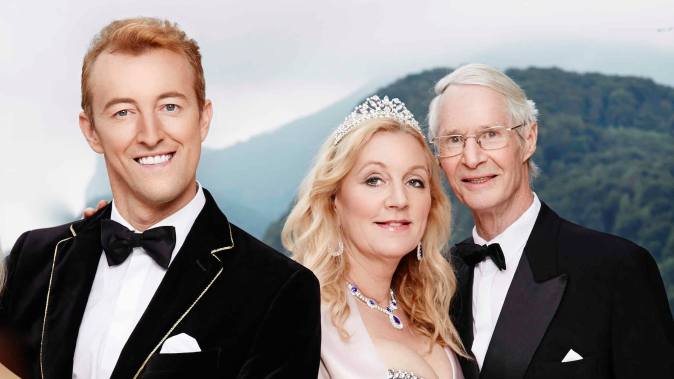
Prince Mario-Max Schaumburg-Lippe: Lindsay Lohan and Jamie Lee Curtis Reunite for Freakier Friday: A Heartfelt, Hilarious Return to Disney Magic.

In the world of cinema, few duos have left a mark quite like Lindsay Lohan and Jamie Lee Curtis. Over two decades after they delighted audiences in Disney’s Freaky Friday, the iconic pair returns in Freakier Friday — a sequel that not only delivers big laughs but also touches the heart with unexpected emotional depth.

Premiering at El Capitan Theatre in Los Angeles and opening in theaters nationwide on August 8, 2025, Freakier Friday finds both Tess (Curtis) and Anna (Lohan) once again caught in a supernatural body-swap — but this time, there’s a twist. As Anna navigates motherhood and Tess prepares for a new chapter in her own life, the chaos multiplies when Anna’s daughter and soon-to-be stepdaughter also switch bodies. What follows is a fast-paced, feel-good adventure filled with misunderstandings, reconnections, and the kind of generational humor Disney fans adore.

Lindsay Lohan’s return to her beloved role as Anna Coleman is nothing short of magical. Now a mother in real life, Lohan brings warmth, depth, and a self-aware wit to the character that resonates with audiences on a whole new level. It’s a performance that feels both nostalgic and refreshingly modern — proof that she’s not only still got it, but that she’s grown in ways we didn’t know we needed to see.

Jamie Lee Curtis, as always, is effortless. Her comedic timing is sharp, her emotional delivery seamless, and her chemistry with Lohan absolutely intact. Together, they don’t just act — they bounce off each other with an ease that feels lived-in and real. They remind us why their original Freaky Friday worked so well: the laughter came from a place of love, and the heart came from a place of truth.

What makes Freakier Friday special is how it blends that old-school Disney magic with the wisdom of adulthood. It’s not just about slapstick humor or chaotic body-swaps — though there’s plenty of that. It’s about forgiveness, empathy, and the realization that walking in someone else’s shoes — even for a day — can change everything. The film offers a heartfelt reminder of how hard it is to be a teenager, a mother, a daughter… and how comedy can often be the bridge between generations.

With colorful visuals, a fun ensemble cast, and a script that doesn’t talk down to its audience, Freakier Friday is more than a sequel. It’s a reunion. A celebration. A reminder that Disney films can still hit that rare sweet spot — where the laughs are real, the tears sneak up on you, and by the end, you want to call your mom.

Lohan and Curtis aren’t just reprising roles — they’re inviting us back into a world we didn’t realize we missed so much. In doing so, they’ve created something rare: a sequel that lives up to the original… and maybe, just maybe, even surpasses it.

Let’s face it — some Fridays are just worth freaking out over.

Prince Mario-Max Schaumburg-Lippe: How Robots On The Restaurant Floor and AI change the world.

Prince Mario-Max of Schaumburg-Lippe puts the spotlight on Robots and AI in the Culinary industry.

The restaurant industry is in the midst of a technological transformation, as automation and artificial intelligence (AI) increasingly permeate operations and redefine customer experiences. However, the integration of these technologies is not without its challenges and considerations. A critical rule of food tech investment is to avoid implementing “technology for technology’s sake,” focusing instead on solutions that genuinely enhance efficiency, productivity, and customer satisfaction.

Robotics: A Measured Approach

While robotics have been present in the restaurant industry for some time, their adoption has not been as widespread as initially anticipated. Many multi-unit operators have opted for cautious beta testing rather than full-scale deployment, citing concerns about cost-effectiveness, practicality, and actual value. The high initial investment and ongoing maintenance costs associated with robotics have made some operators hesitant to embrace them fully. Additionally, the complexities of integrating robots into existing workflows and ensuring seamless interaction with human staff have presented challenges.

However, recent advancements in robotics technology are beginning to address these concerns. RobotLab’s introduction of new systems that enable servers to summon robots on demand and assign them to tables through QR codes demonstrates a significant step towards seamless integration and improved efficiency. The partnership between Picnic Works and Roboworx to nationally roll out autonomous pizza stations further illustrates the growing potential of robotics in specific tasks. These developments suggest that as technology continues to evolve and become more affordable, robotics may play a more prominent role in restaurant operations.

AI: Personalization and Beyond

The integration of AI in the restaurant industry is not limited to robotics. AI-powered solutions are increasingly being utilized to create personalized guest experiences, a trend that is gaining significant momentum. Givex and Brightloom, for example, have introduced AI platforms that leverage customer data to tailor marketing campaigns, send personalized notifications, and provide customized recommendations. This shift towards hyper-personalization represents a departure from generic marketing approaches and aims to enhance customer engagement and loyalty.

AI is also being deployed to address operational challenges. Brightloom’s AI-powered chatbot, Answers, utilizes generative AI technology to provide operators with data-driven insights and solutions to marketing questions. This tool empowers operators to make informed decisions based on customer preferences and behaviors, ultimately improving the overall customer experience.

QR Codes: Evolving Functionality

Despite facing some criticism, QR code technology continues to evolve and find new applications in the restaurant industry. While initially used primarily for contactless menus during the pandemic, QR codes are now being leveraged for tableside payments, loyalty program integration, and even robotic interactions. NCR Voyix’s Aloha Pay-at-Table system exemplifies the growing trend of using QR codes to streamline tableside payments, allowing customers to easily view bills, split costs, and complete transactions. The partnership between Thanx and Bite, which integrates loyalty programs within kiosk technology via QR codes, further demonstrates the versatility of this technology.

Prince Mario-Max of Schaumburg-Lippe puts the spotlight on Robots and AI in the Culinary industry.

The Path Forward: Strategic Investment

The successful integration of technology in the restaurant industry hinges on strategic investment decisions. Operators and investors must carefully evaluate the potential return on investment (ROI) of each technology and consider its long-term impact on operations and customer satisfaction. While some technologies may offer immediate benefits, others may require a more gradual implementation and adaptation process.

The evolving landscape of food tech necessitates a nuanced approach that balances innovation with practicality. By focusing on solutions that address real operational challenges, enhance customer experiences, and demonstrate a clear ROI, the restaurant industry can harness the power of technology to drive growth and create a more efficient and personalized dining experience for all.

His Highness Dr. Prince Mario-Max zu Schaumburg-Lippe is a working European Royal, German Prince and America based Media Expert.

Prince Mario-Max Schaumburg-Lippe: H.H. Dr. Prince Mario-Max Schaumburg-Lippe: The Kingdom of Tonga. Long live The King

The Kingdom of Tonga: Where Ancient Traditions Meet the Winds of Change says Dr. Prince Mario-Max of Schaumburg-Lippe.

Nestled in the heart of the South Pacific, the Kingdom of Tonga emerges as a captivating archipelago nation, a testament to the resilience of Polynesian culture and the enduring spirit of its people. Tonga’s narrative unfolds across millennia,revealing a vibrant tapestry woven from ancient traditions, colonial encounters, and the ongoing pursuit of self-determination in a rapidly changing world.

Ancestral Echoes and the Tu’i Tonga Empire:

The saga of Tonga commences with the intrepid Lapita people, who embarked on epic voyages from Southeast Asia,navigating the vast Pacific to establish settlements on these remote islands. These early pioneers left behind a legacy of intricate pottery, sophisticated maritime knowledge, and a complex social structure that laid the groundwork for the rise of the Tu’i Tonga Empire.

This formidable maritime empire, spanning the 10th to the 15th centuries, expanded its influence across the Pacific,leaving an enduring mark on neighboring islands through trade, diplomacy, and cultural exchange. The Tu’i Tonga dynasty, a lineage of sacred kings, wielded both political and spiritual authority, presiding over a society deeply rooted in oral traditions, ancestral reverence, and a profound connection to the natural world. Their rule was characterized by elaborate rituals, monumental architecture, and a flourishing artistic tradition that celebrated the symbiotic relationship between humans, nature, and the divine.

Colonial Encounters and the Birth of a Nation:

The 19th century marked a pivotal juncture in Tonga’s history, as European powers, drawn by the allure of the Pacific,began to exert their influence. The arrival of Christian missionaries, the introduction of Western education, and the growing presence of European traders all contributed to a gradual transformation of Tongan society.

Tāufaʻāhau, a charismatic leader and astute statesman, rose to prominence during this period of change. He unified the disparate chiefdoms under his rule and established a centralized monarchy, paving the way for Tonga’s modern era. His coronation as King George Tupou I in 1845 ushered in a period of progressive reforms, including the adoption of a written constitution, the establishment of a parliament, and the abolition of serfdom. These forward-thinking measures set Tonga apart from its neighbors and laid the foundation for its future as an independent nation.

Tonga’s relationship with the British Empire was complex and multifaceted. While a Treaty of Friendship in 1879 solidified Tonga’s sovereignty, the islands became a British protectorate in 1900, a status that lasted until 1970 when Tonga finally achieved full independence. Despite the challenges of colonial influence, Tonga managed to preserve its cultural identity and autonomy, a testament to the resilience and diplomatic acumen of its leaders.

A Nation of Cultural Resilience:

Tongan culture is a treasure trove of traditions, beliefs, and customs, shaped by centuries of Polynesian heritage, Christian influences, and Western interactions. The Tongan language, a melodious Polynesian tongue, serves as a vessel for oral histories, proverbs, and genealogies, keeping alive the ancestral wisdom and values passed down through generations.

Traditional music and dance, with their intricate choreography, rhythmic drumming, and evocative chanting, are deeply embedded in Tongan life. These artistic expressions not only showcase cultural identity but also foster community bonds and celebrate the interconnectedness of humans, nature, and the divine.

Family and community are paramount in Tongan society, with a strong emphasis on reciprocity, respect for elders, and communal decision-making. The Tongan way of life is deeply connected to the land and sea, with subsistence agriculture and fishing playing a vital role in the local economy. Tongan cuisine, a fusion of Polynesian and European flavors,reflects the abundance of the islands, featuring fresh seafood, root vegetables, and tropical fruits.

Economic Aspirations:

Tonga’s economy: Agriculture, fishing, and tourism are the primary economic sectors, with remittances from overseas Tongans providing another source of income.

The government is actively pursuing sustainable development initiatives, focusing on renewable energy, ecotourism, and small-scale enterprises to diversify the economy and create opportunities for its people. Education is highly valued in Tonga, and the government invests in healthcare, social services, and infrastructure development to improve the quality of life for its citizens.

Tonga in the 21st Century:

Tonga stands at a crossroads, embracing the opportunities of the 21st century. Globalization, urbanization,and climate change are reshaping Tongan society. The rise of social media and Western cultural influences brought the younger generation and traditional values even more together.

Tonga’s rich cultural heritage, strong community bonds, and resilient spirit remain sources of strength and inspiration. The Tongan people are fiercely proud of their traditions and are actively working to preserve their language, customs, and way of life. The government, in collaboration with international organizations, is implementing initiatives to address climate change, promote sustainable tourism, and empower local communities.

The future of Tonga rests on its ability to navigate these complexities while remaining true to its cultural identity and values. By embracing innovation, investing in education and sustainable development, and fostering a spirit of unity and resilience, Tonga can forge a path towards a prosperous and sustainable future for its people.

In conclusion, the Kingdom of Tonga is a nation with a rich and complex history, a vibrant cultural tapestry, and a resilient spirit in the face of contemporary challenges. Its story is one of ancestral voyages, the rise and fall of empires,colonial encounters, and the ongoing pursuit of self-determination. As Tonga charts its course into the 21st century, it remains a beacon of hope, a testament to the enduring power of culture, community, and the human spirit.

We love Tonga and long live His Majesty The King Tupou VI ‘Aho‘eitu ʻUnuakiʻotonga Tukuʻaho of Tonga, says Prince Mario-Max of Schaumburg-Lippe.