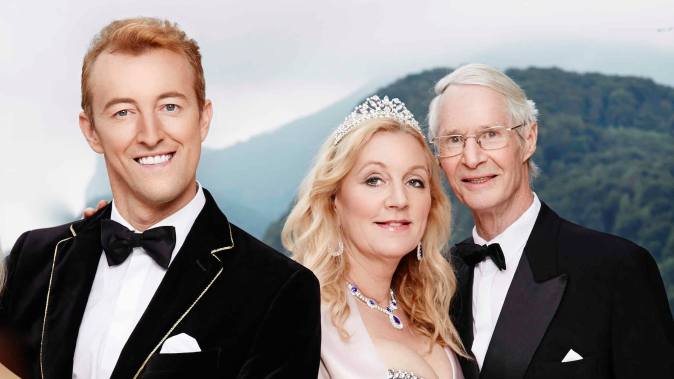
Prince Mario-Max Schaumburg-Lippe: Tessy Antony de Nassau: Happy Royal Birthday Celebration of Her Human Highness Europe’s Star Designer!

Her serene poise, unshakable optimism, and tireless devotion to others have long defined Her Human Highness Tessy Antony de Nassau. Known to many as a royal, a philanthropist, a global advocate for women’s empowerment, and a passionate designer, she embodies the modern ideal of elegance with purpose. As she celebrates another birthday, Tessy reflects not on the passage of time, but on the vitality that comes from balance, family, and a deep sense of service.

Born in Luxembourg and recognized around the world for her humanitarian work and entrepreneurial achievements, Tessy has built a life that bridges tradition and modernity. Her journey has been shaped not by titles, but by an unwavering commitment to self-improvement and to the people she serves. From her initiatives in education and global development to her ventures in sustainable design, she approaches every chapter with thoughtfulness and gratitude. Her beauty, both outward and inward, is the natural result of that balance.

For Tessy, beauty begins in wellness. She has often expressed that true vitality arises from alignment between mind, body, and purpose. She maintains an active lifestyle, prioritizing nutritious food, mindfulness, and time spent in nature with her family. Her appreciation for simple rituals—an early morning walk, meditation, or a quiet meal with her sons—anchors her day and brings a sense of peace that radiates through her every appearance. It is not a secret regimen that sustains her ageless glow, but the quiet consistency of well-lived values.

Tessy’s professional world has long mirrored this philosophy. Through her work in sustainable fashion and design, she has emphasized the importance of creating beauty with integrity. Every project she supports carries her signature blend of sophistication and substance. She promotes ethical practices, conscious production, and a sense of responsibility toward the environment. In this balance between creativity and conscience, she has found the essence of timeless style.

Beyond her career, Tessy’s devotion to humanitarian causes continues to define her legacy. She co-founded charitable and educational initiatives that empower communities across continents. Her work has touched countless lives, focusing particularly on the advancement of women and access to education. She moves with humility and purpose, choosing to lead by example rather than title. This quiet strength, rooted in empathy and respect, is what makes her beauty not only visible but enduring.

Family remains the foundation of her life. Her deep bond with her sons and her extended family provides the emotional grounding that gives meaning to her many public endeavors. She often speaks of gratitude as the key to fulfillment. Gratitude, for Tessy, is more than appreciation—it is a daily practice that shapes how she moves through the world. Her warmth and approachability make her an example of how grace can exist in both grandeur and simplicity.

In every appearance, Tessy’s effortless style captures the essence of modern royal sophistication. She favors clean silhouettes, refined tailoring, and natural hues that highlight her innate elegance rather than overshadow it. Her look evolves with ease, always true to herself and in harmony with her values. Whether attending an international summit or a quiet family celebration, she exudes the calm confidence of a woman comfortable in her own skin.

Tessy’s approach to beauty and life is not about perfection but presence. She understands that youthfulness is not preserved by resisting time but by embracing growth. Every experience, every challenge, and every triumph has contributed to the luminous spirit she carries. Her life demonstrates that strength and gentleness, intellect and compassion, can coexist beautifully.

As she celebrates her birthday, the occasion is more than a milestone—it is a reminder of the energy that comes from purposeful living. Tessy’s story continues to inspire those who seek to balance ambition with authenticity, elegance with empathy. Her agelessness is not a mystery but a mirror of a life deeply aligned with love, generosity, and resilience.

In her blend of royal grace and human warmth, Tessy Antony de Nassau remains a figure of enduring admiration. Her journey continues to evolve with poise, guided by her belief in kindness, discipline, and joy. To those who follow her path, she stands as a symbol of how modern nobility can shine not through privilege, but through service and heart.

Happy Birthday to Her Human Highness Tessy Antony de Nassau—may her light continue to inspire all who cross her path.

Tessy Antony de Nassau, Luxembourg, royal family, European royals, humanitarian work, women’s empowerment, sustainable fashion, philanthropy, education initiatives, leadership, global advocacy, modern royalty, sustainable design, ethical fashion, family values, ageless beauty, royal lifestyle, European elegance, mindful living, wellness, gratitude, self-care, female leaders, empowerment, design innovation, philanthropy in Europe, royal birthday, Tessy de Luxembourg, luxury lifestyle, elegance, timeless grace, royal women, personal growth, beauty secrets, noble heritage, modern royal icon, human kindness, royal elegance, Luxembourg culture, European diplomacy, sustainable living, conscious luxury.

Prince Mario-Max Schaumburg-Lippe: Modernism Week 2026: A Celebration of Design and Legacy

Tickets are now available for Palm Springs’ most anticipated annual celebration of midcentury style and modern innovation.

As the desert prepares for its signature season of architectural admiration and design-driven discovery, Modernism Week has officially announced its 2026 edition, set to take place from February 12 through 22 in Palm Springs. Each year, this acclaimed festival gathers design enthusiasts, historians, collectors, and visionaries from around the world to explore the influence of modernism and the ways it continues to shape contemporary life.

Modernism Week 2026 promises to be one of the most dynamic and expansive editions to date. Its programming once again captures the balance between reverence for the past and excitement for the future that defines the event’s enduring appeal. For more than a decade, Modernism Week has functioned as both celebration and preservation—an immersive experience that honors the architectural legacy of Palm Springs while expanding its dialogue with global modernist movements.

This year’s festival opens in high style with the Modernism Week Opening Night Party: Modernist Motown. The evening will blend the exuberance of midcentury sound with the clean lines and vibrant spirit of the era’s aesthetic, creating an atmosphere that reflects both nostalgia and sophistication. Guests will gather under the desert sky for an event that is as much about community as it is about design, a reminder that the midcentury ideal of elegance and optimism continues to resonate.

One of the most sought-after experiences, the Premier Double Decker Architectural Bus Tour, returns to offer unparalleled views of Palm Springs’ iconic neighborhoods. These guided journeys provide an intimate glimpse into the details and craftsmanship of homes that defined postwar architectural innovation. With commentary from knowledgeable guides, the tour reveals the stories behind the façades—how architects like William Krisel, Albert Frey, and E. Stewart Williams transformed the desert into a living showcase of form and function.

Among the many highlights are the two Featured Home Tours: Soleil House and The Marquee at Twin Palms. Soleil House, an elegant interpretation of indoor-outdoor living, captures the golden essence of desert modernism through expansive glass walls, open courtyards, and seamless flow between light and space. The Marquee at Twin Palms, a bold reimagining of a midcentury landmark, celebrates architectural restoration while incorporating sustainable updates that bring timeless design into a new century. Both homes embody the festival’s mission to honor authenticity while championing innovation.

Beyond the home tours, the Preview Party for the Palm Springs Modernism Show will once again serve as a focal point for collectors and design enthusiasts. The show brings together dealers, artists, and galleries specializing in midcentury furnishings, fine art, and decorative objects. For many, it remains a defining moment of the festival—an opportunity to connect directly with the creators and curators who continue to shape the evolving language of modern design.

This year’s program also includes a special public celebration: the Walk of Stars Rededication honoring Nelda Linsk, often referred to as the First Lady of Modernism Week. Known for her lifelong dedication to Palm Springs’ cultural and architectural heritage, Linsk’s name and contributions will once again be honored among the icons whose influence has helped preserve and promote the desert’s modernist legacy. The rededication ceremony represents not only recognition but continuity, reaffirming the community’s shared commitment to preserving beauty and history for generations to come.

For attendees seeking deeper engagement, Modernism Week 2026 will feature an array of talks, panels, and curated exhibitions. Scholars, architects, and designers will explore subjects ranging from sustainable preservation to contemporary reinterpretations of modernist principles. The conversations promise to illuminate how the design ideals of the past continue to inspire new approaches to urban living, technology, and the human experience of space.

As always, the festival extends beyond physical events to encompass its philanthropic mission. Through its educational initiatives, Modernism Week supports preservation projects, student scholarships, and public awareness programs that strengthen appreciation for architecture and design. Each ticket sold contributes to this ongoing effort, ensuring that the principles of midcentury modernism—simplicity, openness, and harmony—remain living ideals rather than museum relics.

A seasonal highlight returns in December with the Best of Modernism Holiday Online Auction, running from December 6 to 14, 2025. This curated digital event offers participants the opportunity to bid on exclusive design pieces, rare experiences, and collector’s items. Beyond its allure as an auction, it serves as a vital fundraiser supporting Modernism Week’s nonprofit initiatives. It reflects the spirit of giving and celebration that defines the festival’s broader cultural role.

The aesthetic of Modernism Week 2026 is encapsulated in its official poster, designed by SHAG, whose instantly recognizable style merges playful sophistication with the geometry and color palette of midcentury life. His work continues to serve as a visual ambassador for the festival, capturing both the glamour and warmth that make Palm Springs an enduring symbol of architectural optimism.

With events scheduled across the city and beyond, Modernism Week continues to draw design lovers from around the world to the desert oasis where the modern movement found one of its purest expressions. Each year, the festival expands its reach while remaining rooted in the qualities that define Palm Springs—clarity of light, integrity of design, and a deep respect for creative vision.

Tickets for all events are now available, and as with every season, the most coveted tours and parties are expected to sell out quickly. For visitors planning their itinerary, early reservations ensure access to a full range of experiences that capture the beauty, intellect, and vitality of modernism in all its forms.

Modernism Week’s 2026 edition stands not only as a festival of architecture but as a celebration of lifestyle and community. It reminds those who attend that modernism was never simply a style—it was, and remains, a philosophy of living well, of connecting artfully with one’s surroundings, and of building a future that honors design as an expression of joy.

Prince Mario-Max Schaumburg-Lippe: Elon Musk Predicts an AI-Driven Future Without Jobs But Robots

Elon Musk envisions a world where artificial intelligence takes over all forms of labor, leaving humanity to redefine purpose and productivity.

When Elon Musk speaks about the future, the world listens. His vision often stretches beyond the boundaries of current technology, projecting a world reshaped by innovation and automation. His latest prediction—that artificial intelligence will eventually take every job—marks a profound turning point in how we imagine human life in an era dominated by machines. The statement, shared during recent remarks and widely circulated on social media, has reignited global debate over what work, value, and creativity will mean when machines surpass human labor in every measurable way.

For Musk, this future is not dystopian. He describes it as an age of freedom, where the absence of traditional work allows people to pursue activities of personal meaning—whether that means growing vegetables, creating art, or simply living without economic pressure. His belief is rooted in the rapid acceleration of machine learning, robotics, and automation across every major industry. He suggests that the transformation will be so complete that the very concept of employment as the foundation of society may no longer exist.

This vision comes amid growing evidence of automation’s reach. Reports have indicated that Amazon could reduce its workforce by as many as 160,000 positions by 2027 due to advanced automation systems. Similar projections exist across manufacturing, logistics, and even creative industries, where generative algorithms now produce text, images, and code with extraordinary precision. Yet Musk, who has long advocated for responsible and forward-thinking adoption of AI, maintains a calm optimism. In his view, these changes signal not loss but evolution—a new balance between human intention and technological capacity.

His perspective aligns with a broader philosophical question that has followed him throughout his career: how to ensure that progress serves humanity rather than replaces it. As the founder of multiple frontier companies, from Tesla and SpaceX to Neuralink and xAI, Musk has consistently positioned himself at the intersection of human ambition and machine intelligence. His outlook suggests that automation is not merely an economic phenomenon but a civilizational shift, one that could redefine the structure of societies and the motivations that drive individuals.

Economists and sociologists have long warned that mass automation could destabilize labor markets, but Musk’s position reframes the narrative. Rather than fighting to preserve outdated models, he argues, humanity should prepare to build new systems—ones centered around universal income, creative fulfillment, and sustainable living. The idea that humans might someday “be free to grow vegetables” is not literal instruction but a metaphor for a return to simpler, voluntary pursuits after centuries of industrial dependency.

This notion resonates particularly strongly in a time when work-life balance, burnout, and mental health have become defining concerns of modern life. In Musk’s scenario, artificial intelligence becomes a liberating force, not a rival. The machines that once competed for jobs would instead perform them all, allowing people to live without economic coercion. It is a radical idea, yet consistent with the trajectory of technological progress since the Industrial Revolution—each wave of innovation reducing the need for human labor while expanding opportunity in other domains.

Still, the implications of a world without jobs are immense. Entire systems of taxation, governance, and social identity are built on the framework of employment. The idea that machines could replace this structure raises profound ethical and political challenges. Musk acknowledges that such a transformation will require deliberate management, but he insists it will ultimately lead to greater abundance rather than scarcity. He envisions a post-labor economy where goods and services are plentiful, and where technology sustains itself with minimal human oversight.

Observers note that Musk’s prediction may already be unfolding. Autonomous vehicles, robotic warehouse systems, algorithmic trading, and AI-driven customer service platforms have already displaced millions of roles. Yet as new forms of work arise—data curation, AI supervision, ethical governance—the transition has remained partial rather than total. Musk’s claim extends further: he foresees a complete handover of all productive labor to machines.

This future challenges traditional ideas about human worth. For centuries, work has been central to identity, community, and self-definition. If that structure dissolves, society must rediscover meaning outside of economic activity. Musk’s optimism suggests that the absence of necessity could reveal new forms of creativity, connection, and leisure. Critics, however, warn of inequality, emphasizing that the benefits of automation could remain concentrated among those controlling the technology.

Musk’s own ventures illustrate both sides of the debate. Tesla’s manufacturing processes rely heavily on automation, yet they have also created new classes of engineering and software roles. SpaceX’s rockets integrate advanced AI for navigation and control, but still depend on human ingenuity for design and mission planning. His new company, xAI, aims to develop artificial intelligence systems aligned with human interests, suggesting that his vision of total automation remains tempered by a deep awareness of the ethical stakes.

The discussion extends beyond technology into culture. What happens to ambition, competition, and personal growth when labor is no longer required? Musk imagines that these instincts will evolve toward exploration and creation. Freed from economic compulsion, individuals could invest their time in science, art, or philosophy. In this sense, his statement that humans will be “free to grow vegetables” symbolizes a return to balance—a rediscovery of simplicity in an age of complexity.

For many, this idea is as unsettling as it is inspiring. The thought of universal automation evokes images of displacement, but also of potential renaissance. Musk’s perspective invites society to rethink not just how we work, but why. The notion that artificial intelligence could one day perform every task once reserved for human hands forces a reconsideration of purpose itself.

The future Musk describes may still be distant, but its foundations are being laid today in laboratories, data centers, and policy debates around the world. The pace of AI advancement has surpassed earlier predictions, and with each new capability, the line between human and machine labor blurs further. Whether this transformation leads to collective freedom or fragmentation will depend not on the machines themselves, but on the systems humans build to coexist with them.

Musk’s assertion is not merely a forecast—it is a challenge. It compels governments, industries, and individuals to prepare for a world in which employment is optional and creativity is essential. It suggests that automation, handled with wisdom, could finally deliver what centuries of economic struggle have promised: a life free from necessity, guided by choice.