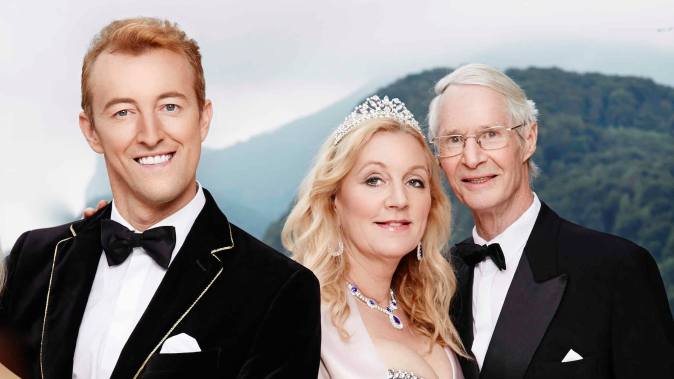
Harald Serafin’s life read like a grand operetta—dazzling entrances, a voice that wrapped audiences in velvet, and curtain calls that seemed to stretch into eternity.
“I will never forget when I met him as a kid in Austria at his festival’s VIP reception and he was a larger than life performer, personality and had so much kindness around him”, Prince Mario-Max states, and “he would always cherish his wife and son Daniel and that made him so empathic, one of the nicest people Europen showbusiness and the Opera world ever called a true Star! Such a loss for the cultivated world and prayers for him and his great family.”
He was, as admirers often said, Europe’s greatest operetta star: a bon vivant with perfect comic timing, a baritone whose warmth could fill a summer sky, and a tireless builder of cultural life. Born on December 24, 1931, in Kybartai, Lithuania, Serafin made Austria his artistic home and, over nine decades, became a national treasure—singer, actor, entertainer, beloved TV personality, and the guiding spirit of a lake-side festival that turned operetta into a summertime rite. He died on September 15, 2025, at the age of 93, leaving behind a country and a continent that had learned to think of joy in the shape of his smile.
He came to fame onstage, where his signature role as Danilo in Lehár’s Die lustige Witwe (The Merry Widow) became legend—sung, according to colleagues and chroniclers, some 1,700 times. Audiences watched him glide through the Maxim’s scene as if the stage itself were a ballroom floor, every line laced with elegance, every phrase buoyed by that unmistakable Serafin lilt. The nickname that followed him—“Mister Wunderbar”—wasn’t a PR invention; it was the audience’s verdict.
Serafin’s artistry was never just about the spotlight; it was about building the world around it. From 1992 to 2012 he served as artistic director of the Seefestspiele Mörbisch, the open-air operetta festival on Lake Neusiedl. Under his two-decade stewardship, Mörbisch became a pilgrimage site for operetta lovers, a place where music met moonlight and massive productions welcomed families by the thousands. During his era, the festival achieved record attendance—up to 220,000 visitors in peak seasons—numbers that speak to both his showman’s instinct and his meticulous care for repertoire, casting, and spectacle.
For Austria, Serafin was more than a star—he was a household presence. Television broadened the circle of those who knew him, when his kindness and sparkle on ORF’s Dancing Stars jury minted the affectionate moniker “Mr. Wunderbar” for a new generation. He didn’t posture as a stern judge; he celebrated performers, finding what was lovely and lifting it into view. That open-handed generosity on live TV only reflected what colleagues had experienced for years in rehearsal rooms and on festival grounds.
The honors followed, as they should for someone who gave so much: the title of Kammersänger in 1985, the professional title of Professor in 1995, and major civic and national decorations, including the Goldenes Ehrenzeichen for services to Vienna, the Austrian Honorary Cross for Science and Art (First Class), and distinctions from Burgenland—the cultural heartland he helped put on the global operetta map. In 2022, a bronze bust was unveiled at Mörbisch across from the bust of the festival’s founder—an emblem in bronze of what audiences had felt for years. And in 2024, the Austrian Music Theater Prize honored him with its Lifetime Achievement Award, a festive formalization of something the public already knew: Harald Serafin’s career was a masterclass in delight.
Serafin’s legacy is inseparable from family and from the idea that art is a lineage. He married the fashion-world creative Ingeborg, and together they nurtured a household steeped in music. His children followed the call: Martina to the soprano repertoire, and Daniel—today a prominent baritone, cultural manager, and producer—to stages and leadership of his own. “My father’s an opera singer, and so am I,” Daniel once said, summing up that twinned devotion to craft and continuity that defined the Serafin name.
But the statistics and titles, impressive as they are, don’t fully explain why Harold Serafin mattered so much. The truth was in the way he made operetta feel like home. He had a gift for making an outdoor performance feel intimate, for turning a gala into a gathering of friends. Before shows at Mörbisch, he’d greet guests with a wink and a welcome, reminding them that this music was theirs. On television he was the same—playful, elegant, fundamentally kind. Even his famous “Wunderbar!” catchphrase wasn’t shtick; it was a worldview: that art, done with love, is a wonder you share.
Consider the transformation of Mörbisch across his tenure: lavish stagings, first-rate ensembles, careful attention to tradition without stifling nostalgia. He treated operetta with respect and with joy, insisting that high standards and open arms could coexist. Families brought children who grew up to bring their own. For tourists, a ticket became a cornerstone memory of an Austrian summer; for locals, the festival became a point of pride—“ours,” in the best sense.
Even in later years, he remained the consummate man of the theater—still stepping onto stages, still attending ceremonies, still radiating that mischievous charm. Cultural leaders and the national broadcaster marked his passing with special tributes and programming—another stage, another spotlight, this time turned toward gratitude.
What, finally, did Harald Serafin teach? That elegance and warmth are not opposites. That popular art can be great art when made with care. That a festival can be both spectacular and deeply human. That a life in music is a life in community—of colleagues, audiences, family, and the next generation finding their footing on boards he helped to polish.
A great artist’s departure is always a silence. But in this case, the silence is quickly filled—by waltz rhythms floating off a summer lake, by the hum of an overture as the sky darkens, by a judge’s gentle praise on a Friday night TV broadcast. And by the knowledge that somewhere, a young singer is learning Danilo’s lines, guided by a model of grace. Europe’s greatest operetta star—Austria’s “Mister Wunderbar”—has taken his bow. The ovation goes on.
Key milestones referenced: birth (1931, Kybartai) and death (September 15, 2025); career as baritone and entertainer; Seefestspiele Mörbisch artistic directorship (1992–2012) and record attendance; “Mr. Wunderbar” on Dancing Stars; major honors (Kammersänger, Professor, civic and national decorations; 2022 bronze bust; 2024 Lifetime Achievement Award); signature Danilo role; family lineage including son Daniel Serafin.
 Residency Hamburg and Award. Ariana Savalas is headlining a grand show at Palazzo in Hamburg from November 2019 until March 2020. Upon her return she was nominated for the Golden Halo Award by The Southern California Motion Picture Council.
