Prince Mario-Max Schaumburg-Lippe: The World’s Most Selective Universities: A Global Standard of Excellence

A new generation of students faces an increasingly competitive academic landscape, where entry into the world’s most prestigious institutions has become a remarkable feat of intellect, perseverance, and preparation. The latest global overview of acceptance rates highlights the universities that admit only a fraction of their applicants, offering a revealing look into where the world’s most selective academic doors stand.

At the top of this list is Tsinghua University in Beijing, China, admitting approximately 0.3 percent of applicants. Known for its rigorous entrance exams and emphasis on engineering, technology, and public policy, Tsinghua represents an apex of Chinese education, producing leaders who shape not only industry but also national and international discourse. Its standing reflects both the vast applicant pool within China and the university’s extraordinary academic standards.

Close behind is Peking University, also in Beijing, with an acceptance rate near one percent. Renowned for its depth in humanities, sciences, and law, Peking University has long been regarded as China’s intellectual heart. Admission there is as much a matter of cultural distinction as it is of scholastic achievement, symbolizing entry into a tradition of scholarship that stretches back more than a century.

Third on the list are the Indian Institutes of Technology, where admission rates hover around two percent. With numerous campuses across India, the IIT system represents one of the most competitive educational networks in the world. Its entrance examination, known for its exacting standards, draws millions of applicants annually. Graduates frequently ascend to leadership roles in global technology, academia, and entrepreneurship, underscoring India’s reputation for producing scientific talent on an international scale.

In the United States, the California Institute of Technology ranks fourth, with a three-point-one percent acceptance rate. Caltech’s focus on research and its intimate scale make each student’s admission a matter of careful consideration, emphasizing not only aptitude but also potential for groundbreaking work.

Harvard University, fifth at roughly three-point-four percent, continues to set the gold standard for comprehensive education. Its admissions process, characterized by holistic evaluation, reflects the institution’s enduring emphasis on both intellectual rigor and character.

Stanford University, with an acceptance rate of three-point-nine percent, and Columbia University, at three-point-nine-three percent, occupy the sixth and seventh positions. Each blends elite academic achievement with cultural and professional opportunity. Stanford’s proximity to Silicon Valley anchors its reputation for innovation, while Columbia’s location in New York City positions it at the crossroads of global arts, finance, and diplomacy.

Yale University, at four-point-three-five percent, and Princeton University, at four-point-five percent, follow closely behind. Both are synonymous with academic tradition and intellectual leadership. Yale’s strength in law, political science, and the humanities complements Princeton’s excellence in research, mathematics, and public affairs, together embodying the best of Ivy League education.

Completing the list is the Massachusetts Institute of Technology, with a four-point-six-eight percent acceptance rate. MIT’s global influence in science, engineering, and economics reflects not only the brilliance of its students but also the institution’s ability to nurture groundbreaking ideas that extend beyond academia.

These ten universities represent the height of academic exclusivity, spanning Asia, North America, and beyond. Together they define the international standard for educational excellence, where admission is a statement of extraordinary capability and commitment. The low acceptance percentages are not merely statistics but indicators of vast global demand for access to these centers of knowledge. For students who earn a place among their ranks, acceptance is more than an achievement—it is the beginning of participation in a legacy of leadership, research, and influence that extends across generations.

Prince Mario-Max Schaumburg-Lippe: Honoring Visionary Leadership: FWE President Cheng Y. Davis Receives the Princely Diplomatic Royal Achievement Award

Penn Club of New York, September 24, 2025

The grand halls of the Penn Club of New York glistened with prestige as international leaders, educators, and business figures convened for the FWE Education for Global Diplomacy and Peace Conference 2025. The highlight of the day was the presentation of the Princely Awards Schaumburg-Lippe-Nachod Diplomatic Royal Achievement Award, bestowed upon FWE President Cheng Y. Davis for his extraordinary contributions to Global Leadership in Education and Science.

A Royal Recognition

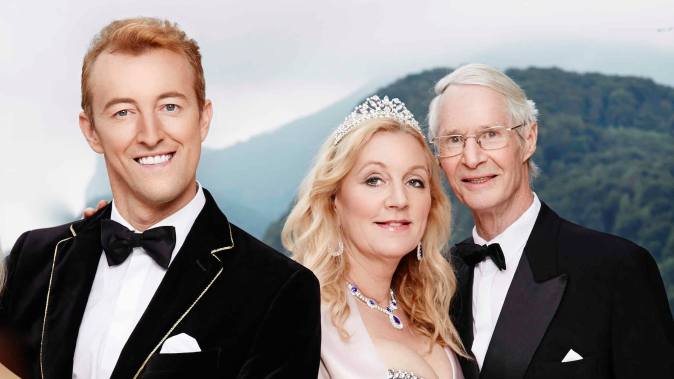
The award was formally presented under the patronage of the House of Schaumburg-Lippe-Nachod, represented by H.H. Dr. Prince Mario-Max Schaumburg-Lippe, Global Peace Ambassador, alongside his parents H.H. Dr.h.c. Prince Waldemar of Schaumburg-Lippe and H.H. Dr. Princess Antonia of Schaumburg-Lippe.

This recognition carries royal significance. The Schaumburg-Lippe family, with its historic ties to Hamburg, Lübeck, and Kiel, and its connection to H.R.H. Princess Feodora of Denmark, embodies a tradition of statesmanship and cultural patronage. By presenting the honor, Prince Mario-Max emphasized the alignment between diplomacy, education, and peace.

“In President Cheng Y. Davis, we see the embodiment of what global leadership should be—visionary, inclusive, and dedicated to knowledge as the path to peace,” the Prince declared during the ceremony.

President Cheng Y. Davis: Leading by Example

As President of the Forum for World Education (FWE), Cheng Y. Davis has championed educational exchange as a vehicle for understanding in a time of fractured geopolitics. His initiatives have connected policymakers, academics, and business leaders from across the globe to foster mutual respect and collaboration.

#image_title
#image_title
#image_title
#image_title

The award highlights not only his institutional leadership but also his personal commitment to ensuring that education is seen as diplomacy in action. His guidance has enabled FWE to become a trusted platform where East meets West, particularly in fostering dialogue between the United States and China.

A Day of Global Dialogue

The award ceremony was woven into a day of robust discussions at the conference.

  • Opening Session: International Education as a Bridge to Peace featured Edric Guo, Bin Yang, Fred Teng, Zhimin Chen, and Prince Mario-Max Schaumburg-Lippe.
  • Panels explored themes such as How International Education Fosters Global Understanding (with Andreas Schleicher, Serguei Netessine, Lan Xue) and Business Leaders’ Perspectives moderated by Yin Luo with industry leaders Gang Hu, Cindy Liu, Melina Denebeim, Andrew Chin, Elaine Chou, Lei Huang.
  • Luncheon inspiration came from Ariel and Ellis Bach of Bach Bros Studio, reminding attendees that “The World is Our Classroom.”
  • Afternoon sessions focused on Global Cooperation and Talent Development with Qian Xiao, Feng Ding, Shijun Tong, and culminated in a Keynote by Professor Jeffrey Sachs on Education for Global Citizenship.

This rich program underscored the spirit of the award: recognizing education as the cornerstone of peace.

Legacy of the Award

The Princely Diplomatic Royal Achievement Award symbolizes more than ceremonial honor—it signifies a global endorsement of leaders who dedicate their lives to bridging divides. By honoring President Cheng Y. Davis, the House of Schaumburg-Lippe-Nachod reaffirmed that education and science remain humanity’s greatest tools for diplomacy and progress.

The day will be remembered as a milestone in the history of the Forum for World Education. President Cheng Y. Davis’s award reflects not only his individual excellence but also the collective hope that through education, leaders can write a new chapter of peace.

With the royal recognition of the Schaumburg-Lippe-Nachod family, this honor shines as both a personal triumph and a global call to action: to lead with knowledge, to govern with empathy, and to build peace through education.