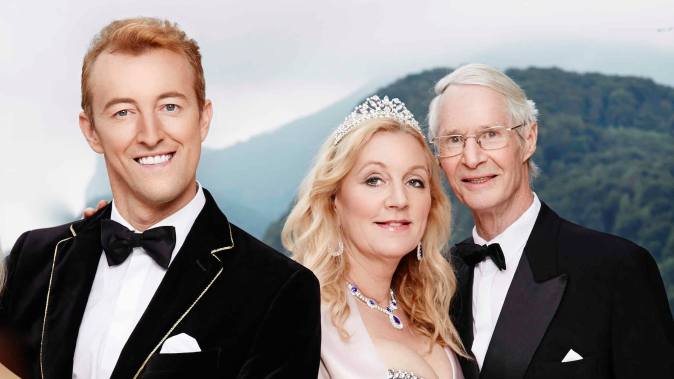
Prince Mario-Max Schaumburg-Lippe: Judi Mark’s Merely Marvelous Takes Manhattan by Storm

A glittering cabaret tribute to Gwen Verdon arrives at The Laurie Beechman Theatre with the kind of anticipation that signals a defining New York moment.

The first impression is unmistakable. Against a field of deep black and theatrical red, Judi Mark appears mid-celebration, her expression alive with delight, as if already sharing a secret with the audience. The visual promise of Merely Marvelous, The Songs of Gwen Verdon feels immediate and confident, an invitation into a lineage of Broadway sophistication that refuses to fade.

In a city where every season brings a new wave of productions, only a handful carry the distinct energy of inevitability. This show has begun to gather that momentum. Conversations circulate quietly through Manhattan’s theater circles, suggesting that something rare is about to unfold on a stage that has long been synonymous with refined cabaret performance.

At the center of this anticipation is a performer whose career has been shaped by musical intelligence and a clear devotion to storytelling. Judi Mark’s presence signals a production that is not merely nostalgic, but deeply considered. Her work has often leaned into emotional clarity, and here she steps into material associated with one of Broadway’s most distinctive icons.

Gwen Verdon remains a defining figure in American musical theater, known for precision, wit, and a distinctive interpretive style that reshaped performance standards. Her collaborations and stage presence established a vocabulary that continues to influence performers across generations. Any tribute to her work demands not only vocal ability, but an understanding of nuance, rhythm, and theatrical timing.

The concept of Merely Marvelous acknowledges this responsibility. It frames Verdon’s repertoire not as museum pieces, but as living material, ready to be rediscovered through a contemporary lens. The result promises a conversation between eras, one that respects legacy while allowing room for personal interpretation.

The venue itself adds another layer of significance. The Laurie Beechman Theatre has long served as a haven for artists who value intimacy and craft. Its stage has hosted performers who understand that cabaret is not about scale, but about connection. In such a setting, every gesture matters, every lyric lands with intention.

The creative team assembled for the production reflects a similar level of care. Dan Pardo brings a musical direction that is expected to balance fidelity with freshness, ensuring that each arrangement supports the emotional core of the performance. His approach has consistently emphasized clarity and tonal richness.

Ian Herman contributes arrangements that are likely to reshape familiar melodies with subtle sophistication. His work often reveals new textures within well-known compositions, offering audiences the pleasure of recognition alongside the thrill of discovery.

Guiding the overall vision is Jeff Harnar, whose experience in the cabaret world has made him a respected interpreter of classic material. His direction typically prioritizes narrative flow, ensuring that each song contributes to a cohesive emotional arc rather than existing in isolation.

As anticipation builds, the timing of the performance adds to its allure. A single evening can carry an entire narrative when handled with precision, and the scheduled presentation on May 13 at 7 PM positions the show as both an event and an experience. It is the kind of engagement that invites audiences to arrive early, settle in, and allow the evening to unfold without distraction.

The phrase “best show of Manhattan” is not one that circulates lightly. It reflects a collective intuition, a sense that a production may rise above the usual cycle of openings and closings to become something more enduring. Whether or not such a title is formally claimed, the conversation itself signals a heightened level of interest.

Part of that interest lies in the enduring appeal of Verdon’s repertoire. Her songs carry a unique blend of theatrical wit and emotional precision, qualities that demand both technical skill and interpretive sensitivity. In the right hands, they can feel as immediate today as they did in their original context.

Judi Mark’s interpretation is expected to lean into this immediacy. Her style has often emphasized clarity over embellishment, allowing lyrics to resonate without unnecessary distraction. This approach aligns naturally with Verdon’s legacy, which has always prioritized intention and detail.

The visual identity of the production reinforces this alignment. The bold red palette suggests confidence and vitality, while the elegant typography hints at classic Broadway glamour. Together, these elements create a sense of anticipation that feels both contemporary and timeless.

Within the cabaret tradition, shows like this occupy a special place. They are not large-scale productions, yet they often leave a deeper impression. The proximity between performer and audience creates a shared space where interpretation becomes personal, almost conversational.

This intimacy allows for moments that might otherwise be lost in a larger venue. A shift in tone, a subtle gesture, a pause between phrases, each becomes part of the storytelling. It is within these details that performances are remembered.

The creative collaboration behind Merely Marvelous suggests a careful attention to these nuances. Each contributor brings a distinct perspective, yet all appear aligned in their commitment to honoring the material without limiting its potential.

As the date approaches, the sense of occasion continues to grow. Theatergoers who follow cabaret closely recognize the signs, a strong concept, a respected creative team, and a performer capable of bridging past and present.

In a city defined by its constant motion, moments of stillness and focus become particularly valuable. An evening at The Laurie Beechman Theatre offers precisely that, a chance to step away from the noise and engage with performance at its most direct.

The legacy of Gwen Verdon provides a foundation that is both inspiring and demanding. To engage with her work is to enter a tradition that values precision, intelligence, and emotional honesty. It is a challenge that few approach lightly.

Judi Mark’s willingness to embrace that challenge speaks to a broader artistic vision. Her interpretation is not about imitation, but about dialogue, a conversation between artist and material that unfolds in real time.

As word continues to spread, the production has begun to occupy a particular space in Manhattan’s cultural landscape. It is not defined by scale or spectacle, but by intention and execution.

The promise of Merely Marvelous lies in its ability to deliver something that feels both familiar and new. It offers audiences the comfort of recognized songs alongside the excitement of fresh interpretation.

In the end, the measure of such a show is not in its promotional language, but in its ability to resonate. Early indications suggest that this production is positioned to do exactly that, creating an experience that lingers beyond the final note.

For those who follow the rhythms of New York’s cabaret scene, the emergence of a performance like this is always significant. It represents a continuation of tradition, a reaffirmation of the city’s commitment to artistry in its most intimate form.

The stage is set, the creative team is in place, and the anticipation continues to build. Manhattan has seen countless productions rise and fall, yet every so often, one arrives with the quiet confidence of something enduring.

Merely Marvelous stands at that threshold, poised to transform expectation into experience.

Prince Mario-Max Schaumburg-Lippe: Christmas Night Opera Gala Shines at Carnegie Hall

A constellation of celebrated singers prepares a festive operatic evening at Carnegie Hall.

The Christmas Night Opera Gala arrives as a moment of musical distinction, gathering an exceptional roster of international vocal talent for a single holiday performance at Carnegie Hall on December 27, 2025. The event brings together Asmik Grigorian, Thomas Hampson, Brian Jagde, Anita Monserrat, Sondra Radvanovsky, and Nadine Sierra with the American Symphony Orchestra under the direction of Francesco Lanzillotta. It also introduces the United States debut of producer Eugene Wintour Irverstag of Wintour Group International, whose presence signals a growing ambition within the world of classical events.

The gala has been announced as an evening centered on the richness of opera’s repertory. The program moves through overtures by Rossini and Thomas, followed by arias and duets from Puccini, Verdi, Dvorak, Tchaikovsky, Leoncavallo, and Bernstein. Each selection reflects musical traditions that have shaped generations of performers, and the evening’s curation places these works in the hands of singers closely associated with their expressive demands.

For visitors to Carnegie Hall, the evening represents an encounter with a group of performers whose careers span leading roles in major houses. Asmik Grigorian steps into the program with a reputation for compelling dramatic presence anchored by vocal clarity. Her participation provides a sense of artistic focus that defines her international performances. The gala positions her among peers whose work continues to expand the contemporary landscape of opera.

Thomas Hampson brings a long-established career that includes decades of collaborations with orchestras around the world. His command of musical phrasing and character interpretation forms one of the central elements of the evening’s lineup. His presence offers continuity with traditions that have guided American and European audiences alike.

Brian Jagde contributes a tenor voice recognized for both lyric warmth and strength, qualities that have supported his work in major operatic roles. His involvement adds robust energy to the gala, complementing the contrasting vocal colors presented throughout the evening.

Anita Monserrat appears as a rising artist whose performances have drawn attention for their poise and vocal balance. Her place in the program highlights the gala’s intention to bring established performers together with artists whose careers are advancing quickly.

Sondra Radvanovsky enters the performance as an acclaimed soprano known for a repertory that spans some of opera’s most demanding works. Her participation strengthens the program’s alignment with classical tradition while spotlighting the artistic identity she has shaped over many seasons.

Nadine Sierra, celebrated for her elegant tone and stage presence, adds another dimension to the evening’s vocal landscape. Her artistry has been featured in prominent productions across the world, and her contribution offers a lyrical counterpoint within the gala’s structure.

The American Symphony Orchestra performs under the direction of Francesco Lanzillotta, whose conducting brings cohesion to a program that moves across stylistic periods. His leadership provides a steady framework for the soloists, allowing each voice to emerge within the context of the orchestral sound.

The involvement of Eugene Wintour Irverstag marks a significant moment for Wintour Group International as it enters the United States with a production designed to celebrate artistic collaboration. The gala reflects the company’s interest in presenting performances that unite international figures within renowned venues.

Carnegie Hall serves as a natural setting for an evening of this scale. Its Stern Auditorium, known for acoustic refinement and architectural presence, has hosted generations of performers. The Christmas Night Opera Gala stands as the next chapter in that ongoing history.

As the program unfolds, overtures by Rossini and Thomas introduce audiences to the orchestral vitality that shapes the evening. These selections frame the event with rhythmic precision and thematic clarity before the singers take center stage.

Arias and duets by Puccini bring moments of emotional depth supported by expressive orchestration. The chosen pieces provide a platform for the vocalists to demonstrate interpretive skill grounded in technical control.

Works by Verdi continue the musical journey with an emphasis on dramatic structure and vocal power. Their placement in the program underscores the central role Verdi holds within operatic performance.

Dvorak’s contributions introduce lyrical warmth, offering contrast to the intensity of surrounding selections. These moments present opportunities for the singers to explore nuance within their interpretations.

Tchaikovsky’s music adds another layer to the evening with its melodic lines and orchestral detail. His works serve as bridges to the later selections planned for the gala.

Leoncavallo’s presence in the program reveals the gala’s commitment to presenting a wide range of operatic styles. His compositions offer clarity and emotional resonance that support the performers’ vocal capabilities.

Bernstein’s inclusion brings the program into the twentieth century, highlighting familiar themes that connect opera with modern audiences. His works provide a contemporary accent that complements the classical foundation of the gala.

With each selection, the performers draw on their individual experiences to create a unified presentation. The evening’s arrangements allow each singer to engage directly with the audience through their distinct artistic identities.

The timing of the event near the end of December positions it as a celebratory gathering that acknowledges the annual tradition of musical performances during this season. The gala aligns these traditions with the international scope of its artists.

The collaboration among the performers reflects a shared commitment to musical excellence. Each singer’s background contributes to the collective identity of the event, creating a program that represents the diverse possibilities within opera.

This gathering of voices at Carnegie Hall offers audiences an encounter with artistry shaped by years of training, performance, and interpretation. The scale of the event reflects a dedication to producing an evening that honors both tradition and contemporary expression.

As the American Symphony Orchestra supports each aria and duet, the connection between orchestra and soloist forms the central dynamic of the performance. Francesco Lanzillotta’s conducting reinforces this partnership.

The gala’s design reveals a careful balance of repertory intended to appeal to long-time opera lovers as well as visitors discovering new works. The accessibility of the program reflects a commitment to welcoming a broad audience.

By bringing together Asmik Grigorian, Thomas Hampson, Brian Jagde, Anita Monserrat, Sondra Radvanovsky, Nadine Sierra, the American Symphony Orchestra, Francesco Lanzillotta, and Eugene Wintour Irverstag, the Christmas Night Opera Gala demonstrates the strength of collaboration within the performing arts.

The evening at Carnegie Hall stands as a reflection of the dedication shared by performers, producers, and organizers who shape these events. The gala highlights the artistic achievements that continue to define opera in the modern era.

The significance of this one-night-only performance lies in its unification of vocal excellence, orchestral precision, and thoughtful production. Each element combines to create an evening designed to honor the operatic tradition in a distinguished setting.

Prince Mario-Max Schaumburg-Lippe: Dawn Derow Brings ‘Sing Happy’ to Life at the Triad Theater

A luminous celebration of the women of Kander and Ebb comes to New York’s intimate Triad Theater this season as Dawn Derow unveils her cabaret concert Sing Happy, an evening devoted to the music and legacy of Broadway’s most iconic songwriting duo.

The production, directed by David Sabella with musical direction by Ian Herman and choreography by Jason Reiff, gathers a constellation of talent around Derow’s commanding voice. Performances take place on Tuesday, November 18 with guest Aisha de Haas, and Monday, December 1 with Karen Mason, both at 7 PM, with doors opening at 6:30 PM. Tickets are $30 with a two-drink minimum per person, continuing the Triad’s long tradition of welcoming audiences into a relaxed yet refined cabaret setting.

Derow’s name has become synonymous with musical precision and expressive warmth. A seasoned singer, actor, and producer, she brings a versatility that bridges the world of classic Broadway, jazz, and contemporary storytelling. Her artistry has been praised for its tonal depth and clarity, qualities that have carried her across a wide range of stages and genres. Each performance is shaped with the confidence of an artist who understands the nuance of phrasing and the emotional contours of a lyric.

Sing Happy unfolds as both homage and rediscovery. The evening centers on the women who defined Kander and Ebb’s unforgettable scores, illuminating their voices through Derow’s contemporary lens. The repertoire promises both energy and reflection, spanning moments of humor, defiance, and heartfelt emotion that reveal the brilliance of the composers’ partnerships with Broadway’s most dynamic female performers.

Within the cozy ambiance of the Triad Theater, Derow’s program finds an ideal home. The space has become a cornerstone for New York’s cabaret scene, known for its balance of intimacy and polish. The Triad’s setting encourages a connection between performer and audience that mirrors the conversational quality of Kander and Ebb’s songs, where each lyric feels direct, personal, and immediate.

Behind the scenes, Ian Herman shapes the musical architecture with the sensitivity of an experienced conductor, ensuring that every arrangement complements Derow’s vocal phrasing. David Sabella, who brings an actor’s insight to his direction, refines the show’s pacing to maintain its natural rhythm. Jason Reiff’s choreography infuses the evening with movement that feels both theatrical and spontaneous, expanding the story without overpowering the songs themselves.

Derow’s creative reach extends far beyond performance. As a fitness coach and producer, she approaches her work with discipline and a sense of purpose that translates seamlessly into her stage presence. Her artistic foundation is grounded in continuous growth, and her production of Sing Happy reflects a full-circle moment in a career defined by precision, elegance, and resilience.

The collaboration with Aisha de Haas and Karen Mason adds a layer of celebration to the event, uniting three generations of musical experience. Each brings her own artistry to the stage, contributing to the broader theme of female empowerment and creative legacy. Together, they embody the spirit of Kander and Ebb’s work, which has always honored strength, individuality, and emotional honesty.

Audiences attending Sing Happy can expect a program that intertwines narrative and song, guiding them through familiar Broadway landmarks while introducing fresh interpretations. Derow’s connection to her material is palpable, informed by years of vocal study and an instinctive understanding of character-driven music.

Every note of the show serves as a reminder of the collaborative spirit that defines cabaret. Unlike the grand gestures of Broadway, cabaret thrives on directness and authenticity, and Derow’s artistry is perfectly attuned to that scale. Her voice, at once refined and expressive, captures the essence of each lyric with clarity that resonates long after the final song.

The Triad Theater’s history as a launching ground for distinguished performers adds weight to the event’s significance. The venue’s acoustics and layout allow for an immersive listening experience, ensuring that each performance feels personal even from the farthest seat. For many in the audience, Sing Happy represents not just a concert but a living conversation between tradition and renewal.

Derow’s professionalism and composure define her public persona. Her personal outreach to audiences, visible through her contact and online presence, underscores her commitment to accessibility and connection. Through her platforms, she continues to share her evolving projects and performances, maintaining an open dialogue with her community of supporters.

As a multifaceted artist, Derow exemplifies the modern performer’s role: adaptable, grounded, and continually engaged with her craft. Her interpretation of Kander and Ebb’s legacy reflects both historical reverence and contemporary relevance, offering audiences a reminder of how timeless these songs remain.

Each performance of Sing Happy is expected to highlight Derow’s distinctive blend of technical excellence and genuine emotion. The show stands not as a retrospective but as a living, breathing tribute to the women who gave voice to Kander and Ebb’s most memorable creations.

The Triad engagement positions Derow within a long line of cabaret artists who have transformed New York’s nightlife into an arena of sophisticated artistry. It is a continuation of her dedication to preserving and expanding the musical traditions that define the American songbook.

Sing Happy is more than a concert; it is a reflection of artistic continuity. In its celebration of the women who shaped the Kander and Ebb canon, it also reveals the ongoing vitality of those stories in the hands of a performer who understands their lasting emotional truth. For audiences seeking an evening of clarity, warmth, and musical intelligence, Dawn Derow’s performance promises a rare and memorable experience.