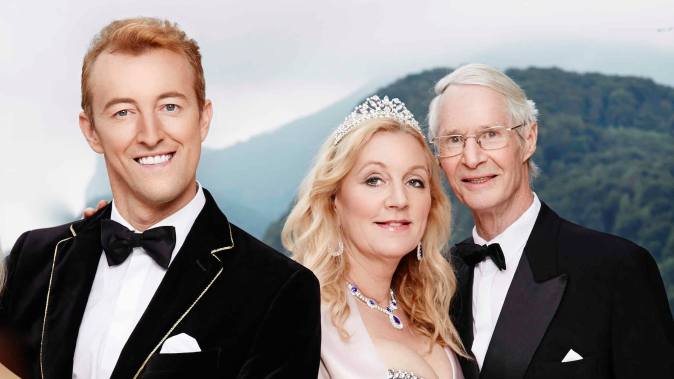
Prince Mario-Max Schaumburg-Lippe: Asprey of London: Inside the World’s Oldest Luxury House

Some names in luxury don’t need an introduction. Asprey is one of them — and an elegant New York evening hosted by brand strategist Michael Gregson Reinert-Sessions was a reminder of why.

Founded in the eighteenth century, Asprey stands as one of the world’s oldest luxury houses — arguably the first true luxury brand. Its reputation was built the slow way: centuries of craftsmanship, discretion, and an unbroken commitment to quality for a distinguished clientele.

An Invitation That Speaks Volumes

The invitation itself set the tone — formal, precise, quietly confident. No spectacle, no noise. Just cocktails and canapés, good company, and a name that has carried weight for generations. Michael Gregson Reinert-Sessions, the noted New York brand strategist, extended it with a personal touch that turned the evening into something more than a gathering: a curated experience.

The format was deliberate. Cocktails and canapés create room for real conversation — social but composed, refined without stiffness. Exactly the register Asprey has always spoken in.

Centuries of Consistency

What makes Asprey remarkable isn’t reinvention; it’s refusal to compromise. Through every era of fashion and every shift in taste, the house has held its standards steady. That consistency is the brand — and it’s why the name still opens doors that money alone can’t.

The evening’s restrained aesthetic — clean typography, balanced composition, a beautifully set table — mirrored the house philosophy: luxury expressed through precision and restraint, not excess.

Asprey is amazing, and the world’s oldest luxury brand earned every bit of that title long ago. Nights like this simply remind you.

Related Reading

Originally published on Times Square Chronicles.

Prince Mario-Max Schaumburg-Lippe: Prince Mario-Max Joins Bill Walsh as Featured Speaker at Beverly Hills CEO Success Summit

When business coach Bill Walsh throws a summit, entrepreneurs listen. The CEO Success Summit in Beverly Hills drew a sharp crowd of business owners and executives to Fogo de Chão — and the headline addition to the program was H.H. Dr. Prince Mario-Max Schaumburg-Lippe, invited by Walsh as a featured celebrity speaker.

Walsh, widely regarded as one of the top business strategists in the game, built the day around what he does best: clear frameworks, actionable growth strategy, and zero fluff. The luncheon format kept things focused — real conversations, real takeaways.

A Royal Speaker on Media and Brand

Walsh’s invitation to Prince Mario-Max was a strategic one. In a business world where personal branding and visibility drive growth, the Prince brought a perspective few can offer: a career spanning entrepreneurship, acting, television hosting, and international media. His talk centered on the intersection of media presence and business — how a consistent public identity builds enterprises that last.

The audience leaned in. Walsh guided the exchange with precision, drawing out practical lessons on positioning and visibility that paired neatly with his own emphasis on systems and scale.

A Full Bench of Expertise

The program also featured Moe Rock on media authority, Poonam Bhuchar on legal strategy, Sally Cham on finance, and Kari Michaelsen on television production — each adding a distinct layer to the day’s central theme: scalable success.

Walsh himself was everywhere: opening the framework, working the room, answering individual challenges one-on-one. That accessibility — mentor as much as host — is what keeps entrepreneurs coming back to his events.

By the close, the summit had delivered exactly what Walsh promises: clarity, connection, and momentum. And with Prince Mario-Max on the bill, it had something extra — a reminder that in modern business, influence and strategy belong in the same room.

Related Reading

Originally published on Times Square Chronicles.

Prince Mario-Max Schaumburg-Lippe: Queen Sofia’s Miami Gala: A Historic Night for America and Spain 250 at the Freedom Tower

Miami is about to host what many are already calling the event of the year. Her Majesty Queen Sofia will preside over a landmark cultural gala at the iconic Freedom Tower at Miami Dade College — the first major Florida event of the America and Spain 250 initiative, commemorating the 250th anniversary of the United States and Spain’s pivotal role in the American Revolution.

Backed by the Queen Sofia Spanish Institute, the Consulate General of Spain in Miami, Miami Dade College, Florida International University, and Miami-Dade250, the evening brings royal patronage, world-class scholarship, and a powerful cultural mission under one roof.

Scholars of the Highest Caliber

The academic program is genuinely exceptional. Ambassador Gonzalo M. Quintero Saravia will speak on the strategic role of Florida, Cuba, and the Caribbean in the Revolutionary War — his scholarship on Bernardo de Gálvez has restored the Spanish general’s decisive Gulf Coast campaigns to their rightful place in history.

Professor Jane Landers of Vanderbilt University brings her groundbreaking work on Fort Mose near St. Augustine, which reshaped our understanding of early Black freedom communities in North America. Professor Richard L. Kagan of Johns Hopkins will examine how Spain’s contribution faded from popular narratives — and why restoring it matters.

Miami Dade College President Madeline Pumariega will open the evening, underscoring the institution’s role as South Florida’s great civic and educational platform.

Music, Heritage, and a Royal Mission

The orchestra and choir of FIU’s Herbert and Nicole Wertheim School of Music will perform works from the era of the Spanish viceroyalty — a living soundtrack to the history being discussed on stage.

Behind it all stands the Queen Sofia Spanish Institute, founded in New York in 1954 to promote understanding of Spanish art, culture, and language, and the Fundación Reina Sofia, whose support for education and heritage gives the initiative its depth.

The Freedom Tower — modeled on Seville’s Giralda and sacred to the story of Cuban immigration — is the perfect vessel for the night’s themes. Under Queen Sofia’s patronage, Miami will witness an evening where scholarship, culture, and civic pride meet at the highest level.

Related Reading

Originally published on Times Square Chronicles.

Prince Mario-Max Schaumburg-Lippe: The Luxury Gala Sells Out With 1,500 Guests for a Grand California Evening

Fifteen hundred guests. Completely sold out. The Luxury Gala just delivered one of the grandest evenings California has seen this season — a sweeping celebration of luxury, culture, and connection hosted by H.H. Dr. Prince Mario-Max Schaumburg-Lippe and presented by founder and CEO Samira Kazemeni.

From the first arrivals, the scale was obvious. Invitations had circulated through international networks of business leaders, society figures, and cultural influencers — and the response filled the room well before the date arrived.

A Night of Standing Ovations

California State Treasurer Fiona Ma graced the gala with a speech that earned genuine standing ovations — a rare thing for a politician, and a testament to her stature as one of the state’s most beloved leaders. The Mayor of Beverly Hills was also in attendance, adding civic weight to the celebration.

Samira Kazemeni, the superb founder behind the Luxury Gala, worked the evening alongside her partner Kamiar — greeting guests, steering the program, and keeping the night’s energy exactly where she wanted it. Her vision has turned the gala into a fixture of the international luxury calendar.

Stars, Icons, and Familiar Faces

The guest list read like a cross-section of entertainment and culture: Eric Roberts (yes, Julia’s brother, and a warm, gracious presence), Kaya Redford with his son the professional cameraman, Poppa Snoop — Vernell Varnado, Snoop Dogg’s father — and Travis Payne, Michael Jackson’s longtime choreographer, with whom the Prince shares a dance-world connection going back to Luigi’s Jazz Centre.

KTM co-CEOs Al Harris and Raquel Sanchez held court, alongside the famous Harris Brothers of the Wow Gifting Suite, beloved Hollywood personality Hayavi Moradi, Rebecca Holden, star photographer and producer Dumi, co-hostess Dustin Quick, and Hollywood’s Lukas Silva with Anshu Zeng Yuan. Virgelia Productions added its signature polish to the proceedings.

Prince Mario-Max brought his unmistakable royal presence to the hosting role — elegant, engaged, and clearly in his element among the international crowd.

For Samira and the Prince, the sold-out night was more than a party. It was proof of concept: 1,500 guests, one shared celebration of the good life, and a community that keeps coming back for more.

Related Reading

Originally published on Times Square Chronicles.

Prince Mario-Max Schaumburg-Lippe: Inside Luxury Gala 2026: The Official Event Map Reveals a World of Its Own

Forget the seating chart — the official map for Luxury Gala 2026 is a blueprint of an entire world. Main stage, LED walls, a Crypto and AI Lounge, vendor villages, runway space: the layout shows how the gala fuses business, fashion, media, wellness, and luxury lifestyle into one meticulously planned evening.

The Heart of the Ballroom

Everything orbits the main stage, backed by a large LED display with the awards table close by. Dozens of round tables fan out around it, keeping every guest connected to the program while leaving room for the networking the gala is famous for.

Prime tables near the stage host Allen Woodman, the Sherard Show team, and VIP ticket holders. Deeper in the room: Rhonda Dawvan Lee, Zarifa Masoud and Dr. Ghazi, Global Latina Production, RasaNari and Kelli Delone of DM Shapewear, Pepe Reyes Torres, and Neo Japonesque — a genuinely international mix.

Media takes its place too, with London Lane, LaFellina Radio TV, and Dream Cinema Productions seated centrally. Business networking runs deep via PowerTeam and Bill Walsh’s multiple tables, plus Beverly Arts LABA bridging the creative and corporate worlds.

Style, Wellness, and What’s Next

Fashion and beauty thread through the whole plan: Luna Fashion House, Zenden Body Sculpting, Vocci International, Rock A Bella Creations, Schofield Jewelry, and Paroma A La Mode. Wellness gets its own lane with Flowing Energy With Amy, Superpatch, and Tesla PEMF. Don Sergio Tequila represents the luxury spirits world.

Beyond the ballroom, the map opens up: a red carpet photo area at the entrance, a runway zone for fashion presentations, cocktail rounds for mingling, and the Crypto and AI Lounge — the gala’s forward-looking hub for tech and innovation talk.

The Grass vendor area hosts brand activations at scale, with Fogo de Chao anchoring the hospitality offering and a Recovery Experience zone nearby for recharging. The Auto Center, represented by Tiffany Cano and Audacious, adds the automotive element. Security and media tables keep the whole machine running.

What the map really reveals is intent. Every lounge, aisle, and table placement is designed to do the same thing the gala itself does: put entrepreneurs, creators, and cultural leaders in the same room — and let the collisions happen.

Related Reading

Originally published on Times Square Chronicles.

Prince Mario-Max Schaumburg-Lippe: Amazon Deforestation Falls to Record Low in 2026

Here is a genuinely good one: deforestation alerts in the Amazon have fallen to their lowest level in 13 years, according to Brazilian satellite monitoring data.

Between August 2025 and July 2026 — the monitoring year for forest loss — alerts covered just 2,874 square kilometers, a 36% drop from the previous year and more than 55% below the average of the prior decade. An area slightly smaller than Rhode Island, in a rainforest that spans eight countries. For a forest that regulates the global climate and shelters one in ten known species on Earth, that decline isn’t a footnote. It’s one of the most consequential environmental turnarounds in recent memory.

What the numbers actually say

The figures come from DETER, Brazil’s near-real-time deforestation detection system, run by the National Institute for Space Research (INPE). DETER uses satellite imagery to spot fresh tree-cutting fast enough for enforcement teams to respond — it trades some resolution for speed.

The 2,874 km² of alerts is the lowest figure since the current DETER series began in 2016. Reaching further back with an older monitoring system, alerts were last lower in 2013, when they hit 2,766 km².

The official annual tally comes from a different, higher-resolution system called PRODES, whose numbers are published once a year. For the year ending July 2025, PRODES recorded 5,796 km² of forest loss — the lowest in eleven years, and roughly half the 11,594 km² recorded in 2022. The final PRODES figures for the year ending July 2026 are expected later this autumn; if the alert data hold, Brazil could post its lowest official deforestation rate since satellite monitoring began in 1988.

The decline isn’t limited to the Amazon, either. Independent monitoring reported falling clearing across Brazil’s other biomes — the Cerrado, Caatinga, Atlantic Forest, and Pampa — pointing to a broad shift rather than pressure simply moving elsewhere.

Why the Amazon matters so much

It’s hard to overstate the Amazon’s role in the planetary system:

  • Climate regulation: The rainforest stores vast quantities of carbon and generates “flying rivers” — atmospheric moisture flows that carry rain across South America.
  • Biodiversity: Around 10% of all known species live in the Amazon, many found nowhere else.
  • Carbon math: When tropical forest burns or is cleared, its stored carbon returns to the atmosphere. Keeping the forest standing is one of the fastest climate levers available.

One widely cited concern in recent years: parts of the Amazon were approaching a tipping point, where forest loss and drying could flip regions from carbon-absorbing rainforest to carbon-emitting savanna. Every square kilometer saved pushes that threshold further away.

What’s driving the decline

No single factor did this. Monitoring specialists point to several forces converging at once.

Faster eyes in the sky

Near-real-time satellite detection has changed the economics of clearing forest illegally. When fresh clearing shows up in the data within days — not months — enforcement teams can reach it before it spreads. DETER was built for exactly that: feeding alerts to field teams while the chainsaws are still running.

Enforcement with teeth

Increased patrolling, stricter penalties for illegal logging, and remote monitoring have raised the cost and risk of clearing forest illegally. When deforesters know they’re being watched from orbit, behavior changes.

Conservation finance and supply chains

The global market for sustainably produced goods has grown, giving industries alternatives to deforestation-linked supply chains. Conservation finance has added another reason to keep forests standing: a living forest can now generate revenue as a carbon asset, not just as timber or farmland.

Protected areas holding the line

Protected conservation areas across the basin have kept deforestation near zero even as pressures rose elsewhere — proof that well-managed protection works at scale.

A note on the bigger picture

Honesty requires the caveat. The Amazon is not saved. A 13-year low is a trend, not a victory — deforestation continues, and researchers warn that forest degradation (thinning, fires, and biomass loss that doesn’t show up as clear-cutting) remains a major, under-counted threat. The alert systems are built to catch clear-cutting; the slow damage underneath the canopy is harder to see.

And the final word on 2026 isn’t in yet. The alert data strongly suggest another record, but the higher-resolution PRODES figures due this autumn will decide whether this becomes the official best year since monitoring began.

But trends matter. A sustained multi-year decline shows something important: deforestation is a problem with known solutions, and those solutions can be put to work. The forest responds quickly when the pressures ease.

What this means for the climate effort

Proof that protection works

The Amazon turnaround is the largest-scale evidence we have that concerted anti-deforestation effort produces measurable results within years, not decades. The lesson applies directly to the Congo Basin and Southeast Asia, where forests face similar pressures.

Nature-based solutions are the cheap win

Protecting and restoring forests remains among the most cost-effective ways to cut emissions — far cheaper than engineered carbon removal. The Amazon’s recovery is a live demonstration.

Momentum is a resource

Climate action runs on credibility. Every verified win — every downward-sloping curve — makes the next commitment easier to defend and fund. The Amazon’s 13-year low is momentum for the harder fights ahead: methane, coal, and the degradation nobody can see in a satellite photo of the canopy.

It also capped a day of encouraging science news, from Starship’s first orbital flight to a successful late-stage drug trial — and a rescue that reads like fiction.

Key takeaways

  • The milestone: Amazon deforestation alerts hit 2,874 km² in the year ending July 2026 — down 36% year-on-year and the lowest in 13 years.
  • Why it matters: The Amazon stores massive carbon, drives continental rainfall, and hosts ~10% of known species; its fate is a planetary issue.
  • What’s working: Near-real-time satellite monitoring, faster enforcement response, conservation finance, and protected areas holding the line.
  • The caveat: Deforestation continues, and forest degradation remains a huge under-counted threat — this is a trend, not a victory. Final annual figures are due this autumn.
  • The lesson: Forest loss responds to monitoring and conservation effort within years. What worked in the Amazon can be adapted for the Congo Basin and Southeast Asia.

Prince Mario-Max Schaumburg-Lippe: Samira’s Luxury Gala Pre-Oscar VIP Party Welcomes the Inner Circle at Universal Hilton

Before the main event comes the inner circle. The VIP warm-up to Samira’s Luxury Gala Pre-Oscar Party took over the Club Room of the Universal Hilton Hotel — an invitation-only evening hosted by H.H. Dr. Prince Mario-Max Schaumburg-Lippe that set the tone for Hollywood’s awards-season festivities.

Presented by Samira’s Network, the gathering welcomed the gala’s Gold, Platinum, Diamond, and Ultimate sponsors, alongside vendors, award recipients, team leaders, and international guests. It was the official welcome moment — and it felt like one.

Hollywood Glam, Global Style

The dress code told the story: Hollywood glam, international couture, or traditional national costume. The result was a room that looked like the world itself showed up — a swirl of cultures, colors, and personal heritage that has become the Luxury Gala’s signature.

As host, Prince Mario-Max worked the room with ease — greeting sponsors, acknowledging partners, and connecting guests across industries. His presence gives these evenings a distinctive charge: part royal ceremony, part genuine warmth.

The Calm Before the Celebration

The Universal Hilton’s Club Room offered the perfect intimate counterpoint to the grand gala to come — close quarters, real conversations, and the kind of introductions that turn into collaborations.

Samira’s Network has built the Luxury Gala into a platform where film, fashion, media, philanthropy, and entrepreneurship meet during the most-watched week in entertainment. This VIP night was the first spark — and by all accounts, the fire is well lit for the main celebration.

Related Reading

Originally published on Times Square Chronicles.

Prince Mario-Max Schaumburg-Lippe: 24-Year-Old Climbs Cliff Without Gear to Save Pilot

The rock chimney was 27 feet of near-vertical stone. Slippery. Moss-covered. Nothing to hold onto. Matthew Robert Clark climbed it anyway — no rope, no harness, no gear.

At the top, a 75-year-old man was hanging semiconscious from a tree, bleeding, his circulation being cut off by his own harness straps.

Clark, a 24-year-old electrician from Victoria, British Columbia, got him out. For that, he has now received the Carnegie Medal — the highest civilian honor for heroism in the United States and Canada.

The crash on Mount Prevost

On February 6, 2026, Stephen Parson, 75, crashed his hang glider into a tree in a vertical gully on the side of 2,585-foot Mount Prevost near Duncan, British Columbia — about 200 feet from the summit. He hung in his harness with several fractures, a gashed leg, and a concussion. Worse, the harness straps were digging into his legs and cutting off his circulation, turning the wait for rescue into a race against time.

At the bottom of the mountain, Clark was among several paragliders who had landed in a field when the distress call came over their radios. A pilot was down, high on the mountain.

The climb

Clark didn’t hesitate. He joined two fellow paragliders and a police officer, driving and then hiking up the mountain to the base of a steep incline below the gully where Parson hung.

Then came the hard part. Clark, the officer, and one paraglider climbed a 40-foot, 45-degree slope to the base of a vertical “chimney” rock formation — a narrow crack roughly 27 feet high. There was no way around it, and no equipment to climb it safely.

So Clark free-climbed it. Back pressed against one slippery, mossy wall, feet braced against the other, inching upward on friction and nerve alone. One slip meant a serious fall onto rock.

He made it. Then he climbed another short incline to reach Parson, cut him out of the harness with a knife, and dragged him down the slope to a level area near the edge of the chimney. There, he performed first aid — and waited.

The long wait

Two rescue teams arrived but couldn’t reach the pair’s position. Clark stayed with Parson for several hours, keeping him alive and stable, until a rescue helicopter arrived and lowered a doctor to the scene. The doctor stabilized Parson enough for the crew to hoist him out and fly him to a waiting ambulance. The helicopter then returned for the doctor — and for Clark.

Parson spent eight days in the hospital with a concussion, broken ribs, a fractured wrist, and a deep gash to his knee. The suspension trauma — the damage from hanging in the harness — took weeks of walking and stretching exercises to fully reverse. He made a full recovery.

The medal

Clark’s rescue is one of 16 recognized in the Carnegie Hero Fund Commission’s third award announcement of 2026, issued September 21. The Carnegie Medal has been awarded to 10,597 individuals since Pittsburgh industrialist Andrew Carnegie established the fund in 1904, and it goes only to those who enter extreme danger to save — or attempt to save — the life of another. Each recipient also receives a financial grant; over the fund’s 122-year history, more than $47 million has been paid in grants, scholarships, and assistance.

Among those saved by this quarter’s recipients were five children. The stories range across the continent — a river rescue in Iowa, a chairlift rescue in Virginia — but Clark’s stands out for the sheer physical audacity of that unroped chimney climb.

Why stories like this matter

It’s easy to be cynical about heroism awards — to file them under “nice, but rare.” The Carnegie Fund’s archive tells a different story. Ordinary people, again and again, choosing danger over safety when a stranger needs them. Electricians. Teenagers. Retirees. The medal doesn’t create heroes. It finds them.

There’s a practical lesson tucked inside the inspiration, too. Clark wasn’t reckless — he was a paraglider who understood mountains, assessed the situation, and acted within his capabilities at the edge of them. Courage without competence is just risk. Clark had both.

And there’s a quieter detail worth holding onto: after cutting Parson free and dragging him to safety, Clark stayed. For hours. Heroism is often imagined as a single dramatic act. Much of it is just refusing to leave. It was one of several remarkable feats that day — the same morning a rocket reached orbit for the first time and a marathoner rewrote the record books.

Key takeaways

  • The rescue: On Feb. 6, 2026, Matthew Clark, 24, free-climbed a 27-foot rock chimney with no gear to reach crashed hang-glider pilot Stephen Parson, 75, on Mount Prevost, BC.
  • The wait: After cutting Parson from his harness and giving first aid, Clark stayed with him for hours until a helicopter could extract them both.
  • The outcome: Parson spent eight days in hospital and fully recovered.
  • The honor: Clark received the Carnegie Medal, North America’s highest civilian heroism award, in the fund’s third 2026 announcement covering 16 recipients.
  • The lesson: Real heroism is usually competence plus the refusal to walk away — not the absence of fear. Days like this one, with a breakthrough drug trial alongside the heroics, are a reminder of what people can do.

Prince Mario-Max Schaumburg-Lippe: New Hepatitis D Drug Succeeds in Late-Stage Trial

For the roughly 230,000 people in the United States and Europe living with chronic hepatitis D — one of the most aggressive forms of viral liver disease — treatment options have been painfully thin. On Monday, that picture got brighter. Mirum Pharmaceuticals announced that its experimental drug brelovitug met the main goal of a late-stage study, sharply reducing virus levels in patients.

Results like this don’t just move a stock price. They move the horizon for patients.

The announcement

Mirum said the Phase 3 portion of its AZURE-1 study hit its primary endpoint: virologic response plus normalization of liver enzymes at 24 weeks, in both dose groups. The numbers, reported by the company on September 28:

  • 56% of patients on the 300-milligram dose achieved both a reduction in hepatitis D virus and normal liver enzyme levels.
  • 45% on the 900-milligram dose hit the same mark.
  • 0% in the delayed-treatment comparison group did.

Treatment was described as well tolerated across dose groups, with a safety profile consistent with previously reported data and no new safety signals. The company also reported encouraging 48-week data from the Phase 2b portion of AZURE-1, showing viral suppression deepening — and ALT normalization rates increasing — with longer treatment.

Full results will be presented at an upcoming medical congress, and Mirum expects to submit a marketing application (a biologics license application) to the U.S. Food and Drug Administration in the first half of 2027. AZURE-1 is one of two pivotal Phase 3 studies intended to form the basis of that registration package; topline results from the second, AZURE-4, are expected later this year.

What is hepatitis D — and why is it so hard to treat?

Hepatitis D is a cruel quirk of virology. The delta virus can only infect people who are already infected with hepatitis B. It hijacks the hepatitis B surface antigen — a protein on the virus’s outer shell — to assemble itself.

That dependency makes it both dangerous and difficult. Chronic hepatitis D can cause severe symptoms and progress to liver damage, cirrhosis, and death faster than other forms of viral hepatitis. And because the virus is essentially a parasite of another virus, standard antivirals aimed at viral replication often miss it. The company estimates it affects about 230,000 people in the U.S. and Europe.

How brelovitug works

Brelovitug aims straight at that dependency. It’s a fully human monoclonal antibody designed to bind to the hepatitis B surface antigen itself — the very protein the delta virus needs to build new copies of itself.

Think of it as cutting the supply line instead of fighting the battle. Without access to the surface antigen, the delta virus can’t assemble, and viral levels fall. The trial’s dual endpoint — lower virus plus normalized liver enzymes — matters because it points to more than less virus in the blood. It points to a liver that’s actually calming down. Notably, Mirum says these results were achieved in a broad patient population, including people with significant liver inflammation, cirrhosis, and clinically significant portal hypertension.

Why this result matters

A genuinely underserved disease

Hepatitis D has historically drawn a fraction of the research attention given to hepatitis B and C. Patients have had very few options, and the disease’s rapid progression means the cost of that neglect is measured in livers — and lives. A single agent that delivers both deep viral suppression and liver-enzyme normalization would be a genuine advance.

The trial results arrived on a day packed with breakthroughs, from a dramatic cliff rescue to an AI system that forecasts from almost no data.

Antibodies as antivirals

The bigger story is the maturation of monoclonal antibodies as antiviral tools. Once confined mostly to cancer and autoimmune disease, engineered antibodies are increasingly being aimed at infectious disease — COVID, RSV, and now hepatitis D. Brelovitug’s success adds momentum to that platform shift.

A realistic timeline

A marketing application in the first half of 2027, if the full data hold up, puts a potential approval inside a plausible two-to-three-year window. Regulators typically take around ten months for a standard review, with faster tracks available for serious conditions with unmet need — and hepatitis D fits that description comfortably.

A note of healthy caution

These are company-reported, top-line results — not yet peer-reviewed or presented in full. Drug development has a long history of promising press releases that looked different under the microscope of full data. The 0% response in the delayed-treatment group is striking, but independent scrutiny at the upcoming medical congress will matter.

That’s not pessimism. It’s how good science works. The signal here is strong enough to be genuinely hopeful about.

The road from trial to treatment

If the full data hold up at the medical congress, the path from here is well mapped but not instant. Watch for the AZURE-4 results later this year — a second pivotal study backing the same registration package — then the FDA filing in the first half of 2027.

For patients, the practical advice is straightforward: if you live with hepatitis B, ask your doctor about delta screening, since hepatitis D can only exist alongside hep B and often goes undiagnosed. And keep expectations calibrated — late-stage trial success is the strongest signal short of approval, but the full peer-reviewed data are still to come.

Key takeaways

  • Trial success: Brelovitug met its Phase 3 primary goal — 56% of patients on the 300mg dose saw virus reduction plus normal liver enzymes at 24 weeks, versus 0% without prompt treatment.
  • How it works: A fully human monoclonal antibody that binds the hepatitis B surface antigen, starving the delta virus of the protein it needs to replicate.
  • Who it helps: People with chronic hepatitis D, a severe liver infection affecting an estimated 230,000 in the U.S. and Europe with few treatment options.
  • What’s next: Full data at an upcoming medical congress; AZURE-4 results later this year; FDA application expected in the first half of 2027.
  • If this affects you: Talk to a hepatologist about the evolving treatment landscape — and remember this article is information, not medical advice.

Prince Mario-Max Schaumburg-Lippe: Tigst Assefa Runs Third-Fastest Women’s Marathon Ever

Tigst Assefa crossed the finish line of the Berlin Marathon on Sunday in 2 hours, 11 minutes, 4 seconds — the third-fastest women’s marathon ever run. She ran the last two kilometers of it with a torn Achilles tendon.

Read that again. One of the greatest marathon performances in history was also an act of staggering toughness.

Under world-record pace — until the final miles

From the gun, Assefa was running at history. She took the lead early with her group of pacemakers and never gave it up, charging through the halfway mark in 1:04:57 and reaching 40 kilometers in 2:03:00 — still about ten seconds inside world-record pace, with a projected finish around 2:09:45. Ruth Chepngetich’s mark of 2:09:56, set in Chicago in 2024, was in her sights.

Then, over the final 2.2 kilometers, something went wrong. Her stride broke down into a visible limp. The record slipped away with every painful step. But the win never did. Assefa refused to stop, hobbled through the finish line in 2:11:04 — a new Berlin course record, 49 seconds faster than her own previous mark — and collapsed in disappointment and exhaustion.

Behind her, the clock told the story of what might have been — and what still was: the third-fastest time any woman has ever run.

Running through the pain

After the race came the explanation. Assefa had injured the tendon in her right leg during that brutal final stretch. Her manager, Gianni Demadonna, told reporters she had traveled to Munich for surgery on Monday with renowned foot and ankle surgeon Dr. Johannes Gabel. Demadonna said recovery could take around six months, likely keeping her out of the spring marathon season.

An Achilles tear is one of the most feared injuries in running. The tendon is the spring that makes fast marathoning possible. That she held her form together well enough to finish in 2:11:04 — limping — says things about her conditioning and her competitive will that no split can capture.

“To finish like this, I’ve never seen something like this,” Berlin race director Mark Milde told the BBC. “The pain is hard to imagine.”

A legacy already written

This was no surprise from nowhere. Assefa, 29, is one of the defining marathoners of her generation:

  • In 2023, she won Berlin in 2:11:53 — a world record at the time, and still her personal best before Sunday.
  • She now owns the third- and fourth-fastest women’s marathon times ever run.
  • Only two women have ever run faster: Kenya’s Ruth Chepngetich (2:09:56, Chicago 2024) and Ethiopia’s Fotyen Tesfay (2:10:51, Barcelona, March 2026 — the fastest marathon debut in women’s history).

Sunday’s run also completed an Ethiopian sweep in Berlin. Bedatu Hirpa finished second in 2:16:53 and Dera Dida third in 2:16:55, with all five top women’s places going to Ethiopia — and Guye Adola winning the men’s elite race in 2:02:50, a personal best and his second Berlin title.

Why Berlin keeps making history

Berlin has earned its reputation as the world’s fastest marathon course: flat, long straightaways, cool late-September weather, deep pace-making. But courses don’t run themselves. What sets Berlin apart is that the best in the world keep choosing it as the place to chase history — and Assefa has now made it her personal stage three times over.

The marathon record capped a remarkable morning, from a daring cliff rescue to SpaceX’s Starship reaching orbit.

There’s a bigger pattern here, too. The women’s marathon record has been tumbling as training, pacing strategy, and shoe technology have all advanced together. Assefa’s 2:11:04 would have been a world record not long ago. The bar keeps rising — and she keeps clearing it.

How fast is 2:11:04, really?

Some context. A 2:11:04 marathon means averaging about 3:07 per kilometer — roughly 5:01 per mile — for 26.2 consecutive miles. That’s a pace most recreational runners couldn’t hold for one mile, sustained for over two hours.

It also continues one of the most dramatic progressions in sports history. As recently as 2019, no woman had ever broken 2:14; Brigid Kosgei’s 2:14:04 in Chicago that year was the landmark. In the seven years since, the record has been shattered repeatedly — first by Assefa herself in Berlin 2023 (2:11:53), then Chepngetich’s 2:09:56 in Chicago 2024, then Tesfay’s 2:10:51 in Barcelona this past March. Sunday’s run slots into that lineage as the third-fastest ever. Run, remarkably, on a torn tendon.

The drivers are well documented: carbon-plated shoes, deeper professional pacing, better fueling science, training groups that treat the marathon like a team time trial. But technology doesn’t limp through the final two kilometers on a damaged Achilles. That part was all Assefa.

The road back

The immediate question is recovery. An Achilles injury usually means months away from competition, and at 29, Assefa is in her prime marathon years. The good news: modern sports medicine has an excellent record with this injury, and her aerobic base — a decade of elite training — will still be there when she returns. Six months puts her back in training in time to consider next year’s spring season.

The major marathon season rolls on with Chicago next month. Assefa won’t be on that start line. But her shadow will be: every elite woman racing now knows the standard, because Assefa just reset what “fast” looks like — on one good leg.

And the record books may not sit still for long. Tesfay, the woman who took No. 2 on the all-time list in March, is scheduled to race Valencia in December, where organizers have put up a 1-million-euro bonus for anyone who breaks a marathon world record — the largest single performance bonus in the sport’s history. The chase Chepngetich’s 2:09:56 has been waiting for is getting crowded.

Key takeaways

  • Historic time: 2:11:04 in Berlin — a course record and the third-fastest women’s marathon ever, behind only 2:09:56 and 2:10:51.
  • Under record pace at 40K: She was about ten seconds inside world-record pace before the injury struck in the final 2.2 km.
  • Toughness for the ages: She finished — and won — on a damaged Achilles, then traveled to Munich for surgery the next day; recovery may take six months.
  • Ethiopia’s day: Guye Adola’s 2:02:50 men’s win completed the sweep, with all five top women’s places going to Ethiopia.
  • What to watch: Her recovery timeline, and whether anyone can touch 2:11:04 — or threaten the world record — in the months ahead.