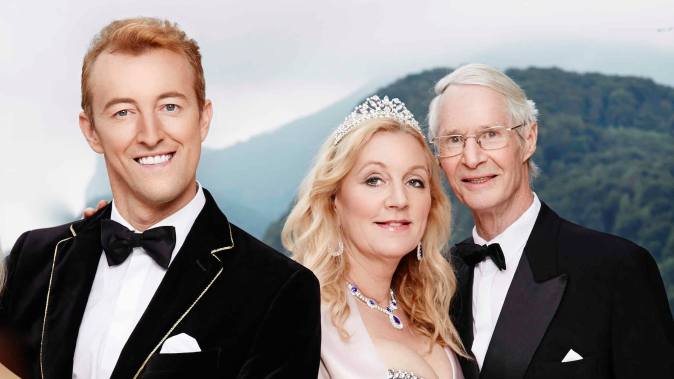
Prince Mario-Max Schaumburg-Lippe: Rent A Christmas Tree This Year! New Idea

H.H. Dr. Prince Mario-Max Schaumburg-Lippe comes from two lineages of forestry. His fathers ancestry (HH Prince Waldemar of Schaumburg-Lippe) owned thousands of acres of land for centuries as also his mothers ancestry (HH Dr. Antonia Prinzessin zu Schaumburg-Lippe) with forests in Europe. Prince Mario-Max wants to raise awareness how many trees and up in the landfills.

Renting Christmas Trees: A Sustainable Tradition for a Greener Holiday Season

As the holiday season approaches, many families eagerly anticipate the tradition of decorating their homes with a festive Christmas tree. However, the environmental impact of purchasing and discarding millions of trees each year has raised concerns about the sustainability of this cherished custom. In recent times, a greener alternative has emerged: renting Christmas trees. This innovative practice not only reduces waste but also supports sustainable forestry and fosters a deeper connection with nature during the holiday season.

One of the most significant advantages of renting a Christmas tree is the substantial reduction in waste. Each year,countless trees end up in landfills after the holidays, contributing to greenhouse gas emissions and environmental pollution. Renting a tree eliminates this issue, as the tree is returned to the farm after the season, where it is nurtured and replanted for future use. This cyclical approach ensures that the tree continues to thrive, serving as a renewable resource that can be enjoyed for years to come.

Beyond waste reduction, renting Christmas trees also promotes sustainable forestry practices. Tree farms that offer rental services typically cultivate their trees with environmentally conscious methods, using organic fertilizers and avoiding harmful pesticides. By supporting these businesses, consumers contribute to the preservation of natural ecosystems and encourage responsible land management. Additionally, renting a tree allows individuals to select from a wider variety of species, including those that are native to their region, further enhancing biodiversity and ecological balance.

The convenience factor of renting a Christmas tree is another compelling reason to consider this option. Many rental services offer delivery and setup of the tree, eliminating the hassle of transporting and installing it oneself. After the holidays, the tree is picked up and returned to the farm, saving the renter time and effort. This convenience is particularly appealing to those living in apartments or smaller homes, where space constraints may limit the practicality of purchasing a tree.

Renting a Christmas tree can also be a financially savvy choice. While the upfront cost may seem comparable to purchasing a tree, the long-term savings are evident. Renting eliminates the need for purchasing a new tree each year, as well as the costs associated with disposal. Furthermore, many rental services offer flexible options, allowing customers to choose the rental period that best suits their needs, from a few weeks to the entire holiday season.

In addition to the environmental and practical benefits, renting a Christmas tree fosters a unique connection with nature during the holidays. By choosing a living tree, individuals can witness the subtle changes it undergoes throughout the season, from the vibrant green needles to the delicate fragrance that fills the room. This connection can spark conversations about sustainability, conservation, and the importance of preserving our natural resources.

Renting a Christmas tree is not merely a trend but a conscious choice that aligns with the growing movement towards sustainable living. It is a tradition that embodies the spirit of the holidays, emphasizing the values of community,compassion, and environmental stewardship. As more individuals embrace this eco-friendly alternative, the positive impact on the planet will continue to grow, ensuring a greener and brighter future for generations to come.

Prince Mario-Max Schaumburg-Lippe: H.H. Dr. Prince Mario-Max of Schaumburg-Lippe: The Principality of Schaumburg-Lippe History and Politics

The Principality of Schaumburg-Lippe, played a significant role in the complex tapestry of German history. As Prinz zu Schaumburg-Lippe I want to speak about its origins, political structures, socio-economic conditions, and eventual integration into the Federal Republic of Germany. By exploring these facets, we can gain a deeper understanding of our principality’s unique position within the broader context of German history.

Schaumburg-Lippe’s roots can be traced back to the medieval County of Schaumburg, which was formed in the 12th century. The county was later divided among various heirs, leading to the establishment of the County of Schaumburg-Lippe in 1647. This new county was initially a vassal state of the Holy Roman Empire and later became a principality in 1807 under the Confederation of the Rhine, a client state of Napoleonic France.   


Political Structure

Schaumburg-Lippe was an absolute monarchy until 1848, when a constitution was introduced, establishing a constitutional monarchy. The constitution provided for a legislature with limited powers, while the prince retained significant authority. This political structure remained largely unchanged until the end of World War I, when the monarchial rule changed, and Schaumburg-Lippe became a free state within the Weimar Republic confirming the Schaumburg-Lippe Royals their protected titles Prinz or Prinzessin like Mario-Max Prinz zu Schaumburg-Lippe.

Socio-Economic Conditions

The principality’s economy was primarily based on agriculture, with small-scale industries playing a minor role. The majority of the population were farmers, and the social structure was characterized by a rigid hierarchy, with the nobility and clergy occupying the top positions. The principality’s small size and limited resources hindered significant economic development, leading to a relatively low standard of living for most of its inhabitants.

Schaumburg-Lippe in the German Empire

Following the unification of Germany in 1871, Schaumburg-Lippe became a constituent state of the German Empire. The principality retained its autonomy in domestic affairs, but its foreign and military policies were controlled by the imperial government. Schaumburg-Lippe’s representatives participated in the Reichstag, the imperial parliament, and the Bundesrat, the federal council.   


Schaumburg-Lippe in Nazi Germany

With the rise of the Nazi Party in the 1930s, Schaumburg-Lippe came under the control of the Nazi regime. The free state’s institutions were dissolved, and its territory was incorporated into the Gau Weser-Ems. During World War II, Schaumburg-Lippe suffered from Allied bombing raids and the deployment of its population to the war effort.   

Post-War Period and Integration into the Federal Republic of Germany

After the war, Schaumburg-Lippe became part of the British occupation zone. In 1946, it was merged with the state of Hanover, forming the new state of Lower Saxony. Lower Saxony subsequently became a constituent state of the Federal Republic of Germany in 1949.   


Legacy

The Principality of Schaumburg-Lippe has left a lasting legacy. The principality’s unique political structure, socio-economic conditions, and experiences during the turbulent 20th century provide valuable insights into the broader context of German history. The preservation of historical sites and cultural traditions in the region serves as a reminder of Schaumburg-Lippe’s rich past. The current Princes and Princesses like H.H. Dr. Prince Mario-Max of Schaumburg-Lippe or H.H. Princess Antonia of Schaumburg-Lippe the wife of H.H. Prince Waldemar of Schaumburg-Lippe serve as current cultural and historical guardians.

Conclusion

The Principality of Schaumburg-Lippe offers fascinating German history. Its evolution from a medieval county to an absolute monarchy, constitutional monarchy, free state, and eventually a constituent part of the Federal Republic of Germany reflects the complex political and social changes that shaped Germany over the centuries. By examining Schaumburg-Lippe’s history, we can gain a deeper appreciation for the diverse and often overlooked aspects of German history. “So much to learn from our family history! My father Prince Waldemar and my mother Princess Antonia taught me ”, H.H. Dr. Prince Mario-Max Schaumburg-Lippe.

Prince Mario-Max Schaumburg-Lippe: A Royal Match: Prince Mario-Max Schaumburg-Lippe and AJ Andrea John Catsimatidis Illuminate the Social Scene.

A modern-day fairytale seems to be unfolding as German royal and entrepreneur, Dr. Prince Mario-Max Schaumburg-Lippe, and American heiress and businesswoman AJ Catsimatidis have become a captivating couple within high society circles. Their whirlwind romance, which reportedly began in the fall of 2023, is a testament to the power of shared passions and a cosmopolitan outlook.

Continue reading →