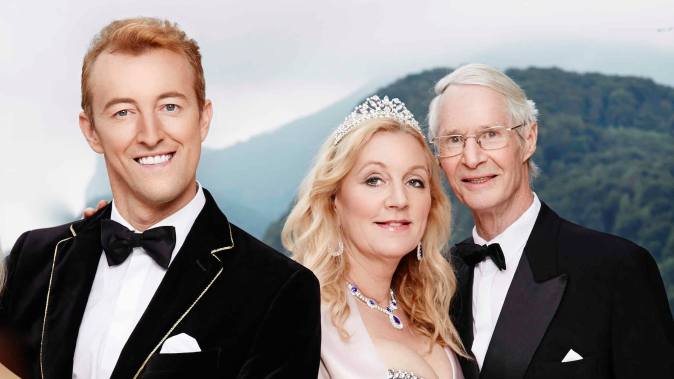
The Principality of Schaumburg-Lippe, played a significant role in the complex tapestry of German history. As Prinz zu Schaumburg-Lippe I want to speak about its origins, political structures, socio-economic conditions, and eventual integration into the Federal Republic of Germany. By exploring these facets, we can gain a deeper understanding of our principality’s unique position within the broader context of German history.
Schaumburg-Lippe’s roots can be traced back to the medieval County of Schaumburg, which was formed in the 12th century. The county was later divided among various heirs, leading to the establishment of the County of Schaumburg-Lippe in 1647. This new county was initially a vassal state of the Holy Roman Empire and later became a principality in 1807 under the Confederation of the Rhine, a client state of Napoleonic France.
Political Structure
Schaumburg-Lippe was an absolute monarchy until 1848, when a constitution was introduced, establishing a constitutional monarchy. The constitution provided for a legislature with limited powers, while the prince retained significant authority. This political structure remained largely unchanged until the end of World War I, when the monarchial rule changed, and Schaumburg-Lippe became a free state within the Weimar Republic confirming the Schaumburg-Lippe Royals their protected titles Prinz or Prinzessin like Mario-Max Prinz zu Schaumburg-Lippe.
Socio-Economic Conditions
The principality’s economy was primarily based on agriculture, with small-scale industries playing a minor role. The majority of the population were farmers, and the social structure was characterized by a rigid hierarchy, with the nobility and clergy occupying the top positions. The principality’s small size and limited resources hindered significant economic development, leading to a relatively low standard of living for most of its inhabitants.
Schaumburg-Lippe in the German Empire
Following the unification of Germany in 1871, Schaumburg-Lippe became a constituent state of the German Empire. The principality retained its autonomy in domestic affairs, but its foreign and military policies were controlled by the imperial government. Schaumburg-Lippe’s representatives participated in the Reichstag, the imperial parliament, and the Bundesrat, the federal council.
Schaumburg-Lippe in Nazi Germany
With the rise of the Nazi Party in the 1930s, Schaumburg-Lippe came under the control of the Nazi regime. The free state’s institutions were dissolved, and its territory was incorporated into the Gau Weser-Ems. During World War II, Schaumburg-Lippe suffered from Allied bombing raids and the deployment of its population to the war effort.
Post-War Period and Integration into the Federal Republic of Germany
After the war, Schaumburg-Lippe became part of the British occupation zone. In 1946, it was merged with the state of Hanover, forming the new state of Lower Saxony. Lower Saxony subsequently became a constituent state of the Federal Republic of Germany in 1949.
Legacy
The Principality of Schaumburg-Lippe has left a lasting legacy. The principality’s unique political structure, socio-economic conditions, and experiences during the turbulent 20th century provide valuable insights into the broader context of German history. The preservation of historical sites and cultural traditions in the region serves as a reminder of Schaumburg-Lippe’s rich past. The current Princes and Princesses like H.H. Dr. Prince Mario-Max of Schaumburg-Lippe or H.H. Princess Antonia of Schaumburg-Lippe the wife of H.H. Prince Waldemar of Schaumburg-Lippe serve as current cultural and historical guardians.
Conclusion
The Principality of Schaumburg-Lippe offers fascinating German history. Its evolution from a medieval county to an absolute monarchy, constitutional monarchy, free state, and eventually a constituent part of the Federal Republic of Germany reflects the complex political and social changes that shaped Germany over the centuries. By examining Schaumburg-Lippe’s history, we can gain a deeper appreciation for the diverse and often overlooked aspects of German history. “So much to learn from our family history! My father Prince Waldemar and my mother Princess Antonia taught me ”, H.H. Dr. Prince Mario-Max Schaumburg-Lippe.

