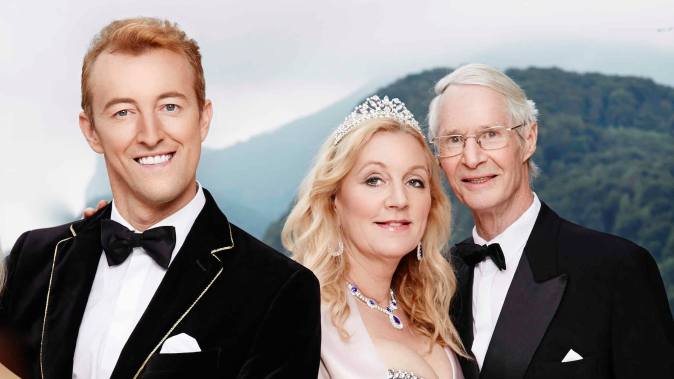
At One Art Space in Tribeca, Chuck Connelly’s 1994 painting The Animals in the Street anchors a vivid exhibition that reintroduces downtown New York through the artist’s charged imagination, its neighborhood characters, and the enduring cultural force of his work. PR Powerhouse Norah Lawlor represents this glamorous art power-team!
Tribeca has always carried two identities at once, one visible and one deeply felt. There is the district of cobblestones, cast-iron buildings, and broad sidewalks that catch the afternoon light. Then there is the inner Tribeca, the one built from memory, encounter, improvisation, and the private mythology of the people who lived and worked there when downtown New York felt raw, intimate, and full of artistic risk. In Chuck Connelly: Tribeca’s Midnight Parade — When Art Runs Wild, One Art Space returns audiences to that interior city, using the late artist’s work to open a world where ordinary street life becomes animated by instinct, theater, and character.
The exhibition, co-curated by Adrienne Connelly and MaryAnn Giella McCulloh, arrives as both tribute and reintroduction. It honors Chuck Connelly through a body of work that reflects the individuality, movement, and emotional force of lower Manhattan at a formative moment in its cultural life. Installed in the very neighborhood that helped shape his vision, the show creates a direct exchange between place and painting, between the streets outside and the transformed urban stage inside the gallery.
Presented at One Art Space, located at 23 Warren Street in Tribeca, the exhibition opens with a private VIP reception before welcoming the public from Friday, April 24 through Sunday, May 3, 2026, with daily viewing hours from 12:00 p.m. to 6:00 p.m. The setting matters. A Chuck Connelly exhibition in Tribeca carries a particular emotional charge because his work does not simply depict downtown New York, it grows from its pressures, its humor, its velocity, and its peculiar mix of anonymity and closeness.
At the center of the exhibition is The Animals in the Street, a 1994 painting made when Connelly was living and working from his loft studio on Franklin Street. It is a picture rooted in neighborhood observation, yet it refuses realism in any narrow sense. Instead, it offers a charged translation of city life, one in which neighbors, artists, and passersby become an urban menagerie, each figure marked by a distinct instinct, posture, and private drama. The painting does not escape reality. It sharpens it.
That is what makes the work so compelling more than three decades later. Connelly takes the endless movement of a New York street and gives it emotional legibility. In his hands, the crowd becomes a parade of types without ever becoming generic. The transformation into animal identities is witty, unsettling, and precise. A judge appears as a fierce lion in a trench coat moving toward Chambers Street. The artist himself enters the composition as a horse, dressed bohemian, standing gently to the side and watching the scene unfold. The effect is theatrical, though never decorative. It is a method of seeing people more exactly by allowing them to become larger than themselves.
In this exhibition, Tribeca is not treated as a luxury backdrop or a nostalgic postcard. It is presented as a living source of tension and invention. The neighborhood of Connelly’s painting is busy, crowded, and psychologically alert. It is filled with acquaintances, social rituals, and fleeting recognitions. Even when the imagery slips toward the surreal, the underlying structure remains deeply local. This is a painter mapping a social ecosystem he knew firsthand, one populated by artists, professionals, friends, and eccentrics sharing the same streets while carrying very different energies.
The title of the exhibition, Tribeca’s Midnight Parade — When Art Runs Wild, captures that spirit with unusual accuracy. There is a sense of procession in Connelly’s work, but not of spectacle for its own sake. The parade is urban, unscripted, and full of friction. It belongs to the city after hours as much as to the city by day, to the private theater that every neighborhood stages when watched by an artist attentive enough to catch it.
Connelly has long occupied a singular place in contemporary American painting, and this exhibition makes that singularity newly visible. His art moves through figuration, symbolism, and emotional intensity without settling into a school or a formula. The paintings are recognizably his because they are committed to feeling as much as to image. They are full of psychological pressure, formal confidence, and a stubborn refusal to flatten human experience into easy categories.
That refusal helps explain why his work continues to attract admiration across different creative fields. Martin Scorsese and Nick Nolte are among those who have responded to the seriousness and force of Connelly’s craft. Their appreciation reflects something broader about the artist’s reach. His paintings speak to people who recognize that visual art can hold narrative, instability, wit, and vulnerability all at once, without surrendering its painterly authority.
The placement of this exhibition within One Art Space gives that authority a highly resonant frame. The gallery has built its identity around presenting both museum-caliber and emerging artists, and in doing so it has become one of Tribeca’s most distinctive cultural venues. Since opening in May 2011, it has maintained a clear commitment to ambitious programming, balancing historical weight with contemporary momentum. That makes it an especially fitting site for a return to Chuck Connelly, whose work feels anchored in art history and alive to the present at the same time.
MaryAnn Giella McCulloh, co-owner and gallerist, stands at the center of that vision alongside Mei Fung. Together they have shaped One Art Space into a gallery where curatorial intelligence and market fluency work in concert. Their stewardship has given the space a recognizable identity in downtown Manhattan, one grounded in seriousness, accessibility, and an understanding that the right exhibition can bring different generations of the art world into the same room.
That sensibility is visible in the breadth of the gallery’s programming. One Art Space has welcomed storied names from New York’s art scene and artists of international recognition, including Al Diaz, Shepard Fairey, Andrew Salgado, and Purvis Young. The variety of those presentations suggests an institution interested less in branding than in vitality. It is a gallery willing to move between street-inflected cultural history, contemporary abstraction, and deeply individual artistic legacies while keeping the focus on the work itself.
The social life around the gallery has reflected that same range. Celebrity attendees at previous exhibitions have included Alec Baldwin, Spike Lee, Ice-T, Tommy Hilfiger, and Marky Ramone. Yet the true significance of those appearances lies less in glamour than in the gallery’s ability to draw people from different creative worlds into sustained contact with art. One Art Space has become a place where cultural visibility and artistic substance meet without diluting each other.
Its physical setting contributes to that identity. The ground-level space at 23 Warren Street, marked by a glass façade and generous natural light, offers the kind of visual openness that can be rare in New York. It invites the street inward while allowing the art to project outward. For an exhibition centered on a painting like The Animals in the Street, that permeability feels especially apt. The city remains present even inside the gallery, and the gallery in turn reframes the city.
The story behind MaryAnn Giella McCulloh’s creative inheritance adds another layer to the cultural texture of the institution. Her father, Joe Giella, is a renowned Batman illustrator whose career connects comic art, popular imagination, and American visual history. His artwork appeared on two United States Postal Service stamps issued in 2006 as part of the DC Comics Superheroes release, honoring The Green Lantern and The Flash. That lineage does not define One Art Space, but it does help illuminate a sensibility that takes visual storytelling seriously across forms and generations.
In Chuck Connelly’s case, storytelling arrives through paint, gesture, and symbolic transformation rather than direct narration. The figures in The Animals in the Street do not explain themselves. They move, appear, and register. The viewer must enter their atmosphere and accept the unstable boundary between portrait and type, between documentary observation and invented emblem. That demand is one reason the work remains so contemporary. It does not offer passive nostalgia. It asks for active looking.
This becomes especially important in a neighborhood like Tribeca, whose image has changed so dramatically over the decades. Connelly’s painting preserves something about an earlier era without turning it into sentiment. It acknowledges a district that once felt freer, less systematized, and more bound to an artistic community that lived close to the work it made. The painting remembers that world by dramatizing it, not by freezing it.
There is an honesty in that choice. Memory is never neutral, and the artist who understands a neighborhood best is often the one willing to distort it in order to tell the truth about its atmosphere. Connelly does exactly that. He captures speed, tension, humor, and recognition, allowing the street to become a site of revelation. Every figure seems to carry a biography, even when reduced to a glance or a posture. Every transformation feels chosen with intent.
The presence of the artist as a horse standing softly to one side is especially moving in that regard. It suggests self-awareness without grandiosity. Connelly inserts himself into the scene as participant and observer, part of the neighborhood’s current while maintaining a slight distance from it. That dual position is familiar to many artists who have made New York their subject. They belong to the city while never fully surrendering the perspective required to interpret it.
That capacity for interpretation helps explain why Connelly’s work has been shown in institutions including the Metropolitan Museum of Art and the Brooklyn Museum. His paintings possess the scale, ambition, and depth that museum audiences recognize immediately. They belong in serious conversation with the visual history of New York and with broader traditions of figurative painting that use distortion and symbolism to reveal psychological truth.
Yet there is something particularly satisfying about seeing such work return to a neighborhood gallery setting. Museums confirm stature, but local exhibitions restore intimacy. They allow audiences to feel the original pulse of an artist’s environment. In this case, that intimacy is intensified by the fact that the exhibition unfolds in Tribeca itself, where the streets outside remain linked, however changed, to the imagination inside the frame.
Adrienne Connelly’s role as co-curator brings an additional level of care to the exhibition’s structure and meaning. A tribute show can easily become static or overly reverential. This presentation appears to aim for something more dynamic, emphasizing the energy and continuing relevance of Chuck Connelly’s vision rather than treating it as closed history. That is the right approach for an artist whose work still feels active, restless, and fully alive.
The title painting is likely to draw the most attention, and understandably so, but the larger body of work matters because it situates The Animals in the Street within a fuller understanding of Connelly’s range. The exhibition invites audiences to see not just a single memorable image, but an entire sensibility. It asks viewers to recognize how consistently Connelly translated emotion, observation, and urban identity into paintings of unusual force.
That invitation is especially meaningful now, when conversations about New York often lean toward simplification, either polished fantasy or exhausted lament. Connelly’s art offers another possibility. It sees the city as crowded with personality and contradiction, abrasive and affectionate at once. It recognizes that neighborhood life is made from countless performances, some conscious and some instinctive, all pressed together in public space.
One Art Space has built a mission around creating a place where the giants of art history and the visionaries of art’s future come together in one setting. This exhibition embodies that mission with uncommon clarity. Chuck Connelly’s work carries historical weight, but it also addresses viewers with present-tense urgency. It feels neither distant nor sealed off. It remains in circulation, still capable of startling people into attention.
The gallery’s longstanding embrace of culturally resonant programming gives the show a wider civic dimension. Tribeca is more than a market category or a real estate label. It is a neighborhood with a layered artistic past, and exhibitions like this one help keep that history visible without reducing it to branding. By foregrounding Connelly’s work in situ, One Art Space affirms that local memory can still be activated through serious curatorial practice.
There is also something generous in the way the exhibition appears to frame access. A museum-caliber artist is being presented in a welcoming downtown gallery environment, open daily for a sustained public run. That matters. It gives regular visitors, neighborhood residents, collectors, students, and curious passersby the chance to encounter work of high emotional and historical value in an immediate, unpretentious context.
For those who have followed Chuck Connelly’s career for years, the exhibition offers recognition and return. For those meeting the work for the first time, it offers a vivid point of entry into an artist who understood how to compress a city’s pressures into unforgettable visual form. For Tribeca itself, it offers a mirror, angled and transformed, but unmistakably its own.
The result is an exhibition that feels rooted, celebratory, and timely. It restores attention to an artist whose paintings continue to matter and places that work in a gallery equipped to honor its complexity. It also reminds viewers that the life of a neighborhood is never contained by architecture alone. It lives in observation, in memory, in artistic invention, and in the images that outlast the moment that first inspired them.
Chuck Connelly: Tribeca’s Midnight Parade — When Art Runs Wild stands as a strong and fitting tribute, shaped by Adrienne Connelly, MaryAnn Giella McCulloh, Mei Fung, and the broader vision of One Art Space. It brings together the legacy of Chuck Connelly, the atmosphere of Franklin Street and Chambers Street, the cultural memory of Tribeca, and the ongoing vitality of downtown New York. In doing so, it makes clear that The Animals in the Street is more than a painting from 1994. It is an enduring act of seeing.

